
Understanding volume measurements is essential for landscaping, construction, gardening, and home improvement projects. One of the most common questions people ask is, how many cubic feet is in 1 yard?
The answer is straightforward:
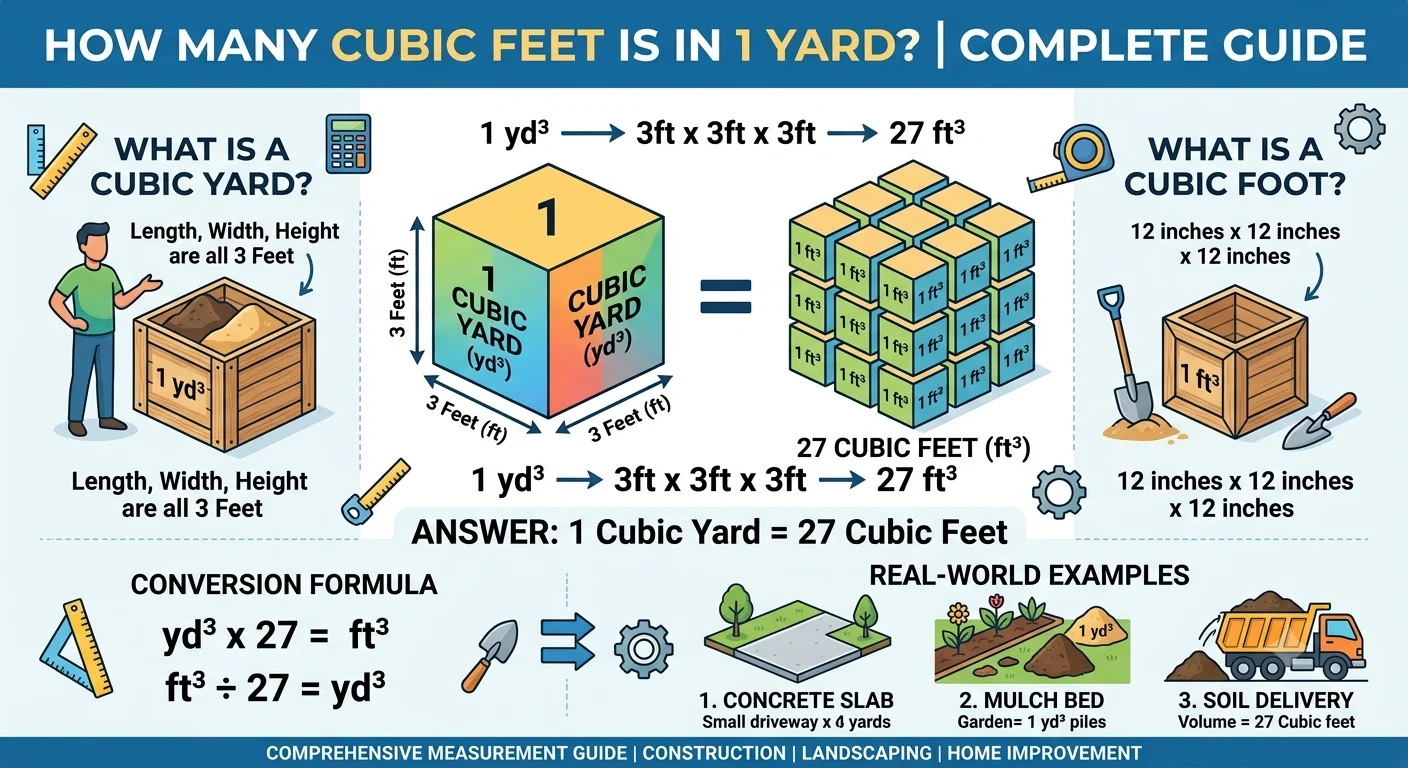
1 cubic yard = 27 cubic feet.
While the conversion itself is simple, knowing how to apply it can help you accurately estimate materials such as soil, mulch, gravel, sand, and concrete. Whether you’re planning a backyard landscaping project or ordering construction materials, understanding the relationship between cubic yards and cubic feet can save time, money, and unnecessary waste.
Understanding Cubic Feet and Cubic Yards
Before learning how the conversion works, it’s important to understand what these units measure.
What Is a Cubic Foot?
A cubic foot is a unit of volume that measures the amount of space inside a cube that is 1 foot long, 1 foot wide, and 1 foot high.
The formula is:
Length × Width × Height
For a cube measuring 1 foot on each side:
1 × 1 × 1 = 1 cubic foot
Cubic feet are commonly used for:
- Soil calculations
- Storage spaces
- Appliance capacities
- Mulch estimates
- Shipping dimensions
What Is a Cubic Yard?
A cubic yard is a larger unit of volume often used in construction and landscaping.
One cubic yard is the volume of a cube that measures:
- 3 feet long
- 3 feet wide
- 3 feet high
Since each side is 3 feet, the volume is:
3 × 3 × 3 = 27 cubic feet
This calculation explains why one cubic yard equals 27 cubic feet.
How Many Cubic Feet Is in 1 Yard?
The exact conversion is:
1 cubic yard = 27 cubic feet
This is the standard conversion used across the construction, landscaping, and gardening industries.
Here are some common conversions:
| Cubic Yards | Cubic Feet |
|---|---|
| 1 | 27 |
| 2 | 54 |
| 3 | 81 |
| 4 | 108 |
| 5 | 135 |
| 10 | 270 |
Whenever you need to convert cubic yards to cubic feet, simply multiply by 27.
Formula for Converting Cubic Yards to Cubic Feet
The conversion formula is:
Cubic Feet = Cubic Yards × 27
Examples:
Example 1
2 cubic yards:
2 × 27 = 54 cubic feet
Example 2
4 cubic yards:
4 × 27 = 108 cubic feet
Example 3
10 cubic yards:
10 × 27 = 270 cubic feet
This formula works for any cubic yard measurement.
Formula for Converting Cubic Feet to Cubic Yards
Sometimes you’ll need to convert in the opposite direction.
Use this formula:
Cubic Yards = Cubic Feet ÷ 27
Example:
81 cubic feet:
81 ÷ 27 = 3 cubic yards
This calculation is especially useful when measuring a project area and determining how much material to order.
Why This Conversion Matters
Knowing how many cubic feet are in a cubic yard helps you estimate materials more accurately.
Common materials sold by the cubic yard include:
- Topsoil
- Mulch
- Compost
- Gravel
- Sand
- Concrete
- Decorative stone
Many project dimensions are measured in feet, but suppliers sell materials by the cubic yard. Understanding the conversion allows you to order the correct quantity.
Benefits include:
- Avoiding over-ordering
- Preventing shortages
- Reducing waste
- Saving money
- Improving project planning
Cubic Yard to Cubic Feet Conversion Chart
Use this quick-reference chart when estimating material quantities.
| Cubic Yards | Cubic Feet |
|---|---|
| 1 | 27 |
| 2 | 54 |
| 3 | 81 |
| 4 | 108 |
| 5 | 135 |
| 6 | 162 |
| 7 | 189 |
| 8 | 216 |
| 9 | 243 |
| 10 | 270 |
| 15 | 405 |
| 20 | 540 |
Keeping this chart handy can make project planning much easier.
Real-World Examples
Soil for Garden Beds
Suppose you are building a raised garden bed measuring:
- Length: 9 feet
- Width: 3 feet
- Depth: 1 foot
The volume is:
9 × 3 × 1 = 27 cubic feet
Since 27 cubic feet equals 1 cubic yard, you would need exactly 1 cubic yard of soil.
Mulch for Landscaping
A landscaping project requires 54 cubic feet of mulch.
Calculation:
54 ÷ 27 = 2 cubic yards
You would order 2 cubic yards of mulch.
Gravel for a Driveway
A driveway project requires 135 cubic feet of gravel.
Calculation:
135 ÷ 27 = 5 cubic yards
You would need 5 cubic yards of gravel.
Concrete for a Slab
If a concrete slab requires 81 cubic feet of concrete:
81 ÷ 27 = 3 cubic yards
You should order approximately 3 cubic yards of concrete.
How to Calculate Cubic Feet
If you know the dimensions of an area, calculating cubic feet is simple.
Step 1: Measure Length
Measure the length in feet.
Step 2: Measure Width
Measure the width in feet.
Step 3: Measure Depth
Measure the depth or height in feet.
Step 4: Multiply the Measurements
Formula:
Length × Width × Height = Cubic Feet
Example:
- Length: 12 feet
- Width: 6 feet
- Depth: 2 feet
Calculation:
12 × 6 × 2 = 144 cubic feet
Step 5: Convert to Cubic Yards
144 ÷ 27 = 5.33 cubic yards
Most contractors would round up slightly to ensure enough material is available.
Common Mistakes to Avoid
Confusing Linear Yards and Cubic Yards
A yard is a measurement of length.
A cubic yard measures volume.
These units are not interchangeable.
Mixing Feet and Inches
Always convert inches into feet before calculating volume.
Examples:
- 6 inches = 0.5 feet
- 12 inches = 1 foot
Using mixed units often leads to incorrect estimates.
Confusing Square Feet and Cubic Feet
Square feet measure area.
Cubic feet measure volume.
For example:
- A lawn may be measured in square feet.
- The soil needed for the lawn is measured in cubic feet or cubic yards.
Ordering Exact Quantities
Materials often settle or compact during transport and installation.
Adding 5% to 10% extra material can help prevent shortages.
Practical Uses for Cubic Yard Conversions
Landscaping Projects
Landscapers use cubic yard calculations for:
- Mulch
- Soil
- Compost
- Decorative rock
Construction Projects
Contractors use cubic yard measurements for:
- Concrete
- Gravel
- Sand
- Backfill materials
Home Improvement Projects
Homeowners often calculate cubic yards when:
- Building raised beds
- Installing retaining walls
- Leveling lawns
- Creating drainage systems
Agricultural Applications
Farmers and gardeners use cubic yard conversions to estimate:
- Soil amendments
- Compost quantities
- Growing medium requirements
Expert Tips for Accurate Estimates
Measure Carefully
Even small measuring errors can significantly affect volume calculations.
Use Consistent Units
Convert all dimensions into feet before performing calculations.
Round Up When Necessary
It’s usually better to have slightly too much material than not enough.
Account for Material Settling
Materials such as mulch and soil can compress after installation.
Adding extra material helps compensate for settling.
Verify Supplier Measurements
Some suppliers round material quantities differently. Confirm measurements before placing an order.
Frequently Asked Questions
How many cubic feet are in one cubic yard?
There are exactly 27 cubic feet in one cubic yard.
Why does one cubic yard equal 27 cubic feet?
Because one yard equals 3 feet, and volume is measured in three dimensions:
3 × 3 × 3 = 27 cubic feet.
How do I convert cubic feet into cubic yards?
Divide the number of cubic feet by 27.
For example:
54 ÷ 27 = 2 cubic yards.
Is a cubic yard larger than a cubic foot?
Yes. One cubic yard contains 27 cubic feet, making it much larger.
What materials are commonly sold by the cubic yard?
Common materials include soil, mulch, gravel, sand, compost, and concrete.
Conclusion
If you’re wondering how many cubic feet is in 1 yard, the answer is simple: 1 cubic yard equals 27 cubic feet. This conversion is widely used in landscaping, construction, gardening, and home improvement projects. Understanding how to convert between cubic yards and cubic feet allows you to estimate material quantities accurately, avoid costly mistakes, and complete projects more efficiently. Whether you’re ordering soil for a garden bed, mulch for landscaping, gravel for a driveway, or concrete for a slab, remembering the conversion factor of 27 will make planning much easier.