

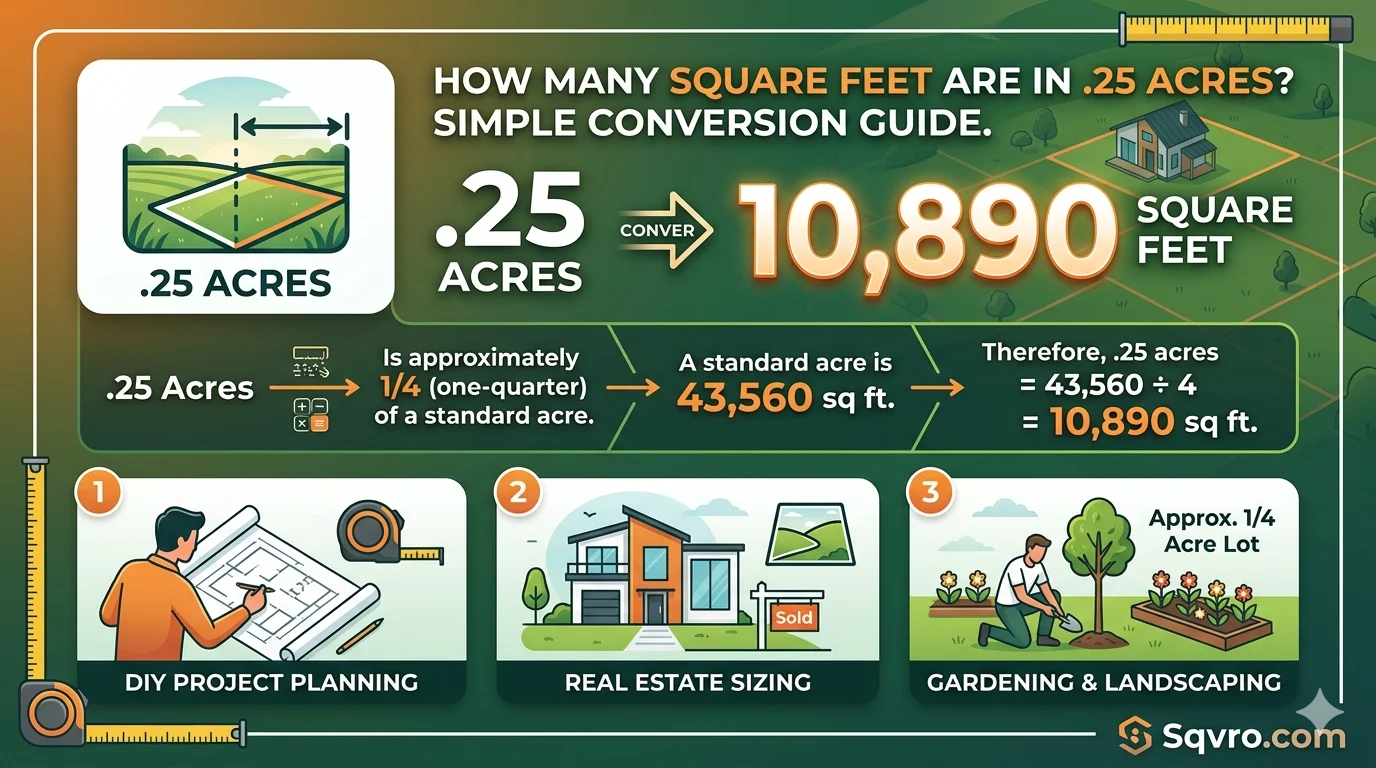
If you are asking how many feet is .25 acres, you are probably trying to understand the actual size of a quarter-acre lot for buying land, building a home, building a house, farming, or investment.
The short answer is:
.25 acres = 10,890 square feet
That means a quarter acre gives you 10,890 square feet of land area.
However, many people want to know more than just the number—they want to understand what that space actually looks like in real life.
Is it enough for a house?
Can you build a garden?
How wide and long is it?
In this guide, we’ll break everything down in simple terms so you can clearly understand how big 0.25 acres really is.
Understanding What .25 Acres Means
An acre is a standard unit used to measure land, especially in real estate and construction.
1 acre = 43,560 square feet
So when we say .25 acres, we mean:
One-fourth of a full acre
This is also called:
- Quarter acre
- 1/4 acre
- 0.25 acre lot
It is one of the most common residential lot sizes in many areas.
How Many Square Feet Is .25 Acres?
To calculate how many square feet is .25 acres, we use a simple formula:
Final Answer:
.25 acres = 10,890 square feet
This is the exact size.
That means if you own a quarter-acre lot, your total usable land area is 10,890 sq ft.
Exact Formula for Acre to Square Feet Conversion
The general conversion formula is:
Examples:
- 0.10 acres = 4,356 sq ft
- 0.25 acres = 10,890 sq ft
- 0.50 acres = 21,780 sq ft
- 1 acre = 43,560 sq ft
This formula helps for all acreage calculations.
Common Dimensions of a .25 Acre Lot
Many people think land must be square—but it can be rectangular, narrow, wide, or irregular.
The total area stays the same.
Here are common examples of quarter acre lot dimensions in feet.
Square-Shaped Quarter Acre Lot
If the land is perfectly square:
That means the dimensions are approximately:
104 ft × 104 ft
This is a common visual example.
Rectangular Quarter Acre Lot
A lot can also be rectangular, such as:
- 80 ft × 136 ft
- 70 ft × 155 ft
- 60 ft × 181.5 ft
- 90 ft × 121 ft
All of these are close to 10,890 square feet.
This is why property dimensions vary depending on location and design.
Real-Life Examples of .25 Acres
Numbers are helpful, but real-life comparisons make it easier to visualize.
Let’s look at what how big is 0.25 acres means practically.
Residential Home Lots
A quarter acre is often enough for:
- A medium to large home
- Front yard
- Backyard
- Driveway
- Garage
- Small garden
- Patio or outdoor seating area
Many suburban homes sit on lots close to this size.
It offers a good balance between living space and outdoor area.
Garden and Backyard Space
If used only for gardening, .25 acres can support:
- Vegetable garden
- Fruit trees
- Greenhouse
- Small poultry area
- Lawn space
- Kids’ play area
This makes it ideal for families wanting outdoor living space.
Parking and Small Commercial Use
A quarter acre may also be used for:
- Small office building
- Parking lot
- Small retail shop
- Storage area
- Workshop
Depending on zoning laws, this size can be very practical.
.25 Acres Compared to Other Land Sizes
Comparison helps you understand land value better.
Land Size Comparison Table
| Land Size | Square Feet |
| 0.10 acres | 4,356 sq ft |
| 0.25 acres | 10,890 sq ft |
| 0.50 acres | 21,780 sq ft |
| 0.75 acres | 32,670 sq ft |
| 1 acre | 43,560 sq ft |
You can see that .25 acres in square feet is a solid amount of usable land for residential purposes.
How to Measure .25 Acres Yourself
If you want to check land size manually, follow these steps.
Step-by-Step Method
Step 1: Measure Length
Use a tape measure or land survey tool.
Example:
Length = 120 feet
Step 2: Measure Width
Example:
Width = 90 feet
Step 3: Multiply Both Numbers
This gives total square feet.
Step 4: Compare with 10,890 sq ft
If your result is close, your land is about .25 acres.
For exact legal boundaries, always use a professional land survey.
Common Mistakes People Make
Many buyers misunderstand acreage.
Here are common mistakes to avoid.
Mistake 1: Thinking “Feet” Means One Straight Line
People ask:
“How many feet is .25 acres?”
But acres measure area, not length.
So the correct answer is square feet, not just feet.
Mistake 2: Assuming All Quarter Acre Lots Are Square
Land shape changes everything.
Two lots can both be .25 acres but look very different.
Mistake 3: Ignoring Buildable Space
Not all land is usable.
Some space may be affected by:
- setbacks
- drainage
- easements
- local building codes
Always check usable land area.
Expert Tips Before Buying a Quarter Acre Lot
Before purchasing, keep these expert tips in mind.
Check Local Zoning Laws
Some areas limit:
- building size
- number of floors
- business use
- farming use
Always verify regulations first.
Think About Future Expansion
Ask yourself:
Will you need:
- a second structure?
- pool?
- garage?
- rental unit?
- garden expansion?
Planning ahead saves money later.
Review Access and Utilities
Check if the land has:
- road access
- electricity
- water supply
- sewer connection
- internet access
A cheap lot without utilities may become expensive.
FAQs
1. How many square feet is .25 acres exactly?
Exactly 10,890 square feet.
That is the official conversion for a quarter acre.
2. Is .25 acres enough to build a house?
Yes, absolutely.
It is commonly used for residential homes with yard space, parking, and landscaping.
3. What does a quarter-acre lot look like?
It may look like:
- 104 ft × 104 ft (square)
- 80 ft × 136 ft (rectangle)
The shape can vary while keeping the same area.
4. How many homes can fit on .25 acres?
Usually one standard residential home, depending on zoning laws and building regulations.
5. Is .25 acres bigger than a standard city lot?
In many cases, yes.
A quarter-acre lot is often larger than small urban residential lots.
Conclusion
So, if you were wondering how many feet is .25 acres, the clear answer is:
.25 acres = 10,890 square feet
This is a common and practical lot size for homes, gardens, and small investments.
Whether you are buying land, planning construction, or comparing properties, understanding how many feet is .25 acres helps you make smarter decisions.
Instead of just seeing numbers, now you can visualize the actual space, compare dimensions, and estimate real-world usage.
A quarter acre may sound small on paper—but in reality, it offers plenty of room for many useful purposes.
Discover More Article
1.5 cubic feet soil covers how many square feet.
how many square feet will one yard of concrete cover
How many square feet is in a acre of land