

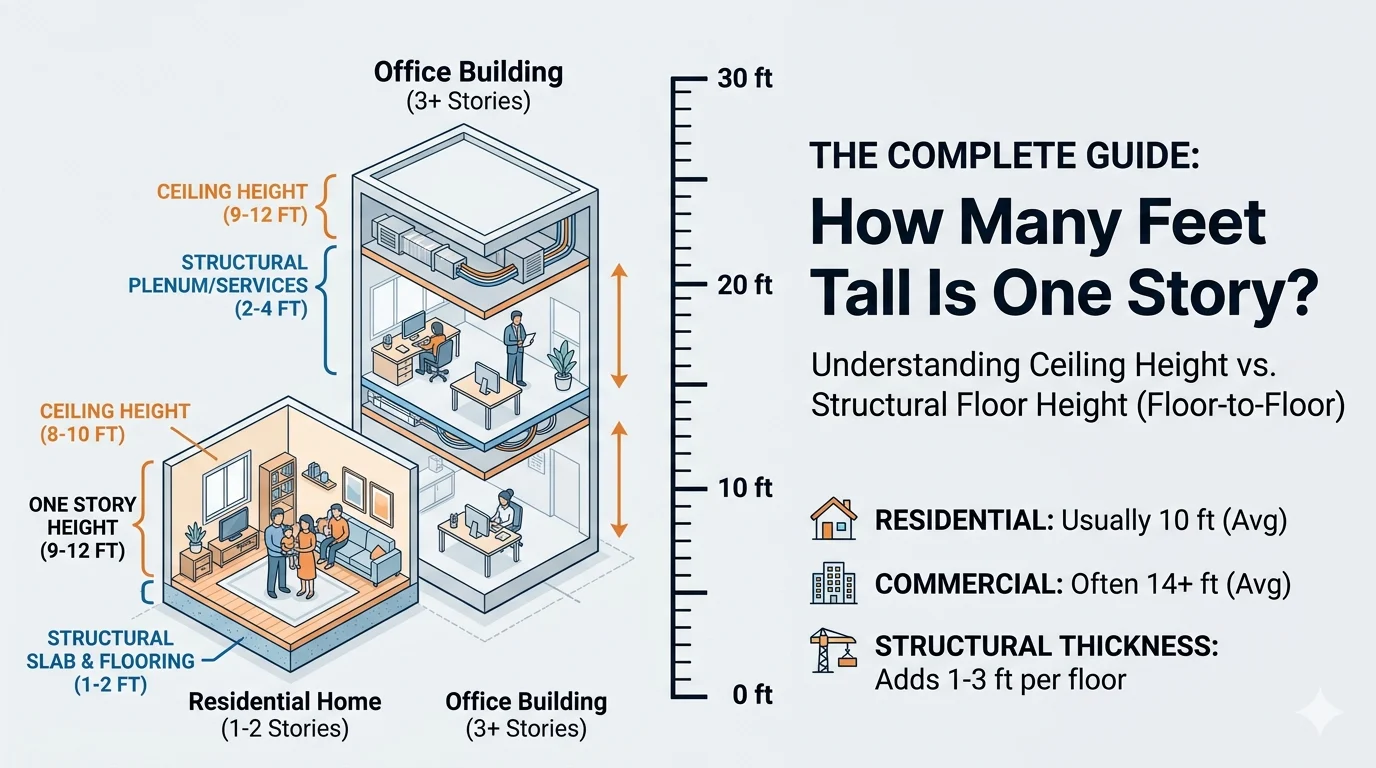
When people ask how many feet tall is one story, they are usually trying to understand the real physical height of a building level. A “story” refers to one complete floor of a building, but the actual height is not fixed. It changes depending on architecture, purpose, and construction standards.
In general, one story is commonly estimated to be around 10 feet tall, but this is only an average. Some buildings are shorter, while others are significantly taller. To truly understand how many feet tall is one story, we need to look at how buildings are designed and what factors influence height.
What Does One Story Mean in a Building?
A “story” is one level or floor in a building. It includes:
- The usable room space
- The ceiling above the room
- The structural flooring between levels
So when you hear “one-story house,” it means a building with only one level above the ground.
However, many people confuse story height with ceiling height. Ceiling height is only part of the measurement, while story height includes structural components as well.
How Many Feet Tall Is One Story on Average?
On average, how many feet tall is one story depends on the building type, but the general range is:
- Residential buildings: 8 to 10 feet per story
- Modern homes: 9 to 12 feet per story
- Commercial buildings: 10 to 14+ feet per story
Simple Answer:
👉 One story is typically around 10 feet tall
But this is not a strict rule. It is an engineering average used for estimation.
Why One Story Height Is Not Always the Same
The height of a story is flexible because buildings are designed for different needs. Let’s explore the main reasons.
1. Ceiling Design Choices
One of the biggest factors is ceiling height. Homes with low ceilings may have 8-foot rooms, while luxury homes may have 12-foot ceilings.
Higher ceilings make spaces feel:
- More open
- Cooler
- More luxurious
2. Structural Floor Thickness
Between each story, there is a thick layer of construction material called a slab.
This includes:
- Concrete
- Steel reinforcement
- Pipes and wiring space
This alone can add 1 to 2 feet per floor.
3. Building Purpose
Different buildings require different heights:
- Homes focus on comfort and energy saving
- Offices need space for lighting and ventilation systems
- Shops and malls require open, tall spaces
4. Local Building Codes
Different countries and cities have rules about minimum ceiling height for safety and comfort. These regulations directly affect how tall a story can be.
Standard Heights in Different Types of Buildings
To better understand how many feet tall is one story, let’s break it down by building type.
Residential Houses
Most common range:
- 8 to 10 feet per story
These are designed for comfort and energy efficiency. Lower ceilings are easier to heat and cool.
Apartments
Average range:
- 9 to 11 feet per story
Apartments often include shared structural systems, slightly increasing total height.
Office Buildings
Average range:
- 10 to 14 feet per story
Offices need space for:
- Air conditioning ducts
- Electrical wiring
- Lighting systems
Commercial Buildings and Shops
Average range:
- 12 to 16 feet per story
These buildings often have high ceilings for:
- Better visibility
- Branding space
- Customer experience
Comparison Table of Story Heights
Here is a simple breakdown:
| Building Type | Low Range | Average Range | High Range |
|---|---|---|---|
| Residential Homes | 8 ft | 9–10 ft | 12 ft |
| Apartments | 9 ft | 10–11 ft | 13 ft |
| Offices | 10 ft | 12–14 ft | 16 ft |
| Commercial Stores | 12 ft | 14–16 ft | 20+ ft |
This table shows clearly that there is no fixed number for how many feet tall is one story. It depends on purpose and design.
Real-Life Examples to Understand Story Height
Let’s look at real-world situations.
Example 1: Small House
- One story ceiling: 9 feet
- Floor structure: 1–2 feet
- Roof space: 2–3 feet
👉 Total height: 12–14 feet
Example 2: Two-Story House
- Each story: ~10 feet
- Roof: ~4–5 feet
👉 Total height: 24–25 feet
Example 3: Office Building
- Each floor: ~12–13 feet
- 5 floors total
👉 Total height: 60–65 feet
These examples help visualize how quickly building height increases.
How Architects Measure One Story
Architects do not simply measure ceiling height when calculating how many feet tall is one story.
They use a method called floor-to-floor height, which includes:
- Ceiling space
- Structural slab
- Flooring and finishing materials
This is the most accurate way to measure a story.
Why Floor-to-Floor Matters
Because it reflects the true construction height, not just the room space.
Common Misconceptions About Story Height
Many people misunderstand this topic. Let’s clear up the confusion.
Myth 1: One story is always 10 feet
This is false. It is just an average, not a rule.
Myth 2: Ceiling height equals story height
Incorrect. Ceiling height is only part of the total measurement.
Myth 3: All buildings follow the same standard
Wrong. Different countries, climates, and designs change the height.
Why Story Height Matters in Real Life
Understanding how many feet tall is one story is useful in many areas.
Real Estate
- Helps estimate building size
- Useful for comparing properties
Construction
- Important for material estimation
- Helps in planning structural design
Renovation
- Needed when adding new floors
- Helps calculate stair and roof design
Even basic knowledge can help you make smarter decisions when dealing with buildings.
Expert Tips for Estimating Building Height
Here are simple ways to estimate height without tools:
Tip 1: Use the 10-Foot Rule
- 1 story ≈ 10 feet
- 2 stories ≈ 20 feet
- 3 stories ≈ 30 feet
This works as a quick mental estimate.
Tip 2: Adjust for Building Type
- Homes: slightly lower
- Offices: slightly higher
- Commercial: much higher
Tip 3: Don’t Forget Roof Height
Roofs can add several extra feet, especially sloped roofs.
Advantages of Higher Story Heights
Higher stories are becoming more popular in modern design.
Benefits:
- Better air circulation
- More natural light
- Luxury appearance
- Less cramped feeling
However, they also increase:
- Construction costs
- Heating and cooling expenses
Disadvantages of Lower Story Heights
Lower ceilings and shorter stories also have trade-offs.
Downsides:
- Less ventilation
- Can feel cramped
- Reduced luxury appeal
But they are:
- More energy efficient
- Cheaper to build
- Easier to maintain
Final Understanding of Story Height
So, how many feet tall is one story in the real world?
The answer is not fixed, but here is the most accurate summary:
- Typical residential story: 8–10 feet
- Average overall estimate: around 10 feet
- Commercial buildings: 12–14+ feet
The key takeaway is that a “story” is not a strict measurement but a flexible building level that changes based on design and function.
Conclusion
Understanding how many feet tall is one story helps you better interpret building sizes in real life. While the average is around 10 feet, the actual height depends on ceiling design, structural thickness, building type, and architectural choices.
Residential buildings tend to have shorter stories for comfort and efficiency, while commercial and office buildings often have taller stories for space and functionality.
In simple terms, a story is not just a number—it is a design choice shaped by purpose, comfort, and engineering needs.