
If you’re working on a woodworking, construction, or DIY project, you may need to know how many board feet are in a 4×8 sheet of plywood. Understanding board footage helps you estimate material costs, compare plywood to dimensional lumber, and calculate how much wood volume you’re purchasing.
Although plywood is typically sold by the sheet, board feet remain one of the most common measurements used throughout the lumber industry. Knowing how to convert a sheet of plywood into board feet can make project planning easier and more accurate.
In this guide, you’ll learn exactly how board feet are calculated, how many board feet are in common plywood thicknesses, and how to use these measurements in real-world projects.
What Is a Board Foot?
A board foot is a unit of volume used to measure lumber.
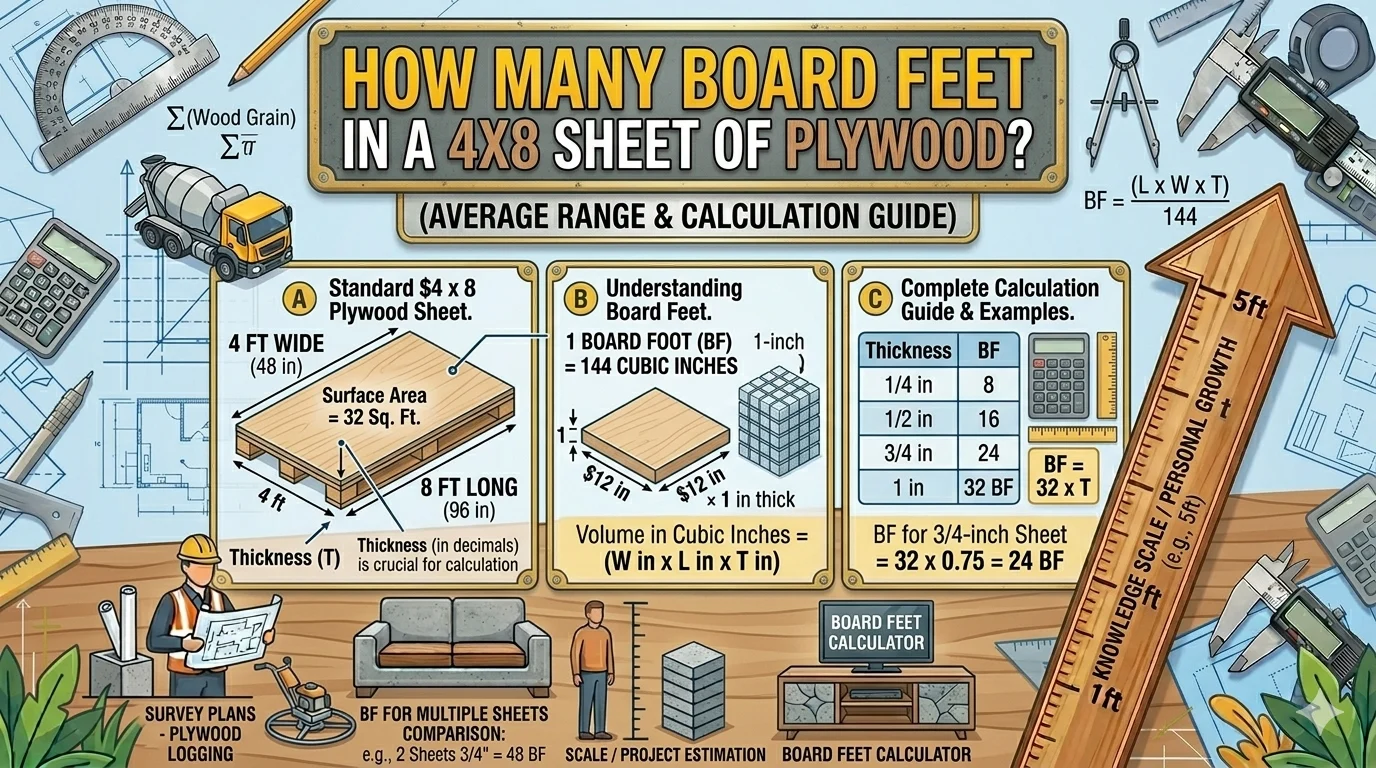
One board foot equals:
- 1 inch thick
- 12 inches wide
- 12 inches long
This equals 144 cubic inches of wood.
Wood suppliers often use board feet to price hardwoods, specialty lumber, and custom wood products. Since plywood is made from layers of wood veneer, its volume can also be expressed in board feet.
Why Board Feet Matter
Understanding board feet offers several benefits:
- Helps estimate project costs
- Makes lumber comparisons easier
- Improves material planning
- Reduces waste
- Simplifies purchasing decisions
Whether you’re building cabinets, furniture, shelving, or home improvements, board footage provides a reliable way to measure wood volume.
How to Calculate Board Feet in a 4×8 Sheet of Plywood
The formula for calculating board feet is simple:
Board Feet = (Thickness × Width × Length) ÷ 144
Where:
- Thickness is measured in inches
- Width is measured in inches
- Length is measured in inches
Since a standard sheet of plywood measures 4 feet by 8 feet, the dimensions become:
- Width = 48 inches
- Length = 96 inches
Example Calculation for 3/4-Inch Plywood
Board Feet = (0.75 × 48 × 96) ÷ 144
Board Feet = 3456 ÷ 144
Board Feet = 24
A standard 3/4-inch 4×8 sheet of plywood contains 24 board feet.
Board Feet Chart for Common 4×8 Plywood Thicknesses
The following chart shows the board footage for standard plywood thicknesses.
| Plywood Thickness | Board Feet |
|---|---|
| 1/8 inch | 4 |
| 1/4 inch | 8 |
| 3/8 inch | 12 |
| 1/2 inch | 16 |
| 5/8 inch | 20 |
| 3/4 inch | 24 |
| 7/8 inch | 28 |
| 1 inch | 32 |
| 1-1/8 inch | 36 |
| 1-1/4 inch | 40 |
| 1-1/2 inch | 48 |
This chart provides a quick reference when estimating plywood quantities for projects.
Board Foot Calculations for Popular Plywood Sizes
1/4-Inch Plywood
Calculation:
(0.25 × 48 × 96) ÷ 144
Result:
8 board feet
Common uses include:
- Drawer bottoms
- Wall paneling
- Cabinet backs
- Decorative projects
1/2-Inch Plywood
Calculation:
(0.50 × 48 × 96) ÷ 144
Result:
16 board feet
Common uses include:
- Furniture
- Shelving
- Wall sheathing
- Interior construction
5/8-Inch Plywood
Calculation:
(0.625 × 48 × 96) ÷ 144
Result:
20 board feet
Common uses include:
- Roof decking
- Flooring underlayment
- Structural applications
3/4-Inch Plywood
Calculation:
(0.75 × 48 × 96) ÷ 144
Result:
24 board feet
Common uses include:
- Cabinet boxes
- Workbenches
- Heavy-duty shelving
- Furniture construction
1-Inch Plywood
Calculation:
(1 × 48 × 96) ÷ 144
Result:
32 board feet
Common uses include:
- Commercial cabinetry
- Industrial projects
- High-strength applications
How Multiple Sheets Affect Board Footage
When purchasing several sheets, simply multiply the board footage of one sheet by the number of sheets.
Example 1
Three sheets of 3/4-inch plywood:
24 × 3 = 72 board feet
Example 2
Five sheets of 1/2-inch plywood:
16 × 5 = 80 board feet
Example 3
Ten sheets of 1/4-inch plywood:
8 × 10 = 80 board feet
This method allows contractors and woodworkers to estimate large projects quickly.
Why Plywood Is Usually Sold by the Sheet
Unlike hardwood lumber, plywood is manufactured in standardized dimensions.
Because of this, suppliers generally sell plywood by:
- Sheet size
- Thickness
- Grade
Examples include:
- 4×8 sheet of 1/2-inch plywood
- 4×8 sheet of 3/4-inch plywood
- 4×10 sheet of cabinet-grade plywood
Board feet are still useful because they provide a universal way to compare wood volume across different products.
Board Feet vs Square Feet
Many people confuse board feet and square feet.
They measure different things.
Square Feet
Measures surface area.
A 4×8 sheet contains:
4 × 8 = 32 square feet
Regardless of thickness, every 4×8 sheet has 32 square feet of surface area.
Board Feet
Measures volume.
The thickness of the plywood changes the board footage.
For example:
| Thickness | Square Feet | Board Feet |
|---|---|---|
| 1/4 inch | 32 | 8 |
| 1/2 inch | 32 | 16 |
| 3/4 inch | 32 | 24 |
The surface area stays the same, but the volume increases as thickness increases.
Board Feet vs Cubic Feet
Another common comparison is board feet versus cubic feet.
Board Feet
Used primarily in woodworking and lumber sales.
1 board foot = 144 cubic inches.
Cubic Feet
Used for shipping, storage, and volume calculations.
1 cubic foot = 1,728 cubic inches.
To convert board feet to cubic feet:
Cubic Feet = Board Feet ÷ 12
For example:
24 board feet ÷ 12 = 2 cubic feet
Therefore, a 3/4-inch 4×8 plywood sheet contains approximately 2 cubic feet of wood.
Real-World Applications of Board Foot Calculations
Estimating Project Costs
Many wood products are priced according to volume.
Knowing the board footage helps compare:
- Hardwood lumber
- Plywood
- MDF
- Veneered panels
This makes budgeting more accurate.
Planning Material Requirements
Board foot calculations help determine:
- How much wood is needed
- How many sheets to purchase
- Expected waste percentages
This reduces project delays.
Comparing Material Options
Contractors often compare plywood and solid lumber using board footage.
This creates a common measurement system that simplifies decision-making.
Common Mistakes When Calculating Board Feet
Using Feet Instead of Inches
The board foot formula requires inches.
Always convert dimensions before calculating.
Incorrect:
4 × 8 × 0.75
Correct:
48 × 96 × 0.75
Forgetting Thickness
Board footage depends on thickness.
Ignoring thickness leads to inaccurate estimates.
Confusing Area With Volume
Square feet measure area.
Board feet measure volume.
They are not interchangeable.
Ignoring Actual Thickness
Some plywood products are slightly thinner than their nominal sizes.
For highly accurate calculations, measure the actual thickness of the sheet.
Expert Tips for Accurate Plywood Estimation
Create a Cut List First
List every component before purchasing materials.
This helps determine the exact number of sheets required.
Account for Waste
Most professionals add:
- 5% extra for simple projects
- 10%–15% extra for complex projects
This accounts for mistakes and unusable offcuts.
Optimize Sheet Layouts
Careful planning reduces waste and maximizes material usage.
Many woodworking programs can help arrange cuts efficiently.
Verify Measurements
Always double-check dimensions before placing an order.
Even a small measurement error can result in purchasing too little material.
Frequently Asked Questions
How many board feet are in a 3/4-inch 4×8 sheet of plywood?
A standard 3/4-inch 4×8 sheet contains 24 board feet.
How many board feet are in a 1/2-inch sheet of plywood?
A standard 1/2-inch 4×8 sheet contains 16 board feet.
Can plywood be priced using board feet?
Yes. Although plywood is commonly sold by the sheet, its volume can be converted into board feet for pricing and comparison purposes.
Does plywood thickness affect board footage?
Yes. Thicker plywood contains more board feet because board feet measure volume rather than surface area.
What is the fastest way to calculate plywood board feet?
Use the formula:
Board Feet = (Thickness × Width × Length) ÷ 144
Or refer to a board foot chart for standard plywood thicknesses.
Conclusion
Knowing how many board feet are in a 4×8 sheet of plywood is essential for accurate project planning, material estimation, and budgeting. The calculation is straightforward: multiply the thickness, width, and length in inches and divide the result by 144.
For the most common plywood sizes, a 4×8 sheet contains anywhere from 4 board feet for 1/8-inch plywood to 48 board feet for 1½-inch plywood. A standard 3/4-inch sheet contains 24 board feet, making it one of the most frequently used references in woodworking and construction.
By understanding board foot calculations and using the chart provided above, you can purchase materials more confidently, reduce waste, and complete projects with greater accuracy.