
If you’re planning a painting project, one of the most important questions to answer before buying supplies is: how many square feet can you paint with 5 gallons of paint? Whether you’re painting a single room, an entire home interior, a garage, or an exterior surface, understanding paint coverage helps you estimate costs, avoid waste, and ensure you purchase the right amount of paint.
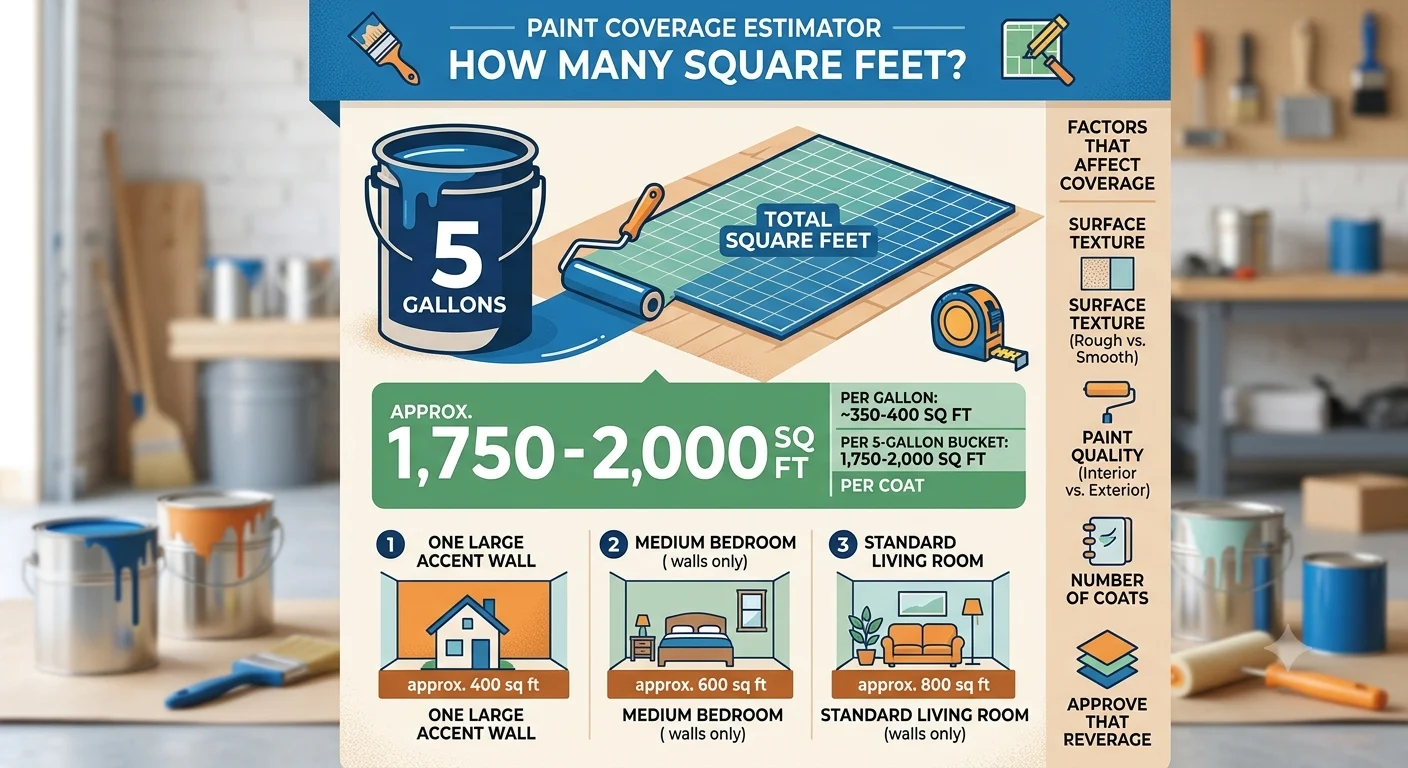
In general, 5 gallons of paint can cover between 1,750 and 2,000 square feet with one coat. However, actual coverage varies depending on factors such as the type of paint, the surface being painted, the application method, and whether one or multiple coats are required.
This guide explains everything you need to know about paint coverage, including formulas, practical examples, coverage charts, and expert tips for accurate estimates.
Quick Answer
A standard gallon of paint typically covers approximately 350 to 400 square feet per coat under normal conditions.
Using this average:
- 1 gallon covers about 350–400 square feet
- 5 gallons cover about 1,750–2,000 square feet
Therefore, if you’re wondering how many square feet can you paint with 5 gallons, the answer is:
Approximately 1,750 to 2,000 square feet with one coat.
If two coats are required, the effective coverage drops to:
875 to 1,000 square feet.
Understanding Paint Coverage
Paint manufacturers usually provide estimated coverage rates on the paint can. These estimates are based on ideal conditions and smooth surfaces.
Most interior and exterior paints are designed to cover:
- 350 square feet per gallon on rough surfaces
- 375 square feet per gallon on average surfaces
- 400 square feet per gallon on smooth surfaces
Coverage estimates assume:
- Proper surface preparation
- Even application
- Standard paint thickness
- Minimal paint waste
Actual results may differ depending on the project.
How Many Square Feet Can You Paint With 5 Gallons?
To determine paint coverage, use this simple formula:
Coverage = Number of Gallons × Coverage Per Gallon
Using the average coverage range:
Low-End Estimate
5 × 350 = 1,750 square feet
High-End Estimate
5 × 400 = 2,000 square feet
This means that 5 gallons of paint generally cover:
| Paint Amount | Coverage |
|---|---|
| 5 Gallons | 1,750–2,000 sq ft |
This estimate applies to one coat.
Coverage for Multiple Coats
Many painting projects require more than one coat for proper color consistency and durability.
| Number of Coats | Coverage With 5 Gallons |
|---|---|
| One Coat | 1,750–2,000 sq ft |
| Two Coats | 875–1,000 sq ft |
| Three Coats | 583–667 sq ft |
When painting over dark colors or unfinished surfaces, additional coats may be necessary.
Paint Coverage Chart
The following chart provides a quick reference for estimating paint coverage.
| Gallons of Paint | Average Coverage |
|---|---|
| 1 Gallon | 350–400 sq ft |
| 2 Gallons | 700–800 sq ft |
| 3 Gallons | 1,050–1,200 sq ft |
| 4 Gallons | 1,400–1,600 sq ft |
| 5 Gallons | 1,750–2,000 sq ft |
| 10 Gallons | 3,500–4,000 sq ft |
This chart assumes smooth surfaces and a single coat of paint.
Factors That Affect Paint Coverage
Although 5 gallons of paint can theoretically cover up to 2,000 square feet, several factors can significantly affect actual coverage.
Surface Texture
The texture of a surface has a major impact on paint consumption.
Smooth surfaces such as:
- Drywall
- Smooth plaster
- Previously painted walls
typically provide the best coverage.
Rough surfaces such as:
- Stucco
- Brick
- Concrete block
- Textured drywall
absorb more paint and reduce coverage.
A rough surface may require 10–30% more paint than a smooth one.
Paint Quality
Higher-quality paints often contain more pigments and better binders.
Benefits include:
- Better hiding power
- Improved durability
- More consistent coverage
- Fewer coats required
While premium paint costs more upfront, it often reduces the total amount needed.
Existing Color
Color changes can affect paint requirements.
Examples:
- White over beige may require one coat.
- White over dark blue may require two or three coats.
- Bright colors often require extra coats for complete coverage.
The more dramatic the color change, the more paint you’ll likely need.
Application Method
Different painting methods produce different coverage rates.
Roller
Rollers provide excellent coverage and are the most common option for walls and ceilings.
Brush
Brushes are useful for trim and detailed work but may use slightly more paint.
Sprayer
Paint sprayers can create a smooth finish but often waste paint through overspray.
As a result, sprayers usually require more paint than rollers.
Surface Preparation
A properly prepared surface improves coverage significantly.
Preparation may include:
- Cleaning dirt and grease
- Repairing holes and cracks
- Sanding rough areas
- Applying primer
Poor preparation often leads to uneven absorption and increased paint usage.
How to Calculate Paint Coverage for Your Project
Estimating paint accurately is easier than many people think.
Step 1: Measure Wall Dimensions
Measure the length and height of each wall.
Formula:
Length × Height = Wall Area
Example:
20 feet × 8 feet = 160 square feet
Repeat for every wall.
Step 2: Add Total Surface Area
Suppose a room has four walls measuring:
- 160 sq ft
- 160 sq ft
- 120 sq ft
- 120 sq ft
Total wall area:
560 square feet
Step 3: Subtract Windows and Doors
Doors and windows do not require paint.
Example:
- Door area: 20 sq ft
- Windows: 40 sq ft
Total deductions:
60 sq ft
Paintable area:
560 − 60 = 500 sq ft
Step 4: Account for Multiple Coats
If two coats are needed:
500 × 2 = 1,000 sq ft
Coverage required:
1,000 square feet
At 400 square feet per gallon:
1,000 ÷ 400 = 2.5 gallons
You would likely purchase 3 gallons.
Real-World Examples
Example 1: Painting a Living Room
A living room has:
- Total wall area: 1,200 sq ft
- Similar paint color
- One coat required
Coverage needed:
1,200 sq ft
Since 5 gallons cover up to 2,000 square feet, 5 gallons are more than sufficient.
Example 2: Painting an Entire Interior
A small home’s interior walls total:
1,800 square feet
One coat coverage:
1,800 sq ft
Five gallons should complete the project under ideal conditions.
Example 3: Exterior House Painting
A home’s exterior siding measures:
2,000 square feet
Because exterior surfaces are often rougher, coverage may be closer to 350 square feet per gallon.
Five gallons:
5 × 350 = 1,750 sq ft
Additional paint may be needed.
Common Mistakes When Estimating Paint Coverage
Many homeowners underestimate paint requirements and end up making extra trips to the store.
Ignoring Surface Texture
Textured walls and rough exterior surfaces absorb more paint than expected.
Forgetting Multiple Coats
Coverage estimates almost always refer to one coat.
If two coats are needed, double the paintable area before calculating.
Not Including Waste
Paint can be lost through:
- Roller absorption
- Paint tray residue
- Spills
- Sprayer overspray
Adding a small safety margin helps avoid shortages.
Skipping Primer
Primer creates a more uniform surface and often reduces the amount of finish paint required.
Tips to Maximize Paint Coverage
If you want to get the most out of your paint purchase, follow these professional tips.
Use High-Quality Paint
Premium paint often covers more area and requires fewer coats.
Prime New Surfaces
Primer reduces paint absorption and improves adhesion.
Use Quality Tools
Good brushes and rollers distribute paint more evenly.
Apply Thin, Even Coats
Applying paint too heavily can create drips and waste material.
Clean Surfaces First
Dust, grease, and debris can interfere with paint adhesion and increase consumption.
Follow Manufacturer Instructions
Always read the coverage recommendations on the paint container.
Coverage by Paint Type
Different paint finishes may provide slightly different coverage rates.
| Paint Type | Average Coverage Per Gallon |
|---|---|
| Flat | 350–400 sq ft |
| Matte | 350–400 sq ft |
| Eggshell | 350–400 sq ft |
| Satin | 350–400 sq ft |
| Semi-Gloss | 300–400 sq ft |
| High-Gloss | 250–350 sq ft |
Actual coverage varies by brand and surface condition.
Is 5 Gallons Enough for Your Project?
Five gallons of paint are often enough for:
- Several average-sized rooms
- A large basement
- A small home’s interior walls
- Some exterior painting projects
However, if your project includes:
- Rough surfaces
- Major color changes
- Multiple coats
- Large exterior areas
you may need additional paint.
Calculating your exact square footage before purchasing paint is always the best approach.
Frequently Asked Questions
How many square feet will 5 gallons of paint cover?
Five gallons of paint typically cover between 1,750 and 2,000 square feet with one coat.
How much area does a 5-gallon bucket of paint cover?
Most 5-gallon buckets cover approximately 1,750–2,000 square feet depending on the paint type and surface condition.
Is 5 gallons enough to paint a house?
For some small houses, yes. Larger homes or projects requiring multiple coats may require additional paint.
Does primer count as a coat?
Primer is separate from paint coverage calculations. If primer is required, you must account for it separately.
What surface uses the most paint?
Rough surfaces such as stucco, brick, concrete block, and textured drywall typically use the most paint because they absorb more material.
Conclusion
When calculating how many square feet can you paint with 5 gallons, the standard estimate is approximately 1,750 to 2,000 square feet with one coat. If your project requires two coats, coverage drops to about 875 to 1,000 square feet. Surface texture, paint quality, application method, and preparation all influence actual results.
By measuring your project carefully and understanding the factors that affect paint coverage, you can purchase the right amount of paint, reduce waste, and complete your project more efficiently. Whether you’re painting a room, an entire house, or an exterior surface, knowing your coverage estimate helps ensure a successful and cost-effective painting job.
Ok