
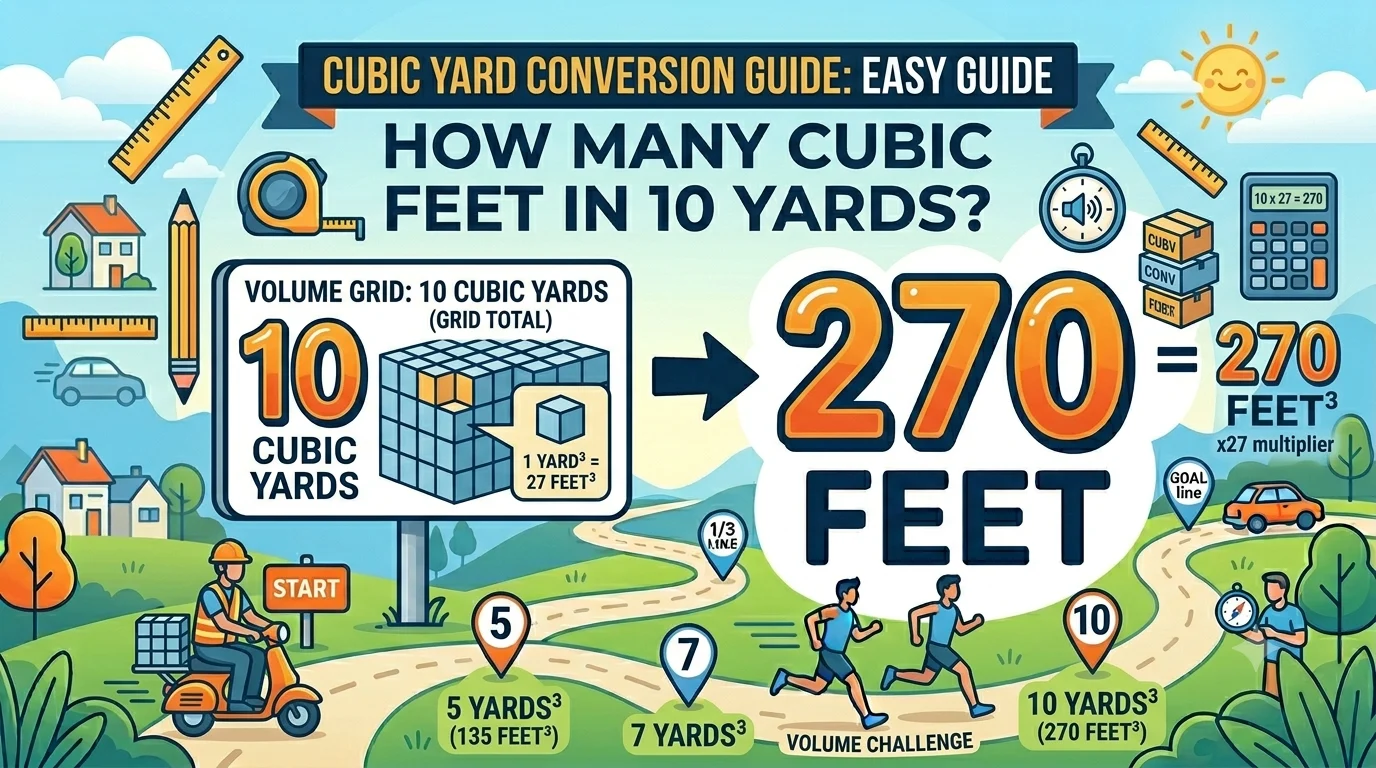
If you are trying to determine how many cubic feet in 10 yards, the answer is simple: 10 cubic yards equals 270 cubic feet. This conversion is commonly used in construction, landscaping, excavation, concrete work, and other projects where materials are measured by volume.
Understanding how to convert cubic yards to cubic feet helps you accurately estimate the amount of soil, gravel, mulch, sand, concrete, or other materials you need. Whether you’re a homeowner planning a landscaping project or a contractor estimating materials for a job site, knowing this conversion can save time, money, and effort.
This guide explains the conversion formula, provides practical examples, includes useful charts, and shows how cubic yards and cubic feet relate to each other.
Understanding Cubic Yards and Cubic Feet
Before converting between units, it’s important to understand what cubic yards and cubic feet actually measure.
Both units are measurements of volume. Volume represents the amount of three-dimensional space an object or material occupies.
What Is a Cubic Yard?
A cubic yard is the volume of a cube that measures:
- 1 yard long
- 1 yard wide
- 1 yard high
Since one yard equals three feet, a cubic yard can also be expressed as:
3 feet × 3 feet × 3 feet
Multiplying these dimensions gives:
3 × 3 × 3 = 27 cubic feet
This means:
1 cubic yard = 27 cubic feet
Cubic yards are commonly used for:
- Topsoil
- Gravel
- Mulch
- Sand
- Concrete
- Compost
- Fill dirt
Because cubic yards represent larger quantities, suppliers often sell bulk materials using this unit.
What Is a Cubic Foot?
A cubic foot is the volume of a cube measuring:
- 1 foot long
- 1 foot wide
- 1 foot high
It is a smaller unit of volume and is often used when more detailed measurements are needed.
Cubic feet are commonly used for:
- Appliance capacity
- Storage space calculations
- Smaller landscaping projects
- Material estimates
- Construction measurements
Understanding the relationship between cubic feet and cubic yards makes volume calculations much easier.
How Many Cubic Feet in 10 Yards?
The direct conversion is:
10 cubic yards = 270 cubic feet
To understand why, let’s look at the formula.
Conversion Formula
The standard formula is:
Cubic Feet = Cubic Yards × 27
Because one cubic yard contains 27 cubic feet, multiplying the number of cubic yards by 27 gives the equivalent volume in cubic feet.
Example Calculation
For 10 cubic yards:
10 × 27 = 270
Therefore:
10 cubic yards = 270 cubic feet
This is the quickest way to calculate the conversion.
Cubic Yards to Cubic Feet Conversion Chart
The following chart shows common conversions.
| Cubic Yards | Cubic Feet |
|---|---|
| 1 | 27 |
| 2 | 54 |
| 3 | 81 |
| 4 | 108 |
| 5 | 135 |
| 6 | 162 |
| 7 | 189 |
| 8 | 216 |
| 9 | 243 |
| 10 | 270 |
| 15 | 405 |
| 20 | 540 |
| 25 | 675 |
| 30 | 810 |
This chart provides a quick reference when estimating materials.
Why Is This Conversion Important?
Knowing how many cubic feet are in 10 yards helps with planning and budgeting.
Accurate Material Orders
Many suppliers sell materials by the cubic yard, but project dimensions are often measured in feet.
Converting between units helps ensure you order the correct amount.
Better Project Planning
Volume calculations are important when working with:
- Concrete
- Gravel
- Mulch
- Sand
- Soil
Converting to cubic feet can make calculations easier when dimensions are measured in feet.
Cost Savings
Ordering too much material increases expenses.
Ordering too little can delay your project.
Accurate conversions help avoid both problems.
Real-World Examples
Let’s see how this conversion works in practical situations.
Landscaping Project
A homeowner plans to spread mulch throughout a garden.
The supplier recommends purchasing 10 cubic yards.
Converting to cubic feet:
10 × 27 = 270 cubic feet
The project requires:
270 cubic feet of mulch
Gravel Driveway
A contractor estimates that a driveway needs 10 cubic yards of gravel.
Using the formula:
10 × 27 = 270 cubic feet
The driveway requires:
270 cubic feet of gravel
Concrete Foundation
A building foundation requires 10 cubic yards of concrete.
Converting gives:
270 cubic feet of concrete
This allows builders to verify material estimates and delivery quantities.
Soil Delivery
A landscaping company orders 10 cubic yards of topsoil.
The volume delivered equals:
270 cubic feet of soil
This information helps determine storage and distribution requirements.
Common Materials Sold by Cubic Yard
Many bulk materials are measured and sold by the cubic yard.
Landscaping Materials
- Mulch
- Compost
- Topsoil
- Decorative rock
- Garden soil
Construction Materials
- Concrete
- Gravel
- Sand
- Crushed stone
Excavation Materials
- Fill dirt
- Backfill
- Excavated soil
- Aggregate
Understanding cubic yard conversions helps estimate these materials accurately.
Cubic Yards vs Cubic Feet
Although both units measure volume, they serve different purposes.
| Feature | Cubic Yard | Cubic Foot |
|---|---|---|
| Volume Size | Large | Small |
| Equivalent | 27 cubic feet | 1 cubic foot |
| Typical Use | Bulk materials | Detailed measurements |
| Landscaping | Common | Less common |
| Construction | Common | Supplemental |
| Precision | Lower | Higher |
For large quantities, cubic yards are easier to use. For detailed measurements, cubic feet provide greater precision.
Common Mistakes When Converting
Even a simple conversion can lead to errors if you’re not careful.
Confusing Linear Yards With Cubic Yards
A linear yard measures length.
A cubic yard measures volume.
These are completely different measurements.
Forgetting the Cubic Factor
Some people multiply by three instead of twenty-seven.
Remember:
1 yard = 3 feet
But:
1 cubic yard = 3 × 3 × 3 = 27 cubic feet
Mixing Units
Always use consistent units when calculating volume.
Converting some dimensions while leaving others unchanged can produce incorrect results.
Ignoring Waste
Many projects require slightly more material than the exact calculation suggests.
Consider ordering an additional 5–10% when possible.
How to Calculate Cubic Yards From Cubic Feet
Sometimes you’ll need to convert in the opposite direction.
The formula is:
Cubic Yards = Cubic Feet ÷ 27
Example
Suppose you have 270 cubic feet.
270 ÷ 27 = 10
Therefore:
270 cubic feet = 10 cubic yards
This reverse calculation is useful when comparing supplier estimates and project measurements.
Practical Coverage Example
Imagine a rectangular area with the following dimensions:
- Length: 30 feet
- Width: 9 feet
- Depth: 1 foot
Calculate volume:
30 × 9 × 1 = 270 cubic feet
Convert to cubic yards:
270 ÷ 27 = 10 cubic yards
Therefore, the area requires approximately:
10 cubic yards of material
This example demonstrates how volume calculations are used in real-world projects.
Expert Tips for Accurate Volume Calculations
Professionals often follow these practices.
Measure Carefully
Double-check dimensions before ordering materials.
Use Consistent Units
Convert all measurements into the same unit before performing calculations.
Keep Conversion Factors Handy
Remember:
- 1 cubic yard = 27 cubic feet
- 1 cubic foot = 0.037 cubic yards
These numbers simplify calculations.
Order Slightly Extra
Many contractors order 5–10% additional material to account for settling, waste, and uneven surfaces.
Verify Supplier Measurements
Different suppliers may list quantities in cubic yards, cubic feet, or tons.
Always confirm which unit is being used.
Frequently Asked Questions
How many cubic feet are in 10 cubic yards?
There are 270 cubic feet in 10 cubic yards.
What formula converts cubic yards to cubic feet?
Multiply cubic yards by 27.
Cubic Feet = Cubic Yards × 27
Why is one cubic yard equal to 27 cubic feet?
Because one yard equals three feet, and volume is calculated in three dimensions:
3 × 3 × 3 = 27.
Is 10 cubic yards a large amount?
Yes. Ten cubic yards equals 270 cubic feet and is suitable for many landscaping and construction projects.
How do I convert cubic feet back to cubic yards?
Divide cubic feet by 27.
Cubic Yards = Cubic Feet ÷ 27
Conclusion
So, how many cubic feet in 10 yards? The answer is 270 cubic feet. Since one cubic yard equals 27 cubic feet, converting between the two units is as simple as multiplying by 27.
This conversion is essential for landscaping, construction, excavation, and home improvement projects. Whether you’re ordering mulch, soil, gravel, sand, or concrete, understanding that 10 cubic yards equals 270 cubic feet helps ensure accurate estimates and efficient project planning.
By using the formulas, charts, and examples in this guide, you can confidently convert cubic yards to cubic feet and avoid costly mistakes when purchasing materials.