

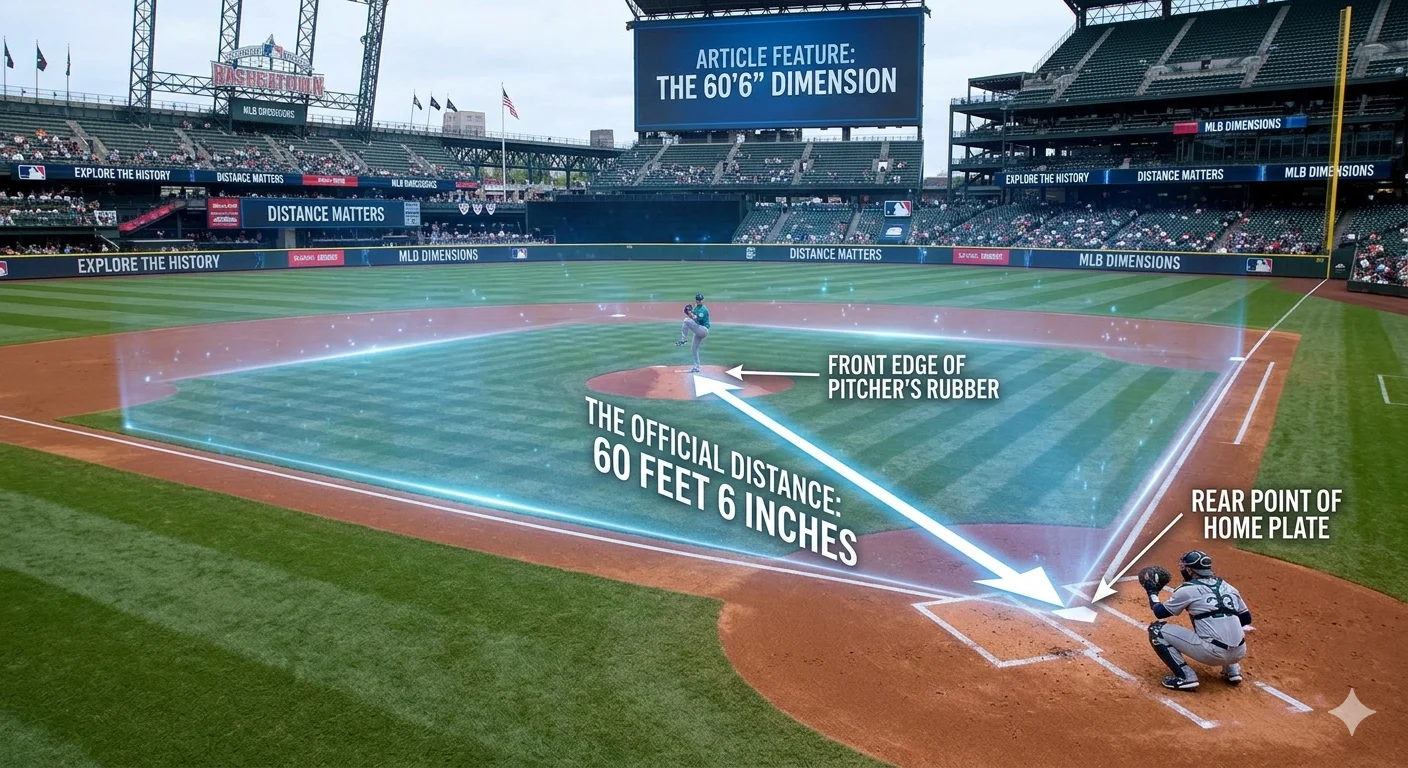
If you’ve ever watched a baseball game, you may have wondered: how many feet pitcher mound to home plate? The answer is straightforward. In Major League Baseball (MLB), the official distance from the pitcher’s mound to home plate is 60 feet 6 inches.
This measurement is one of the most important dimensions in baseball. It influences pitching speed, batter reaction time, player development, and overall game strategy. Whether you’re a player, coach, parent, student, or baseball fan, understanding this distance provides valuable insight into how the game is played.
In this guide, you’ll learn the official pitching distance, how it is measured, why it matters, its history, and how distances vary across different baseball leagues.
Quick Answer
The official distance from the pitcher’s mound to home plate is:
60 feet 6 inches (18.44 meters)
This distance is measured from the front edge of the pitching rubber to the back point of home plate.
For professional baseball, this measurement has remained unchanged since 1893.
Understanding the Official Pitching Distance
Many people assume the distance is measured from the center of the mound. However, that’s incorrect.
Where the Measurement Begins
The measurement starts at the front edge of the pitching rubber, also called the pitcher’s plate.
The pitcher places their pivot foot against this rubber before delivering a pitch.
Where the Measurement Ends
The distance ends at the pointed rear corner of home plate.
Therefore, the official measurement is:
Front of pitching rubber → Back point of home plate = 60 feet 6 inches
This precise measurement ensures consistency across baseball fields around the world.
Why Is the Distance 60 Feet 6 Inches?
The number may seem unusual, but it has a historical explanation.
In the early days of baseball, pitchers stood much closer to home plate. As pitchers improved and throwing speeds increased, hitters had a harder time making contact with the ball.
To create a fairer balance between offense and defense, baseball officials moved the pitching position farther away.
The result was the now-famous distance of 60 feet 6 inches, which remains the standard today.
The History of Pitching Distance
Early Baseball Measurements
Baseball did not always use the current pitching distance.
In the mid-1800s, pitchers threw from much shorter distances, including:
- 45 feet
- 50 feet
At that time, pitching was intended primarily to put the ball into play rather than overpower hitters.
The 1893 Rule Change
As pitching became more competitive, baseball leaders decided to move the pitching area farther from home plate.
In 1893, the pitching distance was increased to 60 feet 6 inches.
This change significantly improved offensive production and created a better balance between pitchers and hitters.
More than a century later, that distance remains unchanged in Major League Baseball.
Pitcher’s Mound Dimensions
The mound itself includes several important measurements.
Mound Height
A regulation MLB pitcher’s mound stands:
10 inches above home plate level
This elevated position helps pitchers generate velocity and movement.
Mound Diameter
The pitching mound measures:
18 feet in diameter
This circular area gives pitchers enough room for their pitching motion.
Pitching Rubber Size
The pitching rubber measures:
- 24 inches wide
- 6 inches deep
It sits at the center of the mound according to official baseball field specifications.
Pitching Distances by League
Different baseball leagues use different pitching distances based on player age and skill level.
Major League Baseball
| League | Distance |
|---|---|
| MLB | 60 ft 6 in |
High School Baseball
Most high school baseball programs use:
60 feet 6 inches
This helps prepare players for college and professional competition.
Little League Baseball
| Division | Pitching Distance |
|---|---|
| Minor League | 46 ft |
| Little League Major | 46 ft |
| Intermediate (50/70) | 50 ft |
| Junior League | 54 ft |
| Senior League | 60 ft 6 in |
Youth Baseball
Younger age groups often use shorter distances such as:
- 35 feet
- 40 feet
- 46 feet
- 50 feet
- 54 feet
The exact distance depends on league rules and player development levels.
Why Pitching Distance Matters
The distance from the mound to home plate affects nearly every aspect of the game.
Player Safety
Proper pitching distances help reduce injury risks.
If pitchers stood too close:
- Batters would have less reaction time
- Ball impact risks could increase
- The game would become less safe
Maintaining the proper distance helps protect players.
Fair Competition
Baseball relies on a balance between offense and defense.
The 60-foot-6-inch distance provides:
- Enough reaction time for hitters
- Adequate challenge from pitchers
- Competitive gameplay
Strategy and Performance
Pitching distance influences:
- Fastball effectiveness
- Pitch movement
- Strikeout rates
- Batting averages
- Pitch selection
Even small changes in distance can dramatically impact game outcomes.
How Fast Does a Pitch Reach Home Plate?
At first glance, 60 feet 6 inches may seem like a long distance.
However, professional pitchers throw incredibly fast.
Here are approximate travel times:
| Pitch Speed | Time to Home Plate |
|---|---|
| 70 mph | 0.59 seconds |
| 80 mph | 0.52 seconds |
| 90 mph | 0.46 seconds |
| 100 mph | 0.41 seconds |
This means batters often have less than half a second to identify a pitch and decide whether to swing.
Visualizing 60 Feet 6 Inches
Many people struggle to picture the distance.
Here are a few practical comparisons:
- About four average cars parked end-to-end
- Slightly longer than a bowling lane
- About 20.17 yards
- Approximately 18.44 meters
- Roughly one-fifth of a football field
These examples highlight the challenge hitters face during every pitch.
Common Misconceptions
The Distance Is Measured From the Center of the Mound
False.
The measurement starts at the front edge of the pitching rubber.
Every Baseball League Uses 60 Feet 6 Inches
False.
Many youth leagues use shorter distances.
Mound Height Equals Pitching Distance
False.
Mound height and pitching distance are separate measurements.
- Height: 10 inches
- Distance: 60 feet 6 inches
The Distance Has Changed Recently
False.
The MLB pitching distance has remained unchanged since 1893.
Tips for Coaches and Players
For Coaches
- Verify field measurements regularly
- Follow league-specific mound distances
- Teach proper mechanics
- Prioritize player safety
For Pitchers
- Practice from regulation distances
- Focus on control before velocity
- Build lower-body strength
- Develop multiple pitch types
For Hitters
- Improve reaction time
- Practice pitch recognition
- Train against game-speed pitching
- Develop consistent timing
These habits help players maximize performance at any level.
Frequently Asked Questions
How many feet is a pitcher’s mound from home plate?
The official MLB distance is 60 feet 6 inches.
Where is the pitching distance measured from?
The measurement starts at the front edge of the pitching rubber and ends at the back point of home plate.
Why is the pitching distance 60 feet 6 inches?
The distance was established in 1893 to create a fair balance between pitchers and hitters.
What is the Little League pitching distance?
Most Little League Major divisions use a pitching distance of 46 feet.
Has MLB ever changed the pitching distance?
Yes. The distance changed multiple times during baseball’s early years before settling at 60 feet 6 inches in 1893.
Conclusion
If you’re wondering how many feet pitcher mound to home plate, the official answer is 60 feet 6 inches. This measurement is taken from the front of the pitching rubber to the back point of home plate and has been the standard in Major League Baseball for more than 130 years.
The pitching distance plays a critical role in player safety, competitive balance, and game strategy. While younger leagues often use shorter distances, professional baseball continues to rely on the same 60-foot-6-inch measurement that has shaped the sport for generations. Understanding this key baseball dimension helps players, coaches, and fans appreciate the precision and skill required every time a pitcher steps onto the mound.