

If you are planning a construction project, one of the first questions you may ask is: how many square feet does 1000 bricks cover? Whether you are building a house wall, boundary wall, outdoor kitchen, or decorative feature, accurate brick estimation helps save money, reduce waste, and improve project planning.
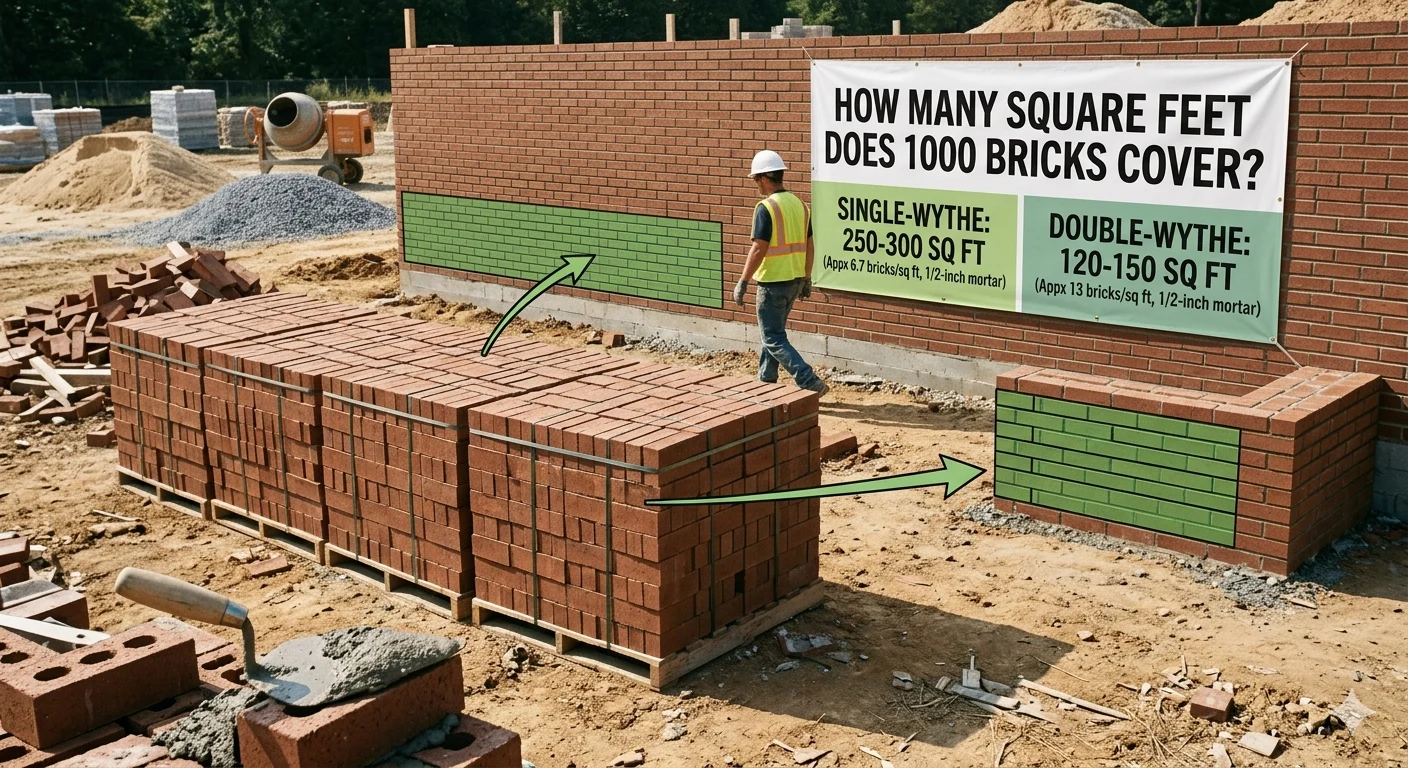
The answer depends on several factors, including brick size, mortar thickness, wall style, and construction method. However, in most standard residential projects, 1000 bricks typically cover around 250 to 300 square feet of wall area for a single-layer brick wall.
This guide explains everything in simple language. You will learn brick coverage formulas, calculation methods, examples, charts, and expert tips to estimate brick quantities accurately.
Understanding Brick Coverage
Before calculating coverage, it is important to understand how bricks are measured in construction.
A brick does not work alone. Builders also include mortar joints between bricks. Mortar spacing affects the final wall size and the number of bricks needed per square foot.
Why Brick Size Matters
Different regions use different brick sizes. Standard brick dimensions in the United States are usually:
- 7.5 inches long
- 3.5 inches deep
- 2.25 inches high
In many Asian countries, common brick sizes are:
- 9 inches × 4.5 inches × 3 inches
Larger bricks cover more area, which means fewer bricks are needed per square foot.
The Role of Mortar Joints
Mortar joints are the spaces between bricks filled with cement mortar. Most mortar joints are about 3/8 inch thick.
Mortar increases the effective size of each brick, slightly reducing the total number of bricks needed.
Without considering mortar, your estimate may be inaccurate.
How Many Square Feet Does 1000 Bricks Cover?
For a standard single-brick wall, builders usually estimate:
- About 6 to 7 bricks per square foot
Using this estimate:
However, when using face brick calculations and standard modular brick spacing, contractors often estimate closer to:
The difference depends on wall thickness and brick orientation.
Standard Brick Coverage Formula
A simple formula is:
For example:
- If 1 square foot requires 7 bricks:
- If using modular face bricks requiring 4 bricks per square foot:
That is why estimates vary between projects.
Quick Average Estimate
Here is a quick industry estimate:
| Wall Type | Average Coverage of 1000 Bricks |
|---|---|
| Single wythe wall | 250–300 sq ft |
| Double brick wall | 120–150 sq ft |
| Thick structural wall | 100–130 sq ft |
| Decorative veneer wall | 275–325 sq ft |
Brick Coverage Chart for Different Wall Types
The following chart gives a better idea of brick usage.
| Bricks Needed | Approximate Wall Area |
|---|---|
| 100 bricks | 25–30 sq ft |
| 250 bricks | 60–75 sq ft |
| 500 bricks | 125–150 sq ft |
| 1000 bricks | 250–300 sq ft |
| 1500 bricks | 375–450 sq ft |
| 2000 bricks | 500–600 sq ft |
These numbers are averages based on standard brick dimensions and mortar spacing.
Factors That Affect Brick Coverage
Many people assume all bricks cover the same area. In reality, several factors change the calculation.
Brick Dimensions
Larger bricks cover more wall area.
For example:
| Brick Type | Bricks Per Sq Ft |
|---|---|
| Standard modular brick | 6.5–7 |
| Queen size brick | 5.5–6 |
| Engineer brick | 4.5–5 |
| Facing brick | 4–6 |
Always check the manufacturer’s dimensions before ordering materials.
Wall Thickness
A thicker wall needs more bricks.
Common wall thicknesses include:
- 4-inch wall
- 8-inch wall
- 12-inch wall
An 8-inch wall may require nearly twice as many bricks as a 4-inch wall.
Waste and Breakage
Builders usually add 5% to 10% extra bricks for:
- Breakage
- Cutting
- Transportation damage
- Design changes
If your project needs exactly 1000 bricks, you may actually order 1050 to 1100 bricks.
Mortar Thickness
Thicker mortar joints reduce the number of bricks needed slightly. Thin joints increase brick usage.
Consistency matters for accurate estimation.
How to Calculate Brick Coverage Step by Step
Here is a simple process you can follow.
Step 1: Measure Wall Area
Measure:
- Wall length
- Wall height
Formula:
Example:
- Length = 20 feet
- Height = 10 feet
The wall area is 200 square feet.
Step 2: Calculate Bricks Per Square Foot
Suppose your brick type requires 4 bricks per square foot.
You need approximately 800 bricks.
Step 3: Add Waste Percentage
Add 10% for waste.
Final estimate:
- Around 880 bricks required
This method improves accuracy for real construction work.
Real World Examples of 1000 Brick Coverage
Understanding practical examples makes estimation easier.
Example 1: Garden Wall
Suppose you want to build:
- Height = 5 feet
- Length = 50 feet
Area:
A standard 1000-brick supply may cover this wall.
Example 2: House Exterior Veneer
An exterior veneer wall requiring 4 bricks per square foot:
This covers about 250 square feet of exterior surface.
Example 3: Thick Structural Wall
For a thicker wall needing 8 bricks per square foot:
The same number of bricks covers much less area.
Common Mistakes When Estimating Brick Coverage
Many construction projects run into problems because of incorrect estimates.
Here are the most common mistakes.
Ignoring Mortar Thickness
Mortar changes spacing and total coverage.
Forgetting Waste Allowance
Broken bricks are normal in construction.
Using Wrong Brick Dimensions
Always confirm actual brick measurements.
Ignoring Openings
Subtract doors and windows from total wall area.
Confusing Wall Thickness
Single-layer and double-layer walls need different calculations.
Expert Tips for Accurate Brick Estimation
Professionals use several techniques to avoid shortages and overspending.
Buy Extra Bricks
Always order 5–10% extra material.
Use a Brick Calculator
Digital calculators improve speed and accuracy.
Confirm Local Brick Standards
Brick sizes vary by country and manufacturer.
Check Bond Patterns
Some brick patterns use more bricks than others.
Examples include:
- Running bond
- Stack bond
- English bond
- Flemish bond
Measure Twice
Incorrect measurements lead to expensive mistakes.
Comparing Different Brick Sizes and Coverage
Different brick types affect coverage significantly.
| Brick Type | Approximate Coverage per 1000 Bricks |
|---|---|
| Modular brick | 250 sq ft |
| Queen brick | 275 sq ft |
| Utility brick | 300 sq ft |
| Structural brick | 125–175 sq ft |
| Thin veneer brick | 325+ sq ft |
Thin veneer bricks cover more surface because they are lighter and thinner.
Benefits of Accurate Brick Calculations
Good estimation offers many advantages.
Saves Money
You avoid overbuying materials.
Reduces Delays
Running out of bricks can stop construction.
Improves Planning
Contractors can estimate labor and transportation more accurately.
Minimizes Waste
Better calculations reduce leftover materials.
FAQs
How many square feet does 1000 standard bricks cover?
In most cases, 1000 standard bricks cover around 250 to 300 square feet for a single-layer wall.
How many bricks are needed for 100 square feet?
Most standard walls require about 400 to 700 bricks depending on wall thickness and brick size.
Does mortar affect brick coverage?
Yes. Mortar joints slightly increase the effective brick size and change coverage calculations.
How many bricks are needed for a 10×10 wall?
A 10×10 wall equals 100 square feet. Depending on thickness, you may need 400 to 800 bricks.
Should I buy extra bricks?
Yes. Builders usually add 5% to 10% extra bricks for waste, cuts, and breakage.
Conclusion
Understanding how many square feet does 1000 bricks cover is essential for accurate construction planning. In most standard projects, 1000 bricks cover approximately 250 to 300 square feet, although the final number depends on brick dimensions, wall thickness, mortar spacing, and waste allowance.
Using proper calculations helps prevent material shortages, overspending, and project delays. Whether you are building a garden wall, house exterior, or structural wall, accurate brick estimation makes construction smoother and more cost-effective.
Before starting your project, always confirm the brick size, wall design, and mortar thickness. A few simple calculations can save both time and money while improving overall project quality.