
When people look at buildings or read property details, one common question appears: how many stories is 55 feet? At first, it may sound simple, but the answer depends on building type, design, and floor height standards.
In general, 55 feet is roughly equal to a mid-rise building of about 4 to 5 stories, but the exact number can change based on whether the structure is residential or commercial. In this guide, you will learn how to accurately convert feet into building stories, real-world examples, and expert methods used in construction and real estate.
Understanding Building Height in Feet vs Stories
To understand how many stories is 55 feet, we first need to understand how buildings are measured.
Buildings are typically measured in:
- Feet (or meters) → physical height
- Stories (or floors) → usable levels inside the structure
What Is a “Story” in Construction?
A story is one complete level in a building. It includes:
- Floor structure
- Ceiling space
- Sometimes mechanical or utility space
However, not all stories are the same height.
Average Height of One Story
The height of one story usually depends on building type:
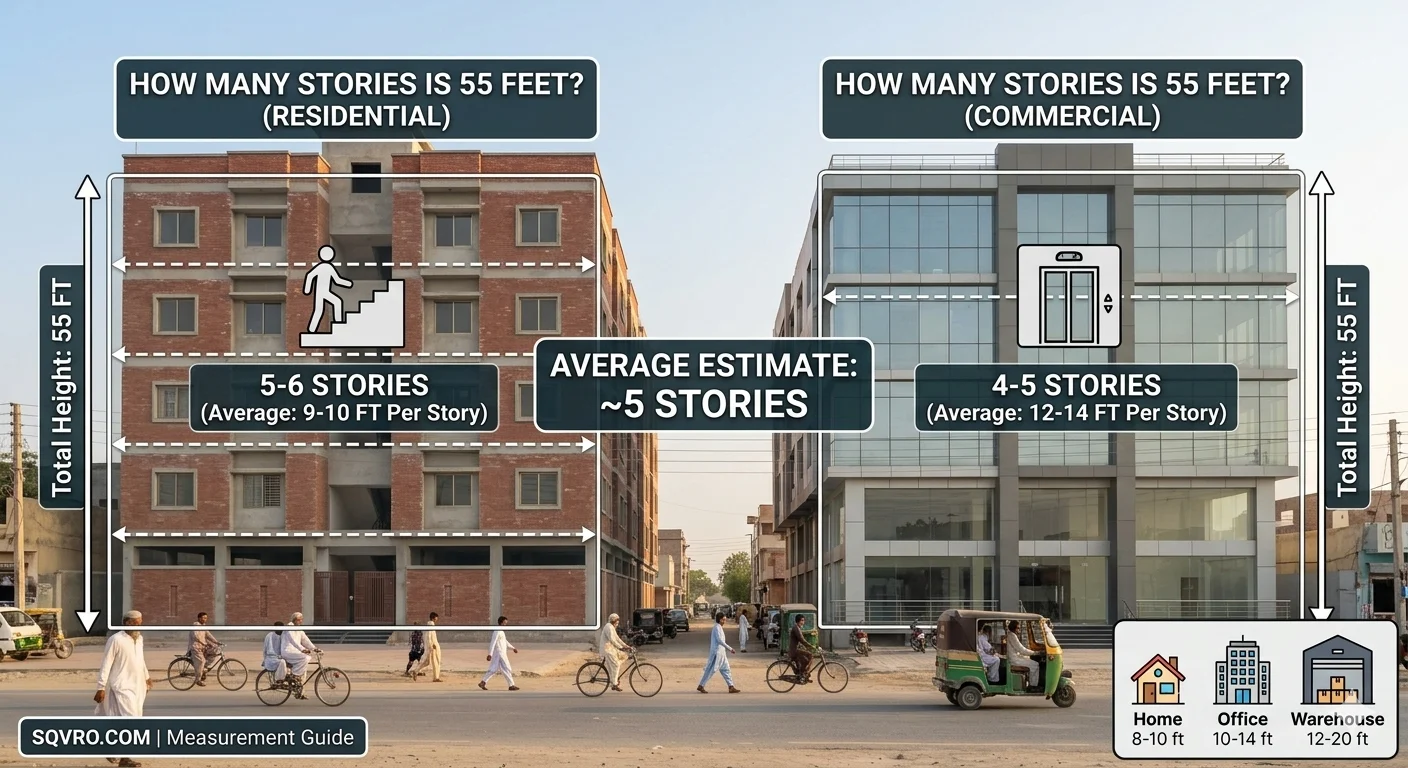
- Residential buildings: 8–10 feet per story
- Commercial buildings: 10–14 feet per story
- Industrial buildings: 12–20 feet per story
So, already you can see why conversions are not exact.
How Many Stories Is 55 Feet? Exact Answer Explained
Now let’s answer the main question: how many stories is 55 feet?
We calculate using average story heights.
Residential Buildings
If we assume:
- 1 story = 9 feet (average residential height)
Then:
55 ÷ 9 ≈ 6.1 stories
But in real-world construction:
- Roof thickness
- Flooring slabs
- Ceiling variation
So the practical estimate becomes:
👉 55 feet ≈ 5 to 6 residential stories
Commercial Buildings
For commercial spaces:
- 1 story = 12 feet (average)
55 ÷ 12 ≈ 4.5 stories
So:
👉 55 feet ≈ 4 to 5 commercial stories
Final Simple Answer
- Residential: 5–6 stories
- Commercial: 4–5 stories
So the most balanced answer to how many stories is 55 feet is:
👉 Approximately 5 stories
55 Feet in Stories Conversion Table
Here is a simple breakdown for better understanding:
| Height (Feet) | Residential Stories | Commercial Stories |
| 40 feet | 4–5 stories | 3–4 stories |
| 50 feet | 5–6 stories | 4–5 stories |
| 55 feet | 5–6 stories | 4–5 stories |
| 60 feet | 6–7 stories | 5 stories |
| 70 feet | 7–8 stories | 5–6 stories |
This helps quickly estimate building height without complex tools.
Factors That Affect Story Height
The conversion of how many stories is 55 feet is not fixed. Several factors influence it.
1. Ceiling Height Differences
Luxury apartments may have:
- Higher ceilings (10–12 feet per floor)
- Decorative ceilings or false ceilings
This reduces total number of stories.
2. Building Purpose
Different building types use different heights:
- Homes → shorter floors
- Offices → medium floors
- Malls/hotels → tall floors
3. Structural Components
Each floor includes:
- Concrete slab thickness
- Pipes and wiring space
- Insulation layers
These add extra height per story.
Real-Life Examples of 55 Feet Buildings
Understanding how many stories is 55 feet becomes easier with real-world comparisons.
Apartment Buildings
A typical residential apartment:
- 5 stories
- Around 50–60 feet total height
So a 55 feet building is usually a mid-rise apartment.
Schools and Offices
- Schools often have higher ceilings
- Offices may include mechanical floors
So: 👉 55 feet = 4–5 story school or office building
Warehouses
Warehouses are different:
- Very tall ceilings (15–25 feet per level)
So: 👉 55 feet may only be 2–3 levels
How to Estimate Stories from Feet (Step-by-Step)
You can estimate easily using this method:
Step 1: Identify building type
- Residential or commercial?
Step 2: Choose average story height
- Residential = 9 feet
- Commercial = 12 feet
Step 3: Divide total height
Example: 55 ÷ 9 = 6.1 stories
Step 4: Adjust for real-world structure
- Roof thickness
- Basement (if any)
Final estimate:
👉 5–6 stories
Common Mistakes in Height Conversion
People often make errors when estimating how many stories is 55 feet:
1. Assuming all floors are equal
Not true—commercial floors are taller.
2. Ignoring roof structure
Roof adds 3–5 feet extra height.
3. Mixing residential and industrial standards
Industrial buildings are much taller per floor.
Expert Tips for Accurate Measurement
- Always check building type first
- Use 9–10 feet for homes
- Use 12–14 feet for offices
- Include structural thickness
- Don’t rely on visual guessing only
Architects often use CAD software for precision, but these manual estimates are useful for real estate and general knowledge.
55 Feet Compared to Other Heights
To better understand how many stories is 55 feet, compare it:
- 30 feet → 3 stories
- 40 feet → 4 stories
- 55 feet → 5–6 stories
- 80 feet → 7–8 stories
- 100 feet → 9–10 stories
So 55 feet sits in the mid-rise building category.
Final Estimation Summary
- 55 feet is not a fixed story count
- Residential buildings → 5–6 stories
- Commercial buildings → 4–5 stories
- Average overall estimate → around 5 stories
So when someone asks how many stories is 55 feet, the most accurate simple answer is:
👉 Approximately a 5-story building
FAQs
1. How many stories is 55 feet in a house?
Around 5–6 residential stories depending on ceiling height.
2. Is 55 feet considered a tall building?
It is a mid-rise building, not very tall in urban construction.
3. How many floors is 55 feet in commercial buildings?
About 4 to 5 floors.
4. Why do story heights vary?
Because of ceiling design, structure, and building purpose.
5. Can 55 feet be 7 stories?
Only in buildings with very low ceilings, which is rare.
Conclusion
Understanding how many stories is 55 feet helps in real estate, construction, and general knowledge. While there is no exact fixed number, the standard conversion shows that 55 feet typically equals about 5 stories, depending on building type.
Residential buildings usually reach 5–6 stories, while commercial structures stay closer to 4–5 stories due to taller floor heights. By understanding average measurements, you can easily estimate building heights in real-world situations without confusion.