

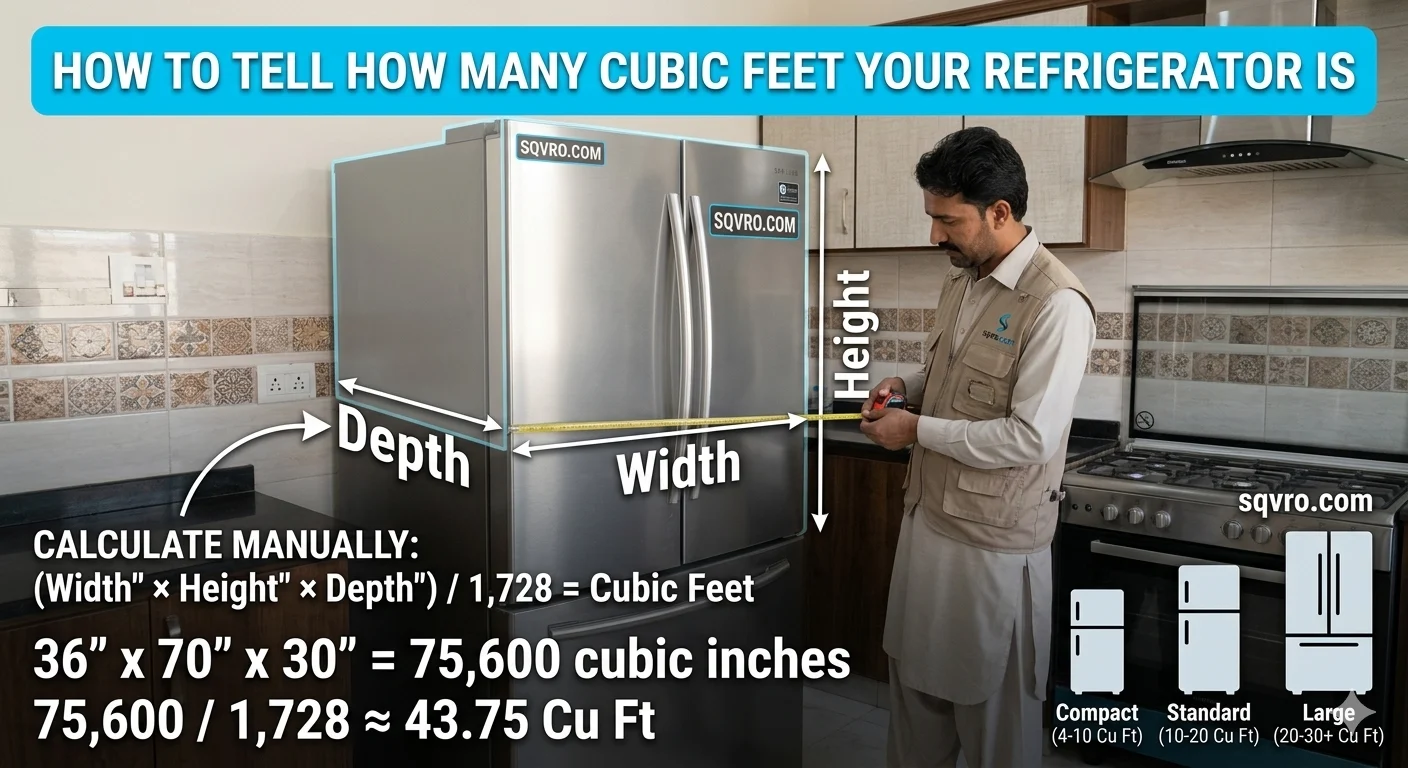
If you’re wondering how to tell how many cubic feet your refrigerator is, you’re not alone. Many people need this information when buying a new fridge, organizing their kitchen, or simply understanding how much storage space they really have.
The good news is that figuring out your refrigerator’s capacity is easier than it sounds. You can either find it on the appliance itself or calculate it using simple measurements. In this guide, you’ll learn everything step by step in a clear and practical way.
What Does Cubic Feet Mean in a Refrigerator?
Cubic feet is a unit used to measure volume. In simple terms, it tells you how much space is inside your refrigerator.
One cubic foot equals the space of a cube that is:
- 1 foot wide
- 1 foot tall
- 1 foot deep
When manufacturers say a fridge is “20 cubic feet,” they mean the total internal storage space equals 20 of those cubes combined.
Understanding this helps you:
- Compare refrigerator sizes
- Choose the right fridge for your needs
- Plan your grocery storage better
Easiest Ways to Tell Your Refrigerator’s Cubic Feet
There are three simple methods you can use.
1. Check the Manufacturer Label
Most refrigerators have a label that includes the capacity.
Look in these places:
- Inside wall of the fridge
- Behind crisper drawers
- On the back panel
You might see something like “Capacity: 18 cu ft.”
2. Search Using the Model Number
If the capacity is not listed clearly:
- Find the model number on the label
- Search it on Google
- Visit the manufacturer’s website
You’ll usually find full specifications, including cubic feet.
3. Measure and Calculate It Yourself
If you can’t find any label or details, you can calculate it manually.
This method is very accurate and works for any refrigerator.
Step-by-Step: How to Calculate Cubic Feet of Your Refrigerator
Follow these simple steps.
Step 1: Measure the Inside Dimensions
Use a measuring tape to find:
- Width (side to side)
- Height (top to bottom)
- Depth (front to back)
Measure in inches for easier calculation.
Step 2: Multiply the Measurements
Use this formula:
Volume = Width × Height × Depth
This gives you the volume in cubic inches.
Step 3: Convert to Cubic Feet
Divide the result by 1,728
This is because:
1 cubic foot = 1,728 cubic inches
Example Calculation
Let’s say your fridge measures:
- Width = 30 inches
- Height = 60 inches
- Depth = 28 inches
Now calculate:
30 × 60 × 28 = 50,400 cubic inches
Convert to cubic feet:
50,400 ÷ 1,728 = 29.16 cubic feet
So your refrigerator is about 29 cubic feet.
Refrigerator Size Guide
Here’s a simple breakdown of common fridge sizes:
- Mini fridge: 1.5 – 4 cubic feet
- Compact fridge: 4 – 10 cubic feet
- Standard fridge: 10 – 20 cubic feet
- Large fridge: 20 – 30 cubic feet
- Extra-large fridge: 30+ cubic feet
This helps you quickly estimate your fridge size even before measuring.
Real-Life Examples
Small Refrigerator
- Dimensions: 24 × 50 × 24 inches
- Result: Around 16–17 cubic feet
Large Family Refrigerator
- Dimensions: 36 × 70 × 30 inches
- Result: Around 40+ cubic feet
These examples show how much sizes can vary.
Standard Refrigerator Types and Their Sizes
Different types of refrigerators usually fall into specific size ranges.
Top-Freezer
- 14–20 cubic feet
- Affordable and simple
Bottom-Freezer
- 18–25 cubic feet
- Easier access to fresh food
Side-by-Side
- 20–30 cubic feet
- Balanced storage
French Door
- 25–35 cubic feet
- Spacious and modern
Tips for Accurate Measurement
To get the best result:
- Measure inside space if possible
- Take measurements twice
- Use inches for easier math
- Remove shelves if needed for accuracy
Common Mistakes to Avoid
Avoid these errors when calculating:
Measuring the outside only
Outer dimensions include walls and insulation, which reduce usable space.
Forgetting to convert units
Always divide by 1,728 if using inches.
Guessing instead of measuring
Even small differences can affect the final result.
Ignoring compartments
Shelves and drawers reduce usable space slightly.
Why Knowing Your Refrigerator’s Cubic Feet Matters
Understanding your fridge capacity helps in real life.
Better Storage Planning
You’ll know how much food you can store comfortably.
Smarter Buying Decisions
Avoid buying a fridge that’s too small or too large.
Energy Efficiency
Right-sized refrigerators use energy more efficiently.
Kitchen Space Management
Helps ensure your fridge fits perfectly in your kitchen layout.
FAQs
1. How can I find my refrigerator size without measuring?
Check the label or search the model number online.
2. Is cubic feet equal to usable storage?
Not exactly. Shelves and compartments reduce usable space.
3. What size refrigerator is best for a family?
A family of 4 usually needs 18–25 cubic feet.
4. Can I measure in centimeters instead of inches?
Yes, but you’ll need to convert the result to cubic feet.
5. Why is my calculation different from the official size?
Manufacturers include total internal volume, including areas you may not measure.
Conclusion
Now you know exactly how to tell how many cubic feet your refrigerator is. Whether you check the label, search the model number, or calculate it manually, each method is simple and effective.
If you want the most accurate answer, measuring and calculating is the best option. Just remember the formula, convert properly, and avoid common mistakes.
Once you know your refrigerator’s capacity, you’ll be able to manage your kitchen space better, shop smarter, and choose the right appliances with confidence.