
If you are working in woodworking, construction, or DIY home improvement, understanding how many board feet you need is one of the most important skills for accurate planning. Lumber is not sold in simple square measurements. Instead, it is measured in board feet, which represent volume. Once you understand this system, buying wood becomes easier, cheaper, and far more precise.
A board foot is a standard unit used in the lumber industry to measure wood volume. It helps builders, carpenters, and suppliers communicate clearly and avoid confusion when dealing with different sizes of timber. Whether you are building furniture, framing a house, or estimating material for a project, knowing how many board feet you require ensures you do not overbuy or run short.
What Is a Board Foot in Lumber Measurement?
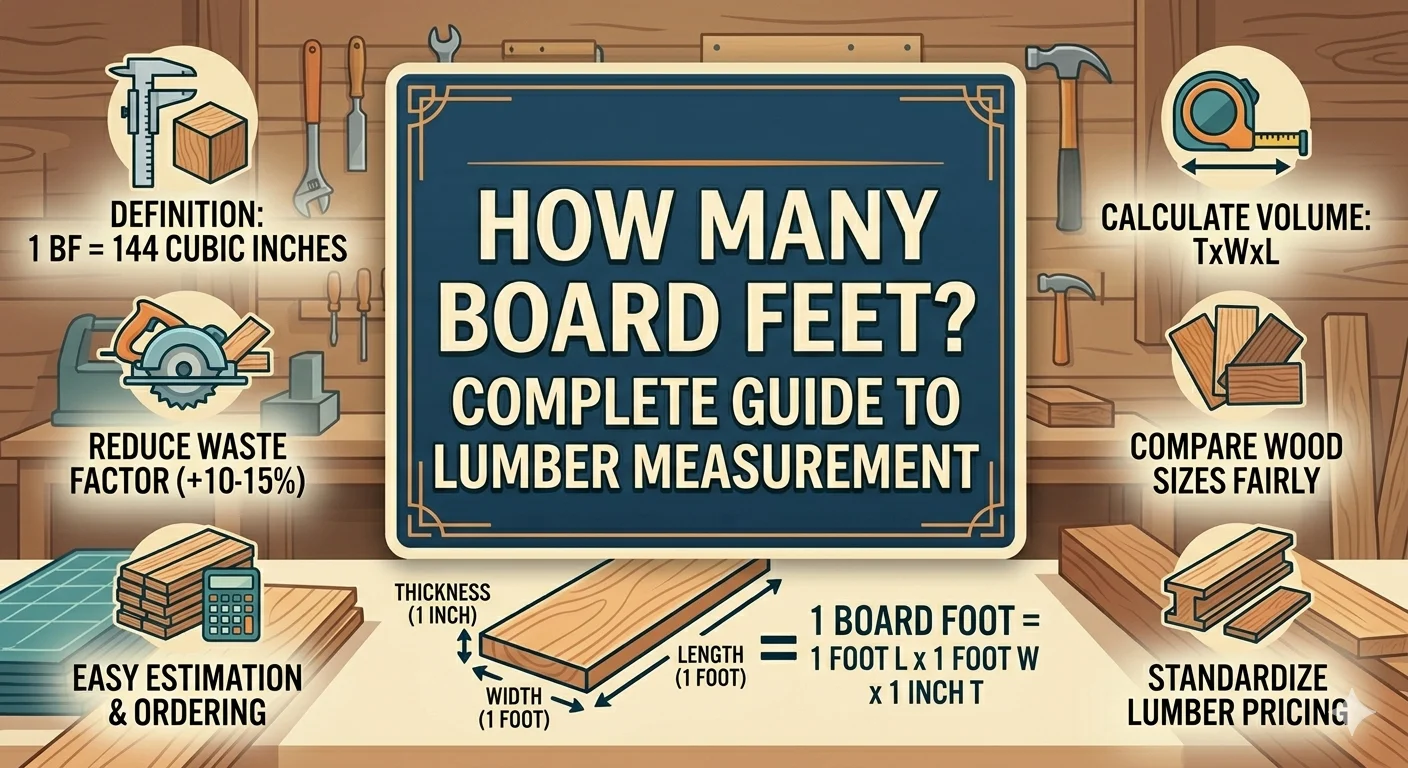
A board foot is a unit that measures the volume of wood.
In simple terms, one board foot equals:
- 1 foot in length
- 1 foot in width
- 1 inch in thickness
This means:
1 board foot = 144 cubic inches of wood
This measurement is widely used in the lumber industry because wood comes in many shapes and sizes. Instead of calculating complicated dimensions every time, professionals use board feet as a standard system.
Why Board Feet Matter
Board feet are important because they help:
- Standardize lumber pricing
- Make material estimation easier
- Reduce waste in construction projects
- Compare different wood sizes fairly
Without board feet, every lumber transaction would require complex conversions.
How Many Board Feet Are in Common Lumber Sizes?
To understand how many board feet are in standard lumber, it is important to know that actual wood dimensions are smaller than their nominal sizes. For example, a 2×4 is not truly 2 inches by 4 inches.
Here are real-world examples of common lumber sizes:
2×4 Lumber (8 feet long)
A very common construction material.
- Actual size: 1.5 in × 3.5 in × 96 in
- Board feet: approximately 3.5 to 5.33 BF
2×6 Lumber (8 feet long)
- Actual size: 1.5 in × 5.5 in × 96 in
- Board feet: approximately 5.5 to 8 BF
2×8 Lumber (8 feet long)
- Actual size: 1.5 in × 7.25 in × 96 in
- Board feet: approximately 7 to 10.67 BF
2×12 Lumber (8 feet long)
- Actual size: 1.5 in × 11.25 in × 96 in
- Board feet: approximately 11 to 16 BF
Key Insight
The thicker and longer the lumber, the more board feet it contains. This is why larger beams cost significantly more than smaller ones.
How to Calculate How Many Board Feet
To calculate how many board feet are in any piece of lumber, you use a simple formula.
Board Foot Formula
Board Feet = (Thickness × Width × Length) ÷ 144
All measurements must be in inches.
Step-by-Step Example
Let’s calculate a standard 2×4 (8 feet long):
- Thickness = 1.5 inches
- Width = 3.5 inches
- Length = 96 inches
Now apply the formula:
(1.5 × 3.5 × 96) ÷ 144
= 504 ÷ 144
= 3.5 board feet
Another Example (2×6, 10 feet long)
- Thickness = 1.5 inches
- Width = 5.5 inches
- Length = 120 inches
(1.5 × 5.5 × 120) ÷ 144
= 990 ÷ 144
= 6.88 board feet
Why This Formula Works
The formula converts cubic inches into board feet by dividing by 144, because one board foot equals 144 cubic inches.
Board Feet Conversion Table
Here is a quick reference guide for how many board feet are in common lumber sizes:
| Lumber Size | Length | Board Feet |
|---|---|---|
| 1×4 | 8 ft | 2.67 BF |
| 1×6 | 8 ft | 4 BF |
| 2×4 | 8 ft | 3.5–5.33 BF |
| 2×6 | 8 ft | 5.5–8 BF |
| 2×8 | 8 ft | 7–10.67 BF |
| 2×10 | 8 ft | 10–13.33 BF |
| 2×12 | 8 ft | 11–16 BF |
This table is extremely useful for quick estimation during construction planning.
Real-World Uses of Board Feet
Understanding how many board feet you need is useful in many industries.
Construction Projects
Builders use board feet to:
- Estimate framing materials
- Plan structural wood usage
- Calculate total project cost
Furniture Making
Carpenters and furniture makers rely on board feet to:
- Estimate hardwood usage
- Reduce material waste
- Plan precise cuts for tables, chairs, and cabinets
Lumber Buying
When purchasing wood, board feet help you:
- Compare prices between suppliers
- Avoid overpaying
- Purchase exact quantities needed
Common Mistakes When Calculating Board Feet
Many beginners make simple errors that lead to incorrect estimates.
1. Using Nominal Dimensions
A 2×4 is not actually 2 inches by 4 inches. Always use actual measurements.
2. Forgetting Unit Conversion
You must convert all measurements into inches before calculating.
3. Ignoring Length Differences
Even small changes in length can significantly affect total board feet.
Expert Tips for Accurate Calculation
Professionals use a few smart strategies when estimating how many board feet they need:
Always Add Extra Material
Add 10%–15% extra wood for:
- Cutting waste
- Errors
- Future adjustments
Use a Calculator
Digital board foot calculators reduce mistakes and save time.
Check Lumber Grades
Higher-grade lumber is more expensive, so accurate estimation helps control budget.
Board Feet vs Square Feet vs Cubic Feet
These three measurements are often confused.
Board Feet
- Measures wood volume
- Used specifically for lumber
Square Feet
- Measures flat surface area
- Used for flooring and walls
Cubic Feet
- Measures total 3D volume
- Used in general construction
👉 Key difference:
Board feet are specifically designed for lumber measurement, while the others are general-purpose units.
FAQs About How Many Board Feet
What is a board foot in simple terms?
A board foot is a measurement of wood equal to 144 cubic inches.
How many board feet are in a 2×4?
An 8-foot 2×4 contains about 3.5 to 5.33 board feet depending on actual dimensions.
How do I calculate board feet quickly?
Multiply thickness × width × length (in inches) and divide by 144.
Why are board feet important?
They help standardize lumber pricing and make material estimation easier.
Are board feet used worldwide?
Mostly in the United States and North American lumber industries.
Conclusion
Understanding how many board feet are needed for any project is essential for anyone working with wood. It simplifies planning, improves accuracy, and prevents unnecessary material waste.
By using the simple formula (Thickness × Width × Length ÷ 144), you can quickly estimate lumber requirements for any project, from small DIY furniture to large construction jobs.
Once you understand board feet properly, you gain better control over your materials, budget, and overall project efficiency.