
Choosing the correct air conditioner size can make a huge difference in comfort, energy bills, and cooling performance. One of the most common questions homeowners ask is: how many BTU for 400 square feet?
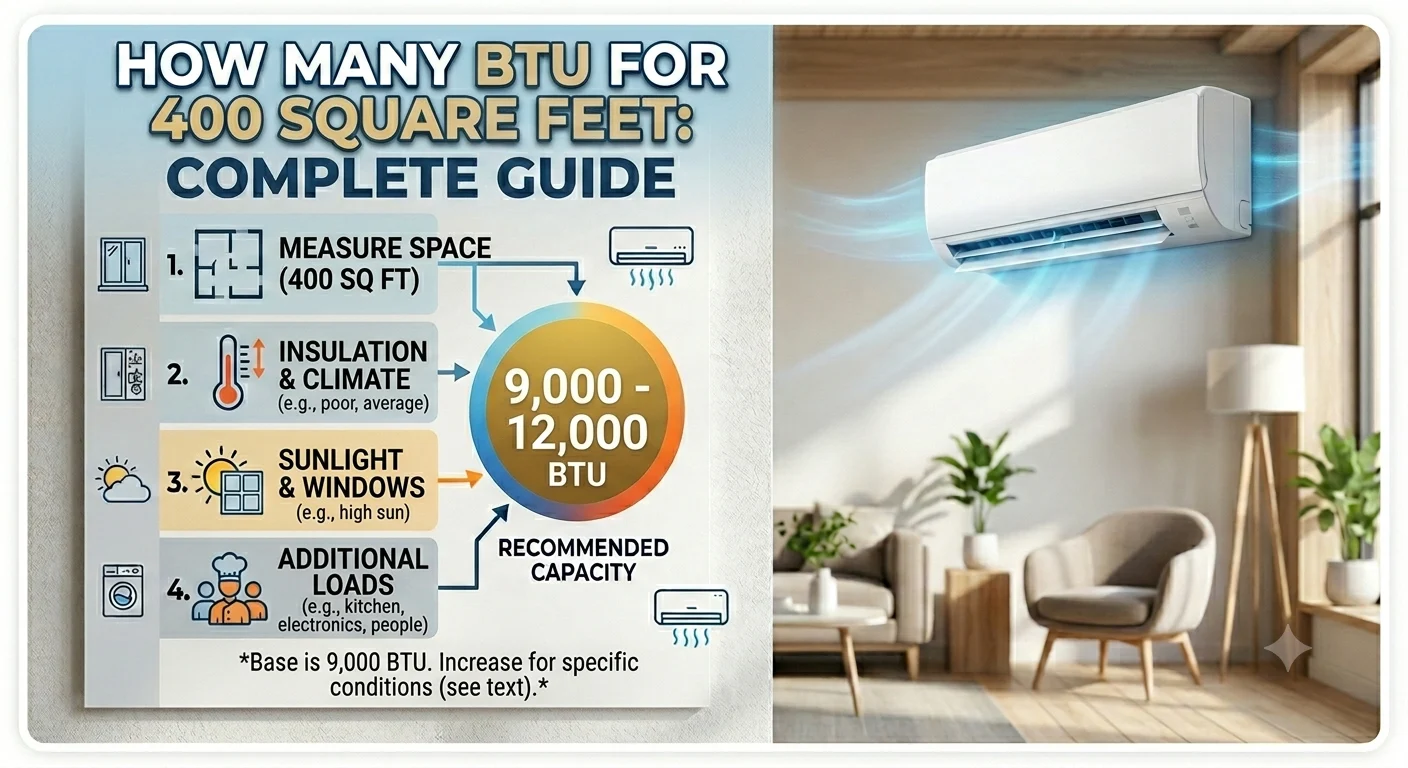
The short answer is that a 400 square foot room typically needs around 8,000 to 10,000 BTUs for effective cooling. However, the exact number depends on several factors such as ceiling height, insulation, sunlight exposure, and climate.
In this complete guide, you will learn exactly how to choose the right BTU size for a 400 sq ft space, avoid common mistakes, and improve cooling efficiency.
What Does BTU Mean?
BTU stands for British Thermal Unit. It measures how much heat an air conditioner can remove from a room in one hour.
In simple words:
- Higher BTU = More cooling power
- Lower BTU = Less cooling power
Air conditioners are rated based on BTUs because different room sizes need different cooling capacities.
Why BTU Matters in Air Conditioning
Choosing the wrong BTU size can create problems:
- Too few BTUs → room stays hot
- Too many BTUs → wasted electricity and humidity issues
That is why correct AC sizing is important for comfort and efficiency.
How Many BTU for 400 Square Feet?
For most homes, the recommended cooling capacity for 400 square feet is:
| Room Size | Recommended BTU |
|---|---|
| 350–400 sq ft | 8,000 BTU |
| 400–450 sq ft | 9,000–10,000 BTU |
In general:
- 8,000 BTU works for well-insulated rooms
- 10,000 BTU is better for hot climates or sunny rooms
If your room gets direct sunlight most of the day, you may need additional cooling power.
BTU Chart by Room Size
Here is a quick air conditioner BTU chart for common room sizes:
| Room Size (Sq Ft) | Recommended BTU |
|---|---|
| 100–150 | 5,000 BTU |
| 150–250 | 6,000 BTU |
| 250–300 | 7,000 BTU |
| 300–350 | 8,000 BTU |
| 350–450 | 8,000–10,000 BTU |
| 450–550 | 12,000 BTU |
| 550–700 | 14,000 BTU |
This chart gives a general estimate. Actual cooling needs can vary.
Factors That Affect BTU Requirements
Even if two rooms are both 400 square feet, they may need different AC sizes. Here are the biggest factors.
Ceiling Height
Most BTU charts assume an 8-foot ceiling.
If your ceiling is higher:
- More air volume exists
- More cooling power is required
For example:
- Standard ceiling → 8,000 BTU
- Vaulted ceiling → 10,000 BTU or more
Sunlight Exposure
Rooms with large windows or direct sunlight heat up faster.
Sunny rooms may need:
- 10%–20% more BTUs
Shaded rooms may need:
- Slightly fewer BTUs
Climate
Your local climate matters a lot.
Hot climates
Areas with long summers and high temperatures usually need stronger AC units.
Cooler climates
Moderate weather regions may require fewer BTUs.
For example, a 400 sq ft room in a very hot area may perform better with a 10,000 BTU unit.
Number of People
People generate body heat.
Add around 600 BTUs for each extra person regularly occupying the room.
For example:
- One person bedroom → standard sizing
- Family living room → additional BTUs needed
Kitchen Appliances
If the room is connected to a kitchen, you may need extra cooling because ovens and stoves create heat.
Experts often recommend adding:
- 3,000–4,000 BTUs for kitchens
Insulation Quality
Good insulation keeps cool air inside.
Poor insulation causes:
- Energy loss
- Longer cooling cycles
- Higher electricity bills
Older homes may need larger AC units compared to modern insulated buildings.
Best AC Types for a 400 Square Foot Room
Different air conditioner types work well for 400 sq ft spaces.
Window Air Conditioner
Window AC units are popular because they are:
- Affordable
- Easy to install
- Energy efficient
Recommended size:
- 8,000–10,000 BTU
Best for:
- Bedrooms
- Living rooms
- Apartments
Pros
- Lower cost
- Strong cooling
- Compact design
Cons
- Blocks window space
- Can be noisy
Portable Air Conditioner
Portable ACs are flexible and easy to move.
However, portable units are usually less efficient than window units.
For 400 sq ft:
- Choose at least 10,000 BTU portable AC
Pros
- Portable
- No permanent installation
- Good for renters
Cons
- Takes floor space
- Less efficient
- Louder operation
Mini Split AC
Mini split systems offer powerful and efficient cooling.
They are ideal for:
- Large bedrooms
- Studios
- Offices
- Long-term use
Recommended size:
- 9,000–12,000 BTU
Pros
- Very energy efficient
- Quiet
- Excellent cooling
Cons
- Higher upfront cost
- Professional installation needed
What Happens if BTU Is Too Low or Too High?
Choosing the wrong AC size can reduce comfort and efficiency.
Problems With Undersized AC
An AC with too few BTUs may:
- Run continuously
- Fail to cool properly
- Increase electricity costs
- Wear out faster
Example:
A 5,000 BTU AC in a 400 sq ft room will struggle during hot weather.
Problems With Oversized AC
Many people think bigger is always better. That is not true.
An oversized AC may:
- Cool too quickly
- Turn on and off frequently
- Leave humidity in the air
- Waste energy
This process is called short cycling.
A balanced BTU size provides the best performance.
How to Calculate BTU for 400 Square Feet
You can estimate BTU needs using a simple formula.
Basic Formula
For a 400 sq ft room:
So, the basic estimate is:
- 8,000 BTU
Then adjust for:
- Sunlight
- Occupants
- Appliances
- Insulation
- Climate
Real-World Examples
Here are some practical examples.
| Room Type | Suggested BTU |
|---|---|
| Small apartment living room | 8,000 BTU |
| Sunny bedroom | 9,000 BTU |
| Home office with electronics | 9,000 BTU |
| Studio apartment | 10,000–12,000 BTU |
| Kitchen-connected room | 10,000 BTU |
These examples help you choose a more accurate AC size.
Energy Efficiency Tips for Better Cooling
Even the best AC performs poorly if the room wastes energy.
Seal Air Leaks
Check for:
- Window gaps
- Door leaks
- Cracks
Sealing leaks improves cooling efficiency.
Use Curtains or Blinds
Sunlight increases indoor temperatures quickly.
Use:
- Blackout curtains
- Reflective blinds
- UV window film
This reduces heat gain.
Maintain Filters
Dirty filters restrict airflow.
Clean or replace filters:
- Every 1–3 months
Benefits include:
- Better airflow
- Lower bills
- Improved cooling
Improve Insulation
Adding insulation can significantly reduce cooling costs.
Focus on:
- Attics
- Walls
- Windows
Better insulation helps maintain stable indoor temperatures.
Common Mistakes When Choosing AC Size
Avoid these common errors when selecting an air conditioner for 400 square feet.
Ignoring Sunlight
A sunny room may need more BTUs than standard charts suggest.
Buying the Largest Unit Available
Oversized ACs often cool poorly and waste electricity.
Forgetting Ceiling Height
High ceilings increase air volume.
Choosing Cheap Low-Efficiency Models
Energy-efficient units save money over time.
Ignoring Energy Ratings
Look for:
- Energy Star certification
- High EER rating
- Inverter technology
These features improve efficiency.
FAQs
Is 8,000 BTU enough for 400 square feet?
Yes, 8,000 BTU is usually enough for a well-insulated 400 sq ft room with standard ceiling height.
Do I need 10,000 BTU for a sunny room?
Yes, sunny rooms often require 9,000–10,000 BTUs because sunlight increases indoor heat.
What size portable AC for 400 square feet?
A portable AC should typically be around 10,000 BTU for effective cooling in a 400 sq ft space.
Can an AC be too powerful?
Yes. Oversized ACs can short cycle, waste electricity, and leave humidity in the room.
How do I know the right BTU for my room?
Measure the square footage and adjust for sunlight, insulation, ceiling height, and room usage.
Conclusion
If you are wondering how many BTU for 400 square feet, the ideal range is usually 8,000 to 10,000 BTUs depending on your room conditions.
For standard rooms:
- 8,000 BTU is often enough
For sunny, hot, or poorly insulated spaces:
- 10,000 BTU may work better
Choosing the correct air conditioner size improves comfort, lowers energy bills, and helps your AC last longer. Always consider room conditions, climate, and insulation before making a final decision.