

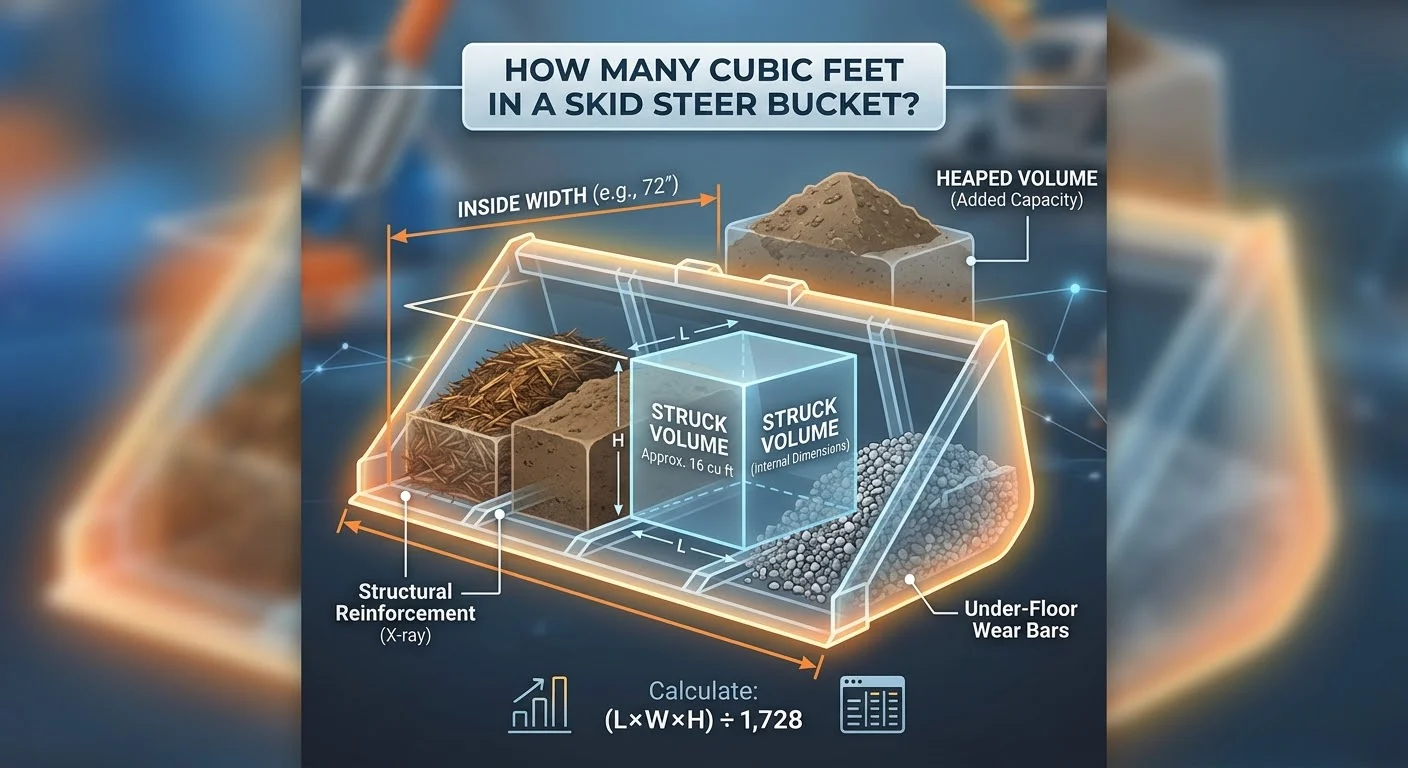
If you have ever rented, purchased, or operated a skid steer loader, you have probably wondered, how many cubic feet in a skid steer bucket? The answer depends on the bucket’s width, depth, height, and whether you are measuring struck or heaped capacity. In general, most standard skid steer buckets hold between 10 and 25 cubic feet, with average general-purpose buckets offering around 15 to 20 cubic feet of volume.
Knowing the cubic foot capacity of a skid steer bucket is essential for construction, landscaping, farming, and property maintenance. It helps you estimate how much dirt, gravel, mulch, sand, or other materials you can move in a single load. Accurate calculations also save time, reduce fuel costs, and help prevent overloading your machine.
Understanding Skid Steer Bucket Capacity
A skid steer bucket is one of the most commonly used attachments for a skid steer loader. It is designed to scoop, transport, and dump loose materials efficiently. Bucket capacity refers to the amount of material the bucket can hold and is usually measured in cubic feet or cubic yards.
The size of the bucket depends on the machine model and the intended application. Compact skid steers often use smaller buckets, while larger machines can handle wider, deeper buckets with greater volume.
Understanding bucket capacity is important because it directly affects productivity. The more material you can safely carry in each trip, the fewer loads you need to complete a project.
How Many Cubic Feet Are in a Typical Skid Steer Bucket?
The exact cubic foot capacity varies by manufacturer and bucket design, but the following estimates cover the most common sizes used in the field.
| Bucket Width | Approximate Capacity (Cubic Feet) | Approximate Capacity (Cubic Yards) |
|---|---|---|
| 60 inches | 10–12 cu ft | 0.37–0.44 cu yd |
| 66 inches | 12–14 cu ft | 0.44–0.52 cu yd |
| 72 inches | 15–18 cu ft | 0.56–0.67 cu yd |
| 78 inches | 18–21 cu ft | 0.67–0.78 cu yd |
| 84 inches | 20–25 cu ft | 0.74–0.93 cu yd |
A standard 72-inch bucket is one of the most common options and typically holds around 16 cubic feet, making it suitable for a wide variety of landscaping and construction jobs.
How to Calculate Cubic Feet in a Skid Steer Bucket
If you know the internal dimensions of your bucket, you can estimate its capacity with a simple formula.
Formula:
Cubic Feet = (Length × Width × Height) ÷ 1,728
The dimensions should be measured in inches because there are 1,728 cubic inches in one cubic foot.
Example Calculation
Suppose your bucket has these inside dimensions:
- Width: 72 inches
- Depth: 30 inches
- Height: 20 inches
First, multiply the dimensions:
72 × 30 × 20 = 43,200 cubic inches
Then divide by 1,728:
43,200 ÷ 1,728 = 25 cubic feet
This means the bucket has an estimated struck capacity of about 25 cubic feet. If the material is piled above the bucket edge, the heaped capacity will be slightly larger.
Skid Steer Bucket Capacity Chart
The chart below provides a quick reference for estimating bucket volume.
| Bucket Size | Estimated Cubic Feet | Estimated Cubic Yards |
|---|---|---|
| 60-inch bucket | 11 cu ft | 0.41 cu yd |
| 66-inch bucket | 13 cu ft | 0.48 cu yd |
| 72-inch bucket | 16 cu ft | 0.59 cu yd |
| 78-inch bucket | 19 cu ft | 0.70 cu yd |
| 84-inch bucket | 22 cu ft | 0.81 cu yd |
Since many landscaping and construction suppliers sell materials by the cubic yard, it is also useful to remember that:
1 cubic yard = 27 cubic feet
This simple conversion makes it easier to estimate the number of bucket loads needed for a project.
Factors That Affect Bucket Volume
While bucket width is important, several other factors influence how many cubic feet a skid steer bucket can actually hold.
Bucket Design
Different bucket styles are designed for different tasks. General-purpose buckets, heavy-duty buckets, and light-material buckets may have similar widths but different depths and side profiles, resulting in different capacities.
Struck Capacity vs. Heaped Capacity
Manufacturers often list two types of volume measurements:
- Struck Capacity: The amount of material the bucket holds when leveled off with the top edge.
- Heaped Capacity: The amount of material the bucket holds when piled above the top edge.
Heaped capacity is usually larger, but actual results depend on the type of material and how it is loaded.
Material Type
Different materials settle differently inside the bucket. Loose mulch takes up space without adding much weight, while wet sand is compact and significantly heavier.
Machine Size and Lift Capacity
Even if a bucket can physically hold a certain amount of material, the skid steer itself may not be able to lift it safely. Heavy materials like gravel or wet soil can exceed the machine’s rated operating capacity if the bucket is overloaded.
How Much Material Fits in a Skid Steer Bucket?
The amount of material that fits inside a bucket depends on both volume and density. Here are some practical examples.
Dirt
A standard 72-inch bucket with a capacity of about 16 cubic feet can hold approximately 0.6 cubic yards of loose topsoil. Depending on moisture content, that load may weigh between 1,200 and 1,800 pounds.
Gravel
Gravel is much denser than dirt. The same 16-cubic-foot bucket may hold over 2,000 pounds of gravel, which is why operators should always check the loader’s lift rating.
Sand
Dry sand is heavy, and wet sand is even heavier. Bucket loads should be adjusted carefully to avoid exceeding equipment limits.
Mulch
Mulch is lightweight and fluffy, making it ideal for larger light-material buckets. Many landscaping projects use oversized buckets to move mulch efficiently.
Snow
Snow is one of the lightest materials commonly handled with a skid steer. Large-capacity buckets allow operators to clear parking lots, driveways, and commercial properties quickly.
Practical Uses for Knowing Bucket Capacity
Knowing how many cubic feet are in a skid steer bucket is useful for more than just curiosity. It helps improve planning and efficiency in many industries.
Landscaping
Landscape contractors use bucket capacity to estimate how many loads of mulch, topsoil, or decorative stone are needed for a project.
For example, if a project requires 10 cubic yards of mulch and your bucket holds 0.8 cubic yards, you will need approximately 13 bucket loads to complete the job.
Construction
Construction crews use bucket volume calculations to estimate excavation work, trench backfilling, and material hauling. Accurate estimates help control labor costs and equipment usage.
Farming and Agriculture
Farmers often use skid steer buckets for handling feed, compost, manure, soil, and grain. Understanding bucket volume improves productivity and reduces unnecessary trips across the property.
Material Estimation
If you are ordering gravel, sand, or topsoil sold by the cubic yard, knowing your bucket capacity allows you to estimate how much material can be transported in each load and how many trips will be required.
Common Mistakes When Estimating Bucket Volume
Many people make simple mistakes when trying to calculate or estimate skid steer bucket capacity.
Assuming All Buckets Have the Same Capacity
Two buckets with the same width may have different depths and shapes, resulting in different cubic foot capacities.
Ignoring Heaped Capacity
Some estimates use struck capacity while actual loading practices result in heaped buckets. This difference can significantly affect project calculations.
Forgetting Material Weight
Bucket volume measures space, not weight. A bucket full of gravel may weigh nearly twice as much as the same bucket filled with mulch.
Using Outside Measurements
Always measure the inside dimensions of the bucket when calculating cubic feet. Outside dimensions include steel thickness and may produce inaccurate results.
Expert Tips for Accurate Bucket Capacity Calculations
- Measure your bucket’s inside width, depth, and height for the best estimate.
- Use struck capacity when calculating project requirements.
- Convert cubic feet to cubic yards when purchasing bulk materials.
- Check the skid steer’s rated operating capacity before carrying heavy materials.
- Keep a simple bucket size and capacity chart available for quick reference.
- Refer to the manufacturer’s specifications whenever possible, as bucket designs vary between brands.
Frequently Asked Questions
How many cubic feet are in a standard skid steer bucket?
Most standard skid steer buckets hold between 10 and 25 cubic feet, while a common 72-inch bucket typically holds around 15 to 18 cubic feet.
How do I calculate the cubic feet of my skid steer bucket?
Multiply the bucket’s inside length, width, and height in inches, then divide the total by 1,728 to convert cubic inches into cubic feet.
How many cubic yards does a skid steer bucket hold?
Most skid steer buckets have a capacity ranging from approximately 0.4 to 0.9 cubic yards, depending on the bucket’s size and design.
Does bucket width determine cubic foot capacity?
Bucket width plays a major role, but depth, height, and bucket shape also affect the total amount of material the bucket can hold.
What is the difference between struck and heaped capacity?
Struck capacity measures the volume when the bucket is level full, while heaped capacity includes additional material piled above the top edge of the bucket.
Conclusion
If you are asking how many cubic feet in a skid steer bucket, the simple answer is that most standard buckets hold between 10 and 25 cubic feet, with many general-purpose models averaging around 15 to 20 cubic feet. The exact capacity depends on bucket dimensions, design, and whether you are measuring struck or heaped volume.
Understanding skid steer bucket capacity helps contractors, landscapers, farmers, and property owners estimate material quantities more accurately and work more efficiently. By using the correct formulas, considering the type of material being moved, and checking the manufacturer’s specifications, you can make better decisions for any project involving a skid steer loader.