
Parking looks simple, but it is one of those driving skills where small mistakes can lead to tickets, fines, or even failing a driving test. One of the most common questions drivers ask is: how many feet from the curb can you park?
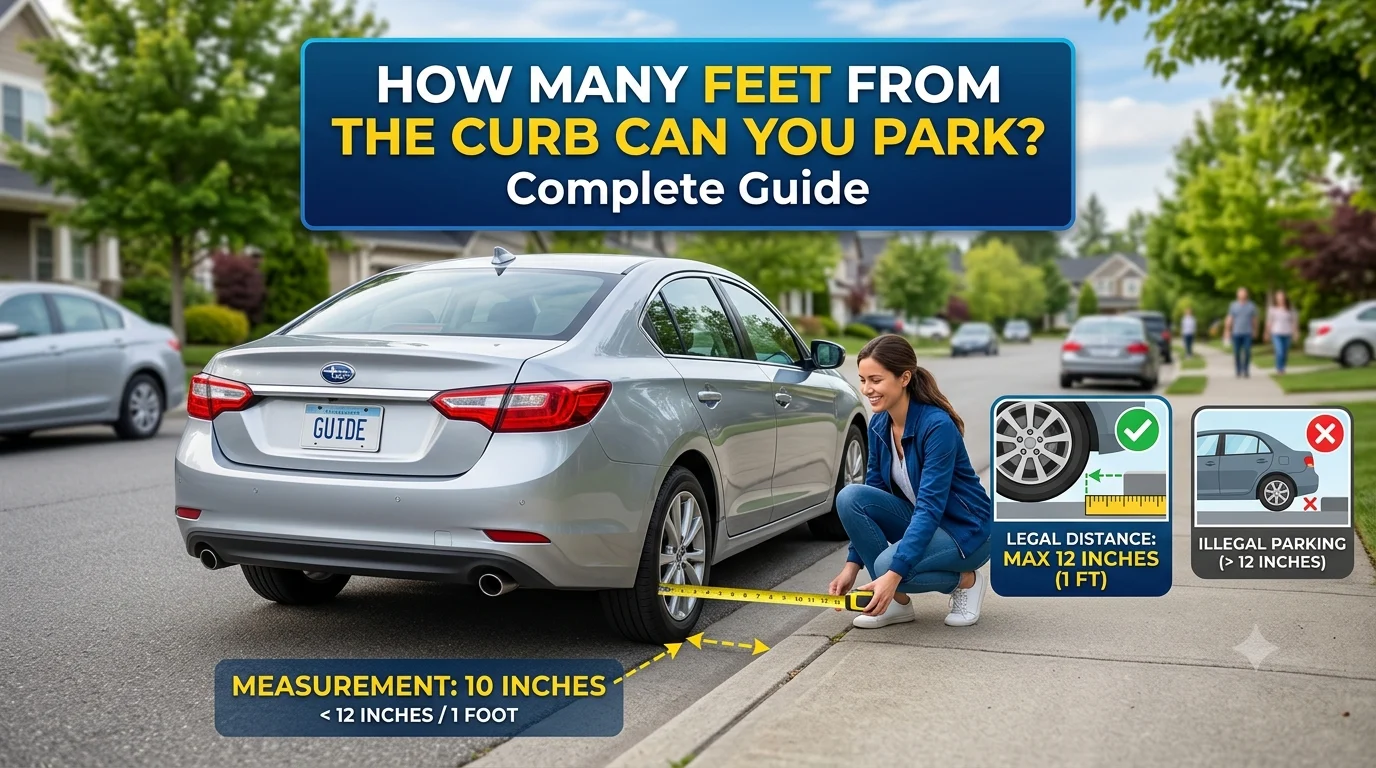
In most real-world situations, the answer is straightforward: you should park very close to the curb, usually within 6 to 12 inches (about 0.5 to 1 foot). Parking too far away is considered unsafe because it can block traffic, while parking too close can damage your vehicle or curb.
However, the exact rule can vary slightly depending on your location, road type, and local traffic laws. In this guide, you’ll learn everything in simple terms—legal distances, safety rules, real-world examples, and step-by-step parking guidance.
What Does Parking From the Curb Mean?
Parking from the curb simply refers to the distance between your vehicle and the edge of the road (the curb) when you stop and leave your car.
The curb acts as a boundary between the road and pedestrian area. Proper positioning is important because it affects:
- Road safety
- Traffic movement
- Space for other vehicles
- Your ability to exit safely
When people talk about curb parking, they usually mean parallel parking along a street where cars line up beside the curb.
Why curb distance matters
The distance between your car and the curb is not just about appearance. It directly affects:
- Whether traffic can pass freely
- Risk of accidents at night
- Legal compliance with traffic rules
- Safety of pedestrians and cyclists
Even a difference of a few feet can turn legal parking into a violation in busy streets.
How Many Feet From the Curb Can You Park Legally?
In most countries, especially the United States and regions with similar traffic systems, the standard rule is:
👉 You should park within 6 inches to 12 inches (0.5 to 1 foot) from the curb.
This is considered the safe and legal parking distance in most driving manuals.
General rule followed in most areas
Most driving authorities expect:
- The vehicle must be parallel to the curb
- Distance must be as close as safely possible
- Tires should not touch the curb, but should not drift far away either
If your car is more than 1–2 feet away from the curb, it is often considered improper parking.
Why there is no single universal rule
The exact distance varies because:
- Cities have different road widths
- Traffic congestion levels differ
- Local enforcement strictness varies
- Some areas allow slightly more flexibility in residential zones
So while 1 foot is the most widely accepted standard, local laws always take priority.
Standard Parking Distance From the Curb
To understand it better, let’s break down practical parking distances:
| Parking Situation | Distance from Curb | Meaning |
|---|---|---|
| Ideal parking | 6–12 inches | Safe and correct |
| Acceptable range | Up to 1 foot | Still legal in most areas |
| Warning zone | 1–2 feet | May cause ticket |
| Unsafe parking | Over 2 feet | Often illegal |
What driving tests expect
If you are learning to drive, examiners usually check:
- Smooth parallel parking technique
- Proper alignment with the curb
- Distance within about 12 inches
Even if your parking is perfect in angle, being too far from the curb can reduce your score or lead to failure.
Parking Too Far or Too Close to the Curb
Understanding both extremes is important because mistakes can go either way.
Parking too far from the curb
If your car is too far away:
- It can block part of the road
- Other vehicles may struggle to pass
- It increases accident risk at night
- You may receive a parking ticket
In busy urban areas, even small distance errors can be fined.
Parking too close to the curb
If you park too close:
- Your tires may rub the curb
- Wheels or rims can get damaged
- It becomes difficult to pull out smoothly
- It may affect alignment over time
The goal is balance—close enough for safety, but not touching or scraping.
Parking Distance Rules in Different Situations
Parking rules change slightly depending on where you are.
Residential streets
In neighborhoods:
- Enforcement is usually relaxed
- Still expected within 1 foot of curb
- Safety is more important than strict measurement
Busy city streets
In cities:
- Rules are strictly enforced
- Even small errors can lead to fines
- Proper alignment is essential
Sloped roads or hills
Extra caution is required:
- Wheels must be turned toward curb or road depending on slope
- Distance still should remain close
- Vehicle should not roll into traffic
Other Important Parking Distance Laws
Curb distance is just one part of parking rules. Drivers must also follow other spacing laws.
Distance from fire hydrants
You must park at least:
- 10 to 15 feet away in most regions
Blocking a hydrant can lead to heavy fines and safety hazards during emergencies.
Distance from intersections
Cars must stay:
- 20 to 30 feet away from intersections
This ensures clear visibility for turning vehicles.
Distance from driveways
You should never block:
- Private driveways
- Entry or exit paths
Even partial blocking can lead to complaints or towing.
How to Park Correctly Near the Curb (Step-by-Step)
Here is a simple method for beginners learning parallel parking.
Step 1: Signal and slow down
Always indicate before pulling over so other drivers know your intention.
Step 2: Position your car
Stop your car parallel to the vehicle in front of the empty space.
Step 3: Start reversing slowly
Turn your steering wheel and begin reversing at a slight angle.
Step 4: Straighten the wheel
Once your car enters the space, straighten your steering wheel.
Step 5: Adjust alignment
Move forward or backward until your car is properly centered.
Step 6: Check curb distance
Ensure your car is:
- Within 6–12 inches of the curb
- Not touching the curb
- Fully inside the parking space
Expert Tips for Perfect Curb Parking
Use your mirrors
Side mirrors help you:
- Judge distance from curb
- Check alignment with other cars
- Avoid hitting obstacles
Use reference points
Experienced drivers use parts of the car such as:
- Side mirror alignment
- Door handles
- Dashboard positioning
These help develop consistency in parking.
Go slow, not fast
Speed is the biggest enemy of accurate parking. Slow movements give you control.
Common Parking Mistakes to Avoid
Many beginners make the same errors:
- Parking more than 2 feet from curb
- Rushing the parking process
- Not checking mirrors properly
- Ignoring alignment with other cars
- Turning steering too early or too late
- Forgetting to adjust final position
Even experienced drivers sometimes make these mistakes when in a hurry.
Penalties for Incorrect Curb Parking
Improper parking can lead to:
- Parking tickets or fines
- Vehicle towing in strict zones
- Failure in driving tests
- Safety violations in crowded streets
The severity depends on location and how badly the rule is violated.
Quick Comparison of Parking Distances
| Situation | Safe Distance |
|---|---|
| Proper curb parking | 6–12 inches |
| Maximum acceptable | 1 foot |
| Risk zone | 1–2 feet |
| Illegal range | Over 2 feet |
This simple guide helps you quickly judge whether your parking is correct.
Final Practical Advice
When learning how many feet from the curb can you park, remember that precision is important, but safety matters more.
The golden rule is simple:
- Stay within 6 to 12 inches of the curb
- Keep your vehicle parallel and aligned
- Avoid blocking traffic or pedestrians
With regular practice, curb parking becomes easy and automatic. It is not about guessing—it is about developing control, awareness, and consistency.
Good parking habits not only help you pass driving tests but also make roads safer for everyone.