
Have you ever needed to convert 100 mm into feet while working on a construction project, measuring furniture, or reading engineering drawings? Understanding metric-to-imperial conversions can save time and prevent costly mistakes.
The short answer is simple:
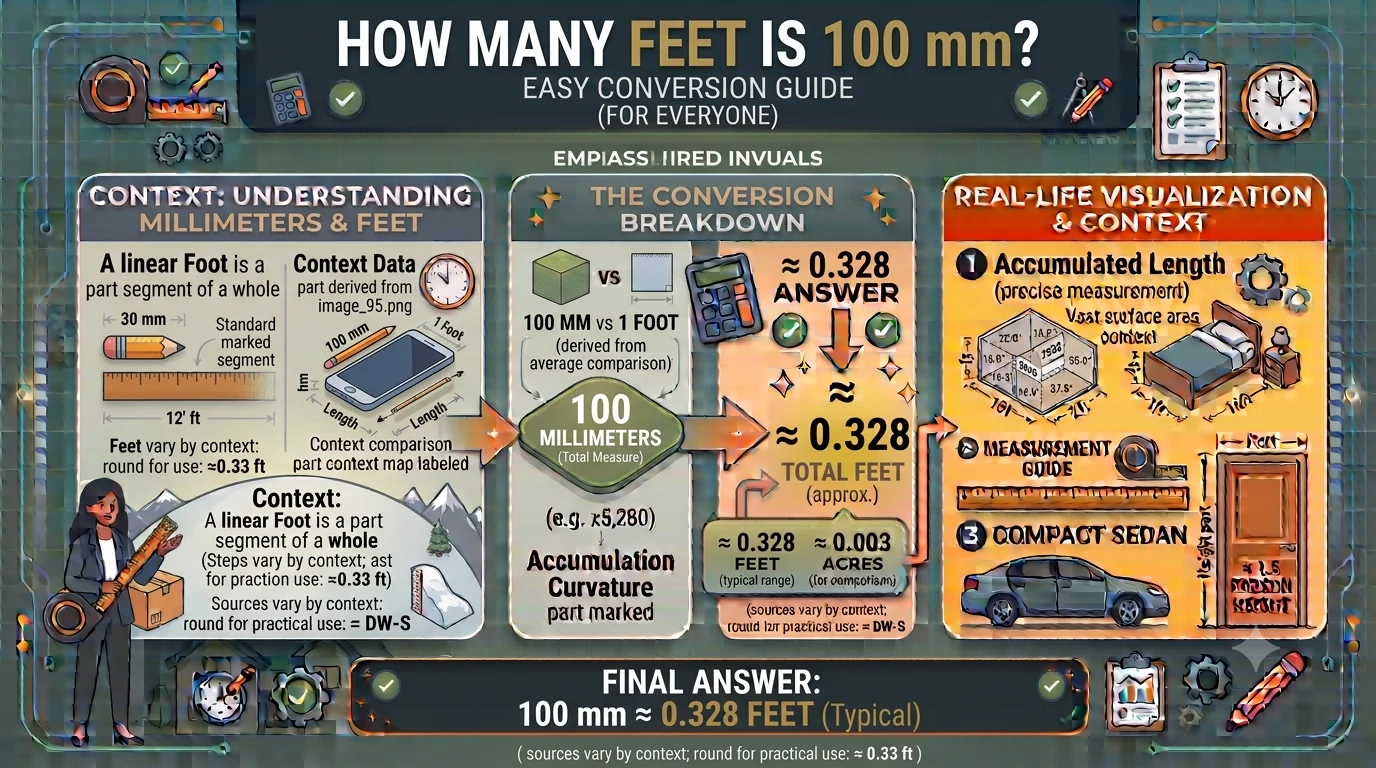
100 mm = 0.328084 feet (approximately 0.33 feet).
In this guide, you’ll learn exactly how to convert 100 millimeters to feet, understand the conversion formula, explore practical examples, and discover where this measurement is commonly used.
100 mm to Feet Conversion
Here’s the exact conversion:
| Millimeters (mm) | Feet (ft) |
|---|---|
| 100 mm | 0.328084 ft |
| Rounded | 0.33 ft |
Answer: 100 mm = 0.328084 feet, or approximately 0.33 feet.
Understanding Millimeters and Feet
Before converting measurements, it’s helpful to understand these two units.
What Is a Millimeter?
A millimeter (mm) is a metric unit of length.
- 1 centimeter = 10 millimeters
- 100 centimeters = 1 meter
- 1 meter = 1,000 millimeters
Millimeters are commonly used for:
- Engineering
- Manufacturing
- Construction plans
- Mechanical parts
- Interior design
What Is a Foot?
A foot (ft) is an imperial unit of length.
One foot equals:
- 12 inches
- 0.3048 meters
- 304.8 millimeters
Feet are commonly used in:
- Home construction
- Architecture
- Real estate
- Landscaping
- Everyday measurements in the United States
How Many Feet Is 100 mm?
To convert millimeters into feet, use this formula:
Feet = Millimeters ÷ 304.8
Now substitute 100 mm:
100 ÷ 304.8 = 0.328084 feet
Therefore,
100 mm = 0.328084 ft
Rounded to two decimal places:
100 mm ≈ 0.33 feet
Quick Conversion Chart
| Millimeters | Feet |
|---|---|
| 10 mm | 0.0328 ft |
| 25 mm | 0.0820 ft |
| 50 mm | 0.1640 ft |
| 75 mm | 0.2461 ft |
| 100 mm | 0.3281 ft |
| 150 mm | 0.4921 ft |
| 200 mm | 0.6562 ft |
| 250 mm | 0.8202 ft |
| 300 mm | 0.9843 ft |
| 500 mm | 1.6404 ft |
| 1000 mm | 3.2808 ft |
How to Convert Millimeters to Feet Step by Step
Converting mm to feet is straightforward.
Step 1: Write the Measurement
Example:
100 mm
Step 2: Divide by 304.8
100 ÷ 304.8 = 0.328084
Step 3: Round If Needed
Depending on your project:
- Exact: 0.328084 ft
- Two decimals: 0.33 ft
- Three decimals: 0.328 ft
Why Convert 100 mm to Feet?
Many industries use both metric and imperial systems.
Common situations include:
- Buying imported furniture
- Reading international blueprints
- Construction projects
- Home renovations
- Woodworking
- Engineering calculations
Knowing the conversion helps avoid mistakes.
Real-Life Examples
Example 1: Pipe Length
A plumbing specification lists a pipe diameter of 100 mm.
Converted:
100 mm = 0.328 feet
Example 2: Furniture Design
A table component measures 100 mm.
Equivalent:
0.328 feet
Example 3: Construction Drawing
An imported blueprint shows a 100 mm spacing.
In feet:
0.328 ft
Example 4: Mechanical Engineering
A machine part measures 100 mm.
Converted length:
0.328084 feet
Millimeters to Feet Conversion Formula
The standard formula is:
Feet = Millimeters ÷ 304.8
Alternatively:
Feet = Millimeters × 0.00328084
Example:
100 × 0.00328084
= 0.328084 feet
Both formulas give the same result.
Conversion Table for Common Millimeter Values
| Millimeters | Feet |
|---|---|
| 1 mm | 0.003281 ft |
| 5 mm | 0.016404 ft |
| 20 mm | 0.065617 ft |
| 40 mm | 0.131234 ft |
| 60 mm | 0.196850 ft |
| 80 mm | 0.262467 ft |
| 90 mm | 0.295276 ft |
| 100 mm | 0.328084 ft |
| 120 mm | 0.393701 ft |
| 150 mm | 0.492126 ft |
| 180 mm | 0.590551 ft |
| 250 mm | 0.820210 ft |
Millimeters vs Feet
| Feature | Millimeter | Foot |
|---|---|---|
| Measurement System | Metric | Imperial |
| Symbol | mm | ft |
| Common Use | Engineering | Construction |
| 1 Foot Equals | 304.8 mm | 12 inches |
| Precision | Very High | Moderate |
Practical Uses of 100 mm
A measurement of 100 mm appears in many industries.
Examples include:
- Pipe diameters
- Tile thickness references
- Concrete spacing
- Cabinet hardware
- Machine components
- Electrical conduit sizing
- Window frame dimensions
- Furniture manufacturing
Tips for Fast Conversion
If you frequently convert millimeters into feet:
- Remember that 1 foot = 304.8 mm.
- Divide mm by 304.8.
- For quick estimates, 100 mm is roughly one-third of a foot.
- Use exact values for engineering work.
- Round only when precision is not critical.
Common Mistakes to Avoid
Mixing Inches and Feet
Some people confuse inches with feet.
Remember:
100 mm is 3.94 inches, not 3.94 feet.
Rounding Too Early
Keep the full decimal until your final answer.
Using the Wrong Formula
Always divide millimeters by 304.8, not by 12.
Forgetting Unit Labels
Always write:
- mm
- ft
This prevents confusion.
Metric to Imperial Comparison
| Metric | Imperial |
|---|---|
| 10 mm | 0.0328 ft |
| 50 mm | 0.1640 ft |
| 100 mm | 0.3281 ft |
| 250 mm | 0.8202 ft |
| 500 mm | 1.6404 ft |
| 1000 mm | 3.2808 ft |
When Precision Matters
For everyday measurements, rounding to 0.33 feet is usually sufficient.
However, use the exact value (0.328084 feet) for:
- Engineering
- CNC machining
- Surveying
- Manufacturing
- Scientific calculations
Accurate conversions help ensure proper fitting and compliance with design specifications.
Frequently Asked Questions
How many feet is 100 mm exactly?
100 mm equals 0.328084 feet.
Is 100 mm equal to one-third of a foot?
Approximately. One-third of a foot is 0.3333 feet, while 100 mm equals 0.3281 feet.
How many inches is 100 mm?
100 mm equals 3.937 inches.
What formula converts millimeters to feet?
Use:
Feet = Millimeters ÷ 304.8
Can I round 100 mm to 0.33 feet?
Yes. For most everyday projects, 0.33 feet is an acceptable rounded value.
Conclusion
If you’re wondering how many feet is 100 mm, the answer is straightforward:
100 mm = 0.328084 feet, or approximately 0.33 feet.
Whether you’re working on construction, engineering, manufacturing, woodworking, or DIY projects, knowing this conversion makes it easier to switch between metric and imperial measurements. Simply divide the number of millimeters by 304.8, or multiply by 0.00328084, to convert any millimeter measurement into feet accurately. This simple calculation helps ensure precise measurements and successful projects every time.