
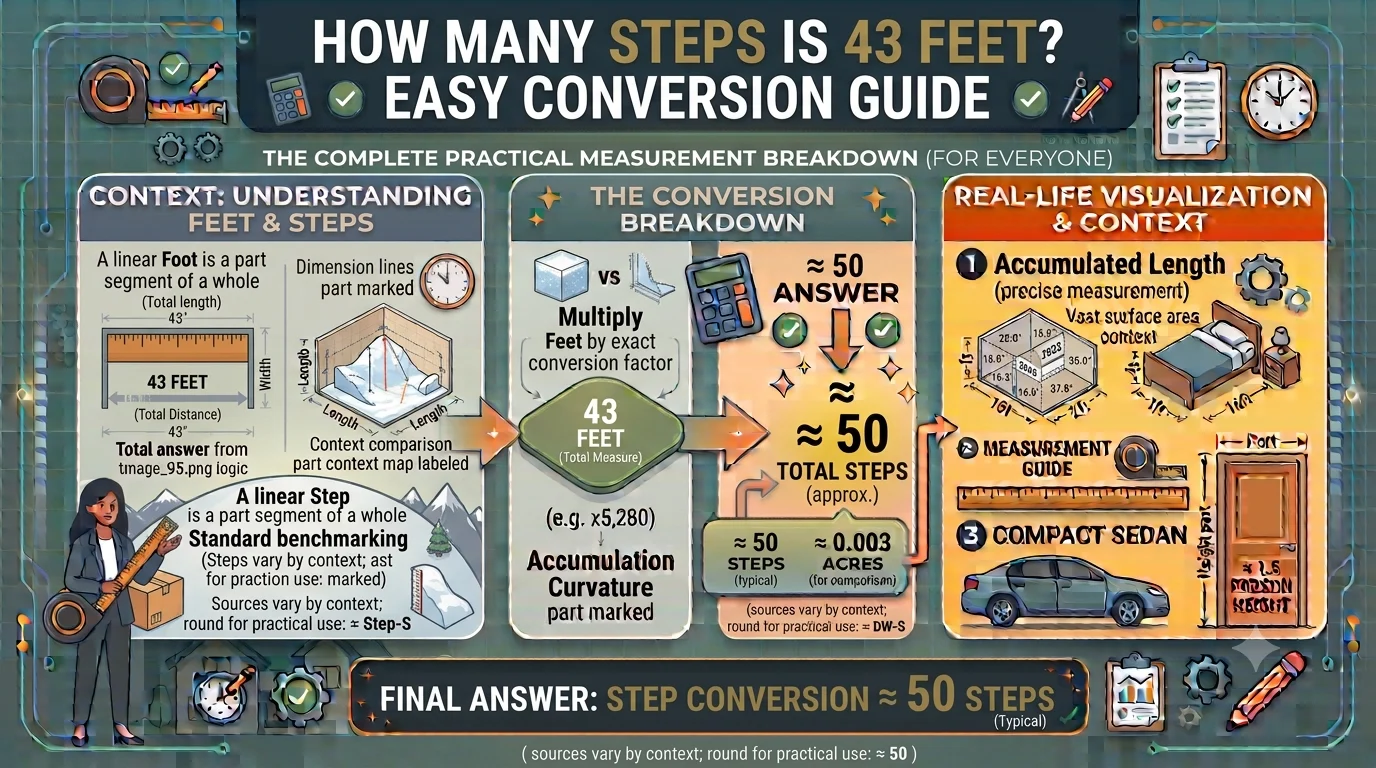
If you’re wondering how many steps is 43 feet, the answer depends on the average length of your stride. For most adults, 43 feet equals about 17 steps when walking at a normal pace. However, the exact number varies based on your height, walking style, and stride length.
Whether you’re measuring walking distances, planning a workout, estimating room dimensions, or completing a construction project, understanding how to convert feet into steps can be surprisingly useful. This guide explains the calculation, provides conversion charts, and helps you estimate your own step count more accurately.
How Many Steps Is 43 Feet?
For the average adult:
| Stride Length | Steps in 43 Feet |
|---|---|
| 2.0 feet | 22 steps |
| 2.2 feet | 20 steps |
| 2.5 feet (average adult) | 17 steps |
| 2.7 feet | 16 steps |
| 3.0 feet | 14 steps |
Answer: 43 feet is approximately 17 steps for an adult with an average stride length of 2.5 feet.
Quick Answer
- 43 feet = approximately 17 steps
- Based on an average walking stride of 2.5 feet per step
- Actual step count may range from 14 to 22 steps
Understanding Feet and Steps
A foot is a standard unit of length in the U.S. customary measurement system. One foot equals 12 inches.
A step is the distance covered between placing one foot on the ground and then the other while walking. Since everyone’s stride is different, steps are not a fixed unit of measurement.
Several factors affect stride length:
- Height
- Leg length
- Walking speed
- Age
- Fitness level
- Terrain
- Footwear
Because of these variables, two people walking the same 43-foot distance may take different numbers of steps.
Formula to Convert Feet to Steps
The basic formula is:
Steps = Distance in Feet ÷ Stride Length
For an average adult:
- Distance = 43 feet
- Average stride length = 2.5 feet
Calculation:
43 ÷ 2.5 = 17.2
Rounded to the nearest whole number:
43 feet ≈ 17 steps
Average Stride Length by Person
| Person | Average Stride Length |
|---|---|
| Young child | 1.5–2.0 feet |
| Teenager | 2.1–2.4 feet |
| Average adult woman | 2.2 feet |
| Average adult man | 2.5 feet |
| Tall adult | 2.7–3.0 feet |
Knowing your own stride gives the most accurate conversion.
Examples of 43 Feet in Everyday Life
Forty-three feet may seem difficult to visualize, but it appears in many daily situations.
Examples include:
- Around the length of a standard city bus’s front half
- About the width of a medium-sized backyard
- A short sprint during sports practice
- Walking across a large classroom
- Crossing a residential driveway and sidewalk
If you walk this distance at a comfortable pace, you’ll typically take around 17 steps.
How to Measure Your Own Stride Length
If you want a more accurate answer than the average estimate, measure your own stride.
Method 1: Measure 20 Feet
- Measure a straight 20-foot distance.
- Walk naturally.
- Count your steps.
- Divide 20 by the number of steps.
Example:
- Distance: 20 feet
- Steps: 8
Stride length:
20 ÷ 8 = 2.5 feet per step
Method 2: Walk 100 Steps
Walk naturally for exactly 100 steps.
Measure the total distance traveled.
Divide the total distance by 100.
This provides your personal stride length.
Why Stride Length Changes
Your stride is rarely identical every time you walk.
Factors include:
Walking Speed
Fast walking increases stride length.
Running
Running creates much longer strides.
Uphill Walking
People naturally shorten their steps.
Fatigue
Tired muscles often reduce stride length.
Carrying Weight
Backpacks or heavy loads may shorten your stride.
Walking vs Running Steps
For the same 43-foot distance:
| Movement | Approximate Steps |
|---|---|
| Slow walk | 19–21 |
| Normal walk | 17 |
| Fast walk | 16 |
| Jogging | 14–15 |
| Running | 13–14 |
Running covers more distance with each step.
Feet to Steps Conversion Chart
| Feet | Approximate Steps |
|---|---|
| 10 | 4 |
| 20 | 8 |
| 30 | 12 |
| 40 | 16 |
| 43 | 17 |
| 50 | 20 |
| 60 | 24 |
| 75 | 30 |
| 100 | 40 |
| 200 | 80 |
These values assume an average stride length of 2.5 feet.
Why Convert Feet Into Steps?
Many people use this conversion for practical reasons.
Fitness Tracking
Estimate walking distance without a GPS device.
Indoor Walking
Measure exercise routes inside buildings.
Construction
Estimate movement across job sites.
Sports Training
Set drill distances quickly.
Property Measurement
Visualize distances while inspecting land or buildings.
How Fitness Trackers Estimate Steps
Fitness trackers do not directly measure distance.
Instead, they use:
- Motion sensors
- Accelerometers
- Personal height
- Estimated stride length
- GPS (on some devices)
The more accurately your profile is set up, the better your distance estimates.
Step Count and Calories
Walking 17 steps burns very few calories by itself.
Estimated calories:
| Body Weight | Calories Burned |
|---|---|
| 125 lb | 0.7 |
| 155 lb | 0.9 |
| 185 lb | 1.1 |
The exact value depends on walking speed and terrain.
Comparing 43 Feet to Other Distances
| Distance | Approximate Steps |
|---|---|
| 15 feet | 6 |
| 25 feet | 10 |
| 35 feet | 14 |
| 43 feet | 17 |
| 60 feet | 24 |
| 80 feet | 32 |
| 100 feet | 40 |
Metric Conversion
Some readers may prefer metric units.
- 43 feet = 13.11 meters
- 13.11 meters ≈ 17 steps
The same stride calculation applies regardless of the measurement system.
Practical Examples
Example 1
You measure a hallway that’s 43 feet long.
Walking from one end to the other usually takes about 17 steps.
Example 2
A trainer sets a sprint marker 43 feet away.
Athletes with longer strides may reach it in only 14 or 15 steps.
Example 3
You’re estimating the length of a room without a tape measure.
Knowing your stride length lets you estimate close to 43 feet simply by counting your steps.
Common Mistakes
Avoid these errors when estimating steps.
Assuming Everyone Has the Same Stride
Stride length varies widely.
Ignoring Walking Speed
Fast walking produces longer steps.
Confusing Step and Stride
One step is a single foot movement.
A stride usually represents two steps.
Using Running Strides
Running estimates should not be used for walking conversions.
Expert Tips
- Measure your own stride for the best accuracy.
- Walk naturally when counting steps.
- Use the same walking speed each time.
- Update your fitness tracker with your actual height.
- Repeat measurements several times and average the results.
Feet to Steps Reference Table
| Distance (Feet) | Average Steps |
|---|---|
| 5 | 2 |
| 10 | 4 |
| 15 | 6 |
| 20 | 8 |
| 25 | 10 |
| 30 | 12 |
| 35 | 14 |
| 40 | 16 |
| 43 | 17 |
| 45 | 18 |
| 50 | 20 |
| 75 | 30 |
| 100 | 40 |
Frequently Asked Questions
How many steps is 43 feet exactly?
For an average adult, 43 feet is about 17 steps. Your personal stride length may result in slightly more or fewer steps.
Is 43 feet equal to 20 steps?
Not usually. Twenty steps would indicate a shorter stride of about 2.15 feet per step.
How many meters is 43 feet?
Forty-three feet equals approximately 13.11 meters.
Does height affect the number of steps?
Yes. Taller people generally have longer strides and therefore take fewer steps over the same distance.
Can a smartwatch calculate this automatically?
Yes. Most modern fitness trackers estimate steps using motion sensors and your stored stride length or height.
Conclusion
If you’re asking how many steps is 43 feet, the best general estimate is 17 steps using the average adult stride length of 2.5 feet per step. While individual results vary based on height, walking speed, and stride, this estimate works well for most everyday situations. For the most accurate conversion, measure your own stride length and divide the distance in feet by that value. Whether you’re tracking fitness, planning a walking route, or estimating distances, understanding the relationship between feet and steps makes measurements more practical and easier to visualize.