
If you are planning a painting project, one of the most important things you need to know is: how many feet will a gallon of paint cover? This simple question can save you from wasting money, buying too much paint, or running out in the middle of your project.
On average, one gallon of paint covers around 350 to 400 square feet with one coat on a smooth, properly prepared surface. However, this number is not fixed. It changes depending on surface type, paint quality, number of coats, and how the paint is applied.
In this detailed guide, you will learn everything about paint coverage, how to calculate it correctly, real examples, mistakes to avoid, and expert tips to get the most out of every gallon.
Understanding Paint Coverage
Paint coverage refers to the total area a specific amount of paint can cover. It is usually measured in square feet per gallon.
Manufacturers print coverage estimates on paint cans, but those numbers assume ideal conditions:
- Smooth walls
- Proper primer
- Good quality roller or spray
- One thin coat
In real-world projects, conditions are rarely perfect, which is why actual coverage can be lower.
Average Coverage of One Gallon of Paint
Here is a simple breakdown:
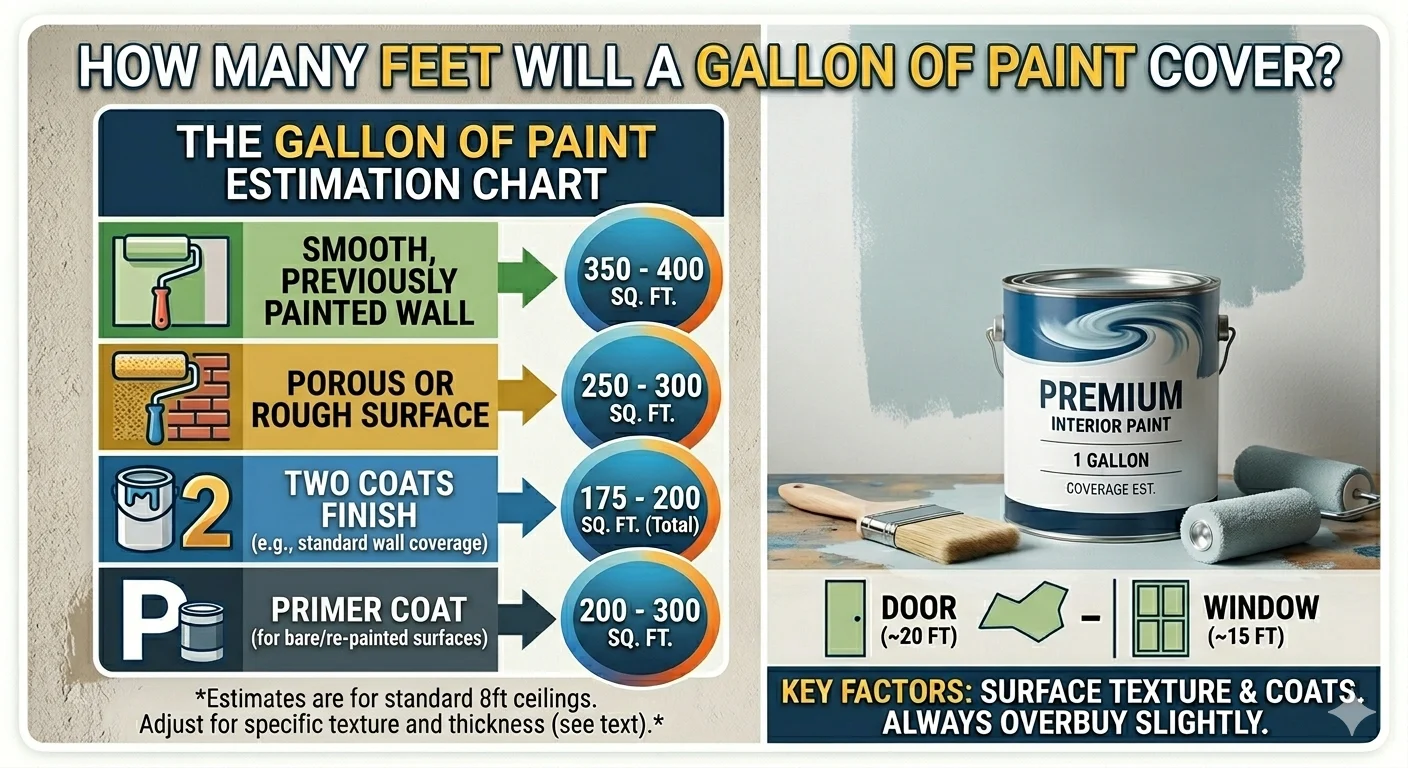
- Interior walls: 350–400 sq ft
- Exterior walls: 250–350 sq ft
- Textured surfaces: 150–300 sq ft
- Primer: 200–300 sq ft
So when someone asks how many feet will a gallon of paint cover, the most accurate answer is: it depends on the surface, but usually around 350–400 square feet.
Factors That Affect Paint Coverage
Several real-world factors directly impact how far one gallon of paint will go.
Surface Texture
The smoother the surface, the better the coverage.
- Smooth drywall → maximum coverage
- Light texture → medium coverage
- Brick, stucco, rough plaster → lower coverage
Rough surfaces absorb more paint, which increases consumption.
Paint Quality
Not all paint is created equal.
High-quality paint:
- Has more pigment
- Covers better in fewer coats
- Spreads more evenly
Low-quality paint:
- Requires more coats
- Looks patchy
- Uses more gallons overall
Investing in better paint often reduces total cost in the long run.
Number of Coats
One of the biggest mistakes beginners make is ignoring coats.
If:
- 1 gallon = 400 sq ft (one coat)
Then:
- 2 coats = 200 sq ft per gallon
Most interior walls need at least 2 coats for a clean finish.
Application Method
How you apply paint matters a lot:
- Roller → most efficient
- Brush → moderate waste
- Spray → higher waste due to overspray
Professional painters often use rollers for walls because they reduce paint loss.
Wall Condition
Damaged or porous walls soak up paint quickly.
Examples include:
- Unprimed drywall
- Water-damaged walls
- Cracked plaster
Proper preparation reduces paint absorption and improves coverage.
Standard Paint Coverage Table
Here is a quick reference for planning:
| Surface Type | Coverage per Gallon |
|---|---|
| Smooth interior walls | 350–400 sq ft |
| Light textured walls | 300–350 sq ft |
| Heavy textured walls | 150–250 sq ft |
| Exterior siding | 250–350 sq ft |
| Brick or concrete | 150–250 sq ft |
| Primer coat | 200–300 sq ft |
This table helps you estimate how many gallons you need before starting your project.
How to Calculate Paint Needed
To calculate paint requirements, you must first measure your walls.
Step 1: Measure Each Wall
Multiply height × width.
Example:
- Wall height = 8 ft
- Wall width = 12 ft
So one wall = 96 square feet.
Repeat for all walls and add totals.
Step 2: Find Total Area
Suppose your room has 4 walls:
- Wall 1 = 96 sq ft
- Wall 2 = 96 sq ft
- Wall 3 = 120 sq ft
- Wall 4 = 120 sq ft
Total = 432 sq ft
Step 3: Divide by Coverage
If 1 gallon covers 400 sq ft:
So you need approximately:
- 2 gallons (for safety and full coverage)
Paint Coverage by Room Size
Understanding real room examples helps beginners estimate better.
Small Bedroom
- Size: 10 × 10 ft
- Total wall area: ~320 sq ft
Paint needed:
- 1 gallon (one coat)
- 2 gallons (two coats)
Medium Living Room
- Size: 12 × 18 ft
- Total wall area: ~500–600 sq ft
Paint needed:
- 2 gallons (one coat)
- 4 gallons (two coats)
Large Garage
- Size: double car garage
- Wall area: ~900–1,200 sq ft
Paint needed:
- 3 gallons (one coat)
- 6 gallons (two coats)
Interior vs Exterior Paint Coverage
Interior and exterior paints behave differently.
Interior Paint
- Smooth application
- Higher coverage efficiency
- Less exposed to weather
Typical coverage: 350–400 sq ft per gallon
Exterior Paint
- Designed for durability
- Thicker formula
- Rough surfaces
Typical coverage: 250–350 sq ft per gallon
Weather conditions like heat, moisture, and dust also reduce efficiency.
Common Mistakes That Waste Paint
Many people waste paint without realizing it.
Skipping Primer
Primer is extremely important.
Without primer:
- Paint absorbs into wall
- You need more coats
- Color looks uneven
Using Cheap Tools
Low-quality rollers:
- Waste paint
- Leave streaks
- Require extra coats
Applying Thick Layers
Thick paint layers:
- Take longer to dry
- Cause drips
- Use more paint
Thin, even coats always perform better.
Expert Tips to Maximize Coverage
Here are professional tips to make one gallon last longer:
Prepare the Surface
Before painting:
- Clean walls
- Remove dust
- Fix cracks
- Sand rough spots
Smooth walls absorb less paint.
Use Quality Paint
Good paint costs more but:
- Covers better
- Needs fewer coats
- Lasts longer
Use Proper Rolling Technique
- Use “W” motion
- Do not overload roller
- Spread evenly
This prevents waste and improves finish.
Real-World Paint Usage Examples
Here are practical scenarios:
Example 1: One Bedroom Wall Refresh
- Area: 300 sq ft
- Paint needed: 1 gallon
Example 2: Full Living Room Repaint
- Area: 800 sq ft
- Paint needed: 2–3 gallons
Example 3: Exterior Wall Renovation
- Area: 1,000 sq ft
- Paint needed: 3–5 gallons
These estimates help avoid underbuying or overbuying paint.
Benefits of Understanding Paint Coverage
Knowing how many feet a gallon of paint will cover gives you:
- Better budget control
- Accurate paint purchasing
- Less waste
- Faster project completion
- Professional-quality results
Even small planning mistakes can increase cost significantly.
Frequently Asked Questions
How many square feet does one gallon of paint cover?
Usually 350 to 400 square feet on smooth interior walls.
Does primer affect paint coverage?
Yes, primer reduces absorption and improves coverage efficiency.
Why does textured wall use more paint?
Because rough surfaces absorb more paint into their gaps and pores.
How much paint do I need for two coats?
Double your estimate. Two coats reduce coverage by half per gallon.
Is exterior paint coverage lower than interior paint?
Yes, because exterior surfaces are rougher and more exposed to weather.
Conclusion
So, how many feet will a gallon of paint cover?
The simple answer is that one gallon of paint typically covers 350 to 400 square feet per coat, but real coverage depends on surface texture, paint quality, preparation, and application method.
If you plan carefully, measure accurately, and use proper techniques, you can maximize every gallon and complete your project efficiently without waste.
Understanding paint coverage is not just about numbers—it is about saving money, improving results, and making your painting project smooth and stress-free.