
When planning a flooring project, buying lumber, installing countertops, or measuring materials for construction, many people ask the same question: how many square feet is in a linear foot?
The answer depends on one important factor: width.
A linear foot measures only length, while a square foot measures area. Because area requires both length and width, there is no direct conversion between linear feet and square feet unless you know the width of the material.
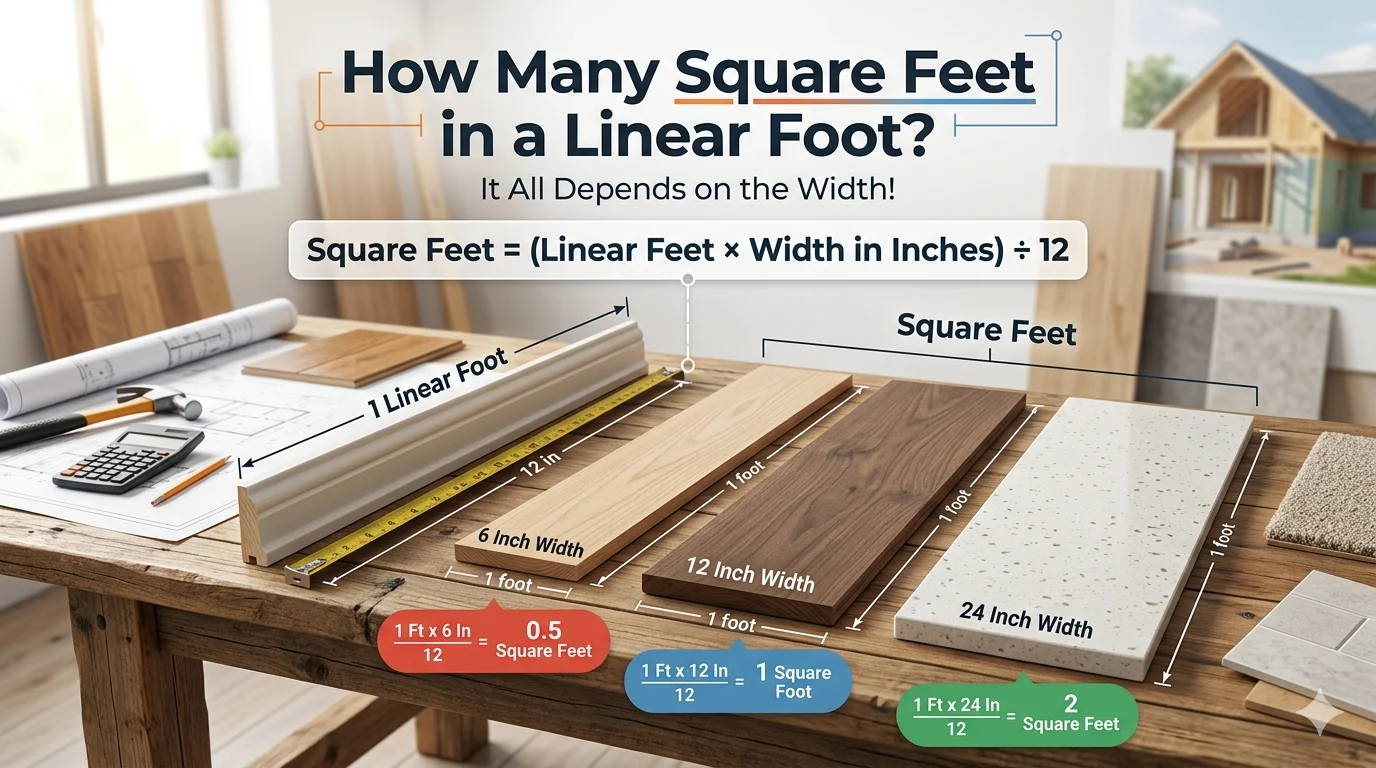
For example, one linear foot of material that is 12 inches wide equals one square foot. However, if the material is 6 inches wide, then one linear foot equals only half a square foot.
Understanding this difference helps homeowners, contractors, and DIY enthusiasts avoid expensive mistakes when buying materials. In this guide, you will learn exactly how to convert linear feet into square feet using easy formulas, examples, charts, and practical applications.
What Is a Linear Foot?
A linear foot is simply a measurement of length equal to 12 inches. It measures distance in a straight line and does not include width or height.
People commonly use linear feet when measuring:
- Lumber
- Fencing
- Pipes
- Countertops
- Fabric
- Baseboards
- Wiring
- Shelving
For instance:
- A board that is 10 feet long equals 10 linear feet
- A fence measuring 25 feet long equals 25 linear feet
Only the length matters in a linear foot measurement.
What Is a Square Foot?
A square foot measures area rather than length. It represents a square that is 12 inches long and 12 inches wide.
Square footage is used to measure surface coverage, including:
- Flooring
- Rooms
- Walls
- Roofing
- Tile installation
- Carpet coverage
- Paint estimation
For example, a room measuring 10 feet by 12 feet has:
120 square feet of area.
Unlike linear feet, square feet always require both length and width.
Linear Foot vs Square Foot
Many people confuse these measurements because both use the word “foot.” However, they measure completely different things.
| Linear Foot | Square Foot |
|---|---|
| Measures length | Measures area |
| One-dimensional | Two-dimensional |
| Uses only length | Uses length and width |
| Common for lumber and fencing | Common for flooring and rooms |
A linear foot tells you how long something is. A square foot tells you how much space something covers.
How Many Square Feet Is in a Linear Foot?
There is no single answer because square footage depends on the width of the material.
Here are simple examples:
- 1 linear foot of 12-inch-wide material = 1 square foot
- 1 linear foot of 6-inch-wide material = 0.5 square feet
- 1 linear foot of 24-inch-wide material = 2 square feet
The wider the material, the greater the square footage coverage.
This is why flooring installers, contractors, and builders always need width measurements before calculating square feet from linear feet.
Formula to Convert Linear Feet to Square Feet
To calculate square footage from linear footage, use this formula:
Square Feet = (Linear Feet × Width in Inches) ÷ 12
This formula works because there are 12 inches in one foot.
Step-by-Step Process
- Measure the linear feet
- Measure the width in inches
- Multiply the two numbers
- Divide the result by 12
The final answer gives you the square footage.
Examples of Linear Feet to Square Feet Conversion
Real examples make the calculation easier to understand.
Example 1: Flooring
Suppose you have flooring material that measures:
- 20 linear feet
- 12 inches wide
Calculation:
(20 × 12) ÷ 12 = 20 square feet
Answer:
20 linear feet of 12-inch-wide flooring equals 20 square feet.
Example 2: Lumber
A board measures:
- 15 linear feet
- 6 inches wide
Calculation:
(15 × 6) ÷ 12 = 7.5 square feet
Answer:
15 linear feet of 6-inch lumber equals 7.5 square feet.
Example 3: Countertops
A countertop measures:
- 8 linear feet
- 25 inches wide
Calculation:
(8 × 25) ÷ 12 = 16.67 square feet
Answer:
The countertop covers approximately 16.67 square feet.
Quick Conversion Chart
This chart helps estimate square footage quickly.
| Linear Feet | Width | Square Feet |
|---|---|---|
| 1 | 12 inches | 1 sq ft |
| 1 | 6 inches | 0.5 sq ft |
| 1 | 24 inches | 2 sq ft |
| 10 | 12 inches | 10 sq ft |
| 10 | 6 inches | 5 sq ft |
| 20 | 18 inches | 30 sq ft |
| 50 | 12 inches | 50 sq ft |
| 100 | 4 inches | 33.3 sq ft |
Practical Uses of Linear Feet and Square Feet
Understanding these measurements is extremely useful in real-life projects.
Flooring Installation
Many flooring products are sold by square foot, but some materials come in rolls or planks measured in linear feet.
Knowing the width helps calculate how much area the flooring covers.
Carpet Measurement
Carpet rolls are often sold by linear foot with a fixed width.
For example:
- Carpet width = 12 feet
- Carpet length = 10 linear feet
Calculation:
12 × 10 = 120 square feet
This means the carpet covers 120 square feet of floor space.
Lumber and Decking
Builders frequently use linear feet when estimating:
- Deck boards
- Fence panels
- Trim
- Molding
- Baseboards
However, the total coverage depends on board width.
Countertops and Cabinets
Countertops are commonly priced per linear foot. Yet installers often calculate square footage to estimate material usage and project costs accurately.
Common Mistakes People Make
Many measurement problems happen because people misunderstand the difference between length and area.
Ignoring Width
This is the most common mistake.
Without width, square footage cannot be calculated accurately.
Mixing Units
Some people accidentally combine:
- Inches
- Feet
- Square inches
- Square feet
Always convert units properly before calculating.
Measuring Incorrectly
Inaccurate measurements can lead to buying too much or too little material.
Always measure carefully and double-check dimensions.
Expert Tips for Accurate Measurements
Professionals follow several best practices when calculating measurements.
Measure Twice
Double-check every measurement before purchasing materials.
Small errors can become expensive later.
Use the Same Units
Keep measurements consistent. Use either feet or inches throughout the calculation process.
Add Extra Material
Most contractors recommend adding:
- 5–10% extra flooring
- Additional lumber for cuts
- Extra carpet for waste
This helps avoid shortages during installation.
Understand Product Sizes
Two materials may have the same linear footage but completely different widths, which changes the square footage significantly.
Always check product specifications before buying.
When Should You Use Linear Feet?
Linear feet work best when measuring length-based materials, including:
- Pipes
- Fencing
- Trim
- Rope
- Wire
- Boards
- Fabric
These materials are often long and narrow, so length matters more than area.
When Should You Use Square Feet?
Square feet are ideal for measuring surface coverage, such as:
- Floors
- Walls
- Roofs
- Rooms
- Tiles
- Paint coverage
- Carpet installation
Whenever area matters, square footage is the correct measurement.
Why Understanding This Conversion Matters
Knowing how many square feet is in a linear foot helps you:
- Estimate project costs accurately
- Reduce material waste
- Buy the correct amount of flooring or lumber
- Prevent expensive mistakes
- Improve planning for renovation projects
Whether you are a homeowner or contractor, understanding these measurements can save time and money.
Frequently Asked Questions
Is one linear foot equal to one square foot?
Only if the material is exactly 12 inches wide.
How do I convert linear feet to square feet?
Use this formula:
Square Feet = (Linear Feet × Width in Inches) ÷ 12
Why can’t linear feet convert directly to square feet?
Because linear feet measure only length, while square feet measure area, which requires width too.
How many square feet is 10 linear feet?
It depends on width.
Examples:
- 12-inch width = 10 sq ft
- 6-inch width = 5 sq ft
- 24-inch width = 20 sq ft
What industries use linear feet?
Construction, flooring, woodworking, plumbing, and home improvement industries commonly use linear feet.
Conclusion
Understanding how many square feet is in a linear foot becomes much easier once you know the difference between length and area.
A linear foot measures only length, while a square foot measures surface coverage. Because of this, there is no universal conversion between the two without knowing the material’s width.
The basic formula is:
Square Feet = (Linear Feet × Width in Inches) ÷ 12
This simple calculation helps homeowners, contractors, and DIY enthusiasts estimate flooring, lumber, countertops, carpet, and other materials accurately.
By understanding linear feet and square feet properly, you can avoid mistakes, reduce waste, save money, and complete projects with greater confidence and precision.