

When planning a roofing project, one of the most common questions homeowners and contractors ask is: how many square feet in a roofing bundle?
Understanding roofing bundle coverage is essential for estimating materials, calculating costs, and avoiding unnecessary waste. Whether you are replacing an old roof, building a new home, or handling a small shed project, knowing how roofing bundles work can save both time and money.
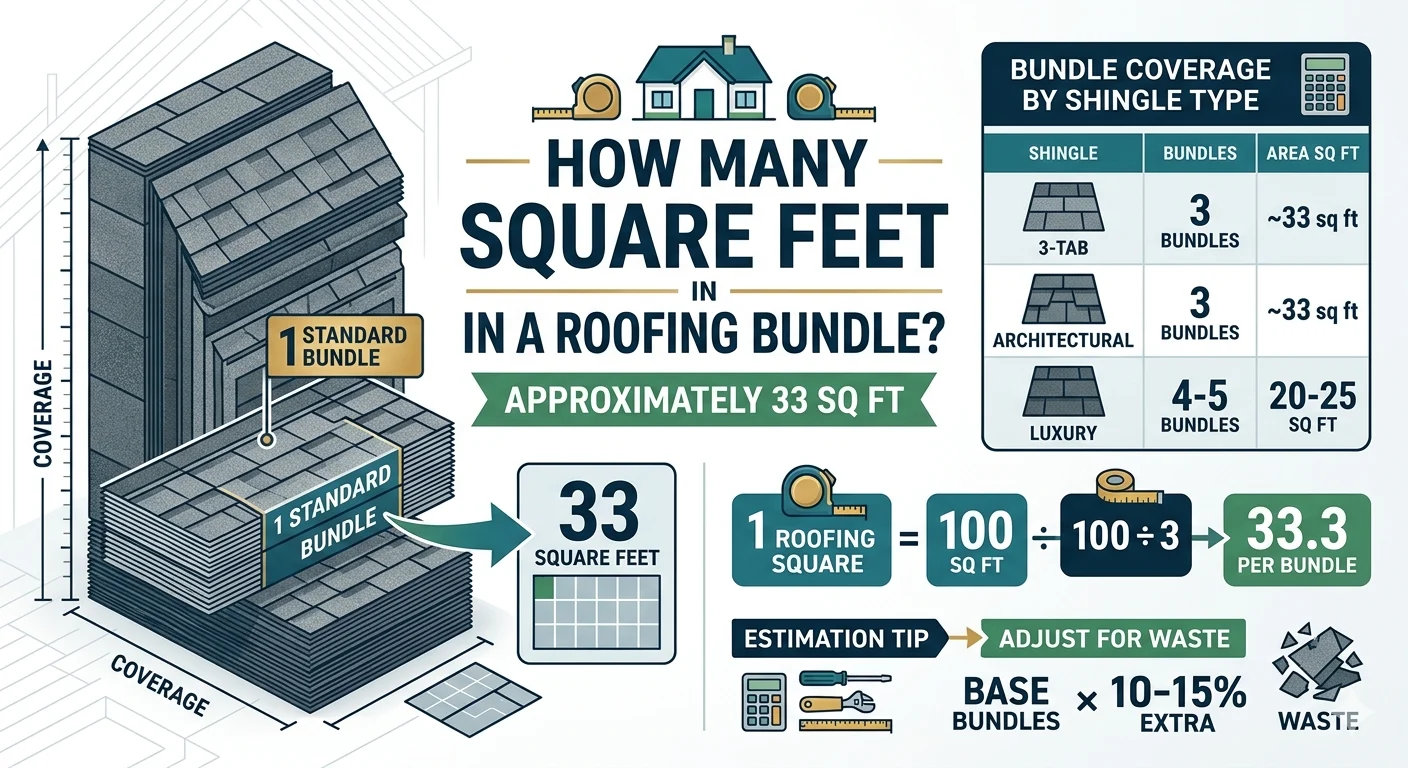
In most cases, a standard roofing bundle covers approximately 33 square feet. However, the exact amount can vary depending on the type of shingles, manufacturer, and roofing material.
This guide explains roofing bundle coverage, how to calculate bundles, the number of bundles per roofing square, and practical examples to help you estimate your roofing project accurately.
What Is a Roofing Bundle?
A roofing bundle is a package of shingles grouped together for easier transportation and installation. Roofing shingles are rarely sold individually. Instead, manufacturers package them into manageable bundles that workers can safely carry onto roofs.
Roofing materials are usually measured in “roofing squares.”
What Is a Roofing Square?
A roofing square is a roofing industry measurement equal to 100 square feet of roof area.
For example:
- 100 square feet = 1 roofing square
- 1,000 square feet = 10 roofing squares
- 2,000 square feet = 20 roofing squares
Roofers use roofing squares because it simplifies large roofing calculations.
How Many Square Feet Does a Roofing Bundle Cover?
A standard roofing bundle typically covers:
- Approximately 33 square feet
This number comes from the fact that most asphalt shingles require three bundles to cover one roofing square.
Since:
- 1 roofing square = 100 square feet
- 3 bundles = 1 roofing square
The calculation becomes:
- 100 ÷ 3 = 33.3 square feet per bundle
Therefore, one roofing bundle usually covers around 33 square feet.
However, the exact coverage depends on the shingle type and manufacturer specifications.
Roofing Bundle Coverage by Shingle Type
Different roofing shingles have different coverage amounts.
| Shingle Type | Bundles Per Square | Coverage Per Bundle |
|---|---|---|
| 3-Tab Shingles | 3 | About 33 sq ft |
| Architectural Shingles | 3 | About 33 sq ft |
| Luxury Shingles | 4–5 | 20–25 sq ft |
| Wood Shingles | Varies | Depends on style |
| Slate Roofing | Varies | Depends on material |
Always check the product packaging before purchasing roofing materials.
How Many Bundles Are in One Roofing Square?
For standard asphalt shingles:
- 3 bundles = 1 roofing square
This is the most common roofing calculation used across residential roofing projects.
However, heavier premium shingles may require:
- 4 bundles per square
- 5 bundles per square
Luxury roofing products are thicker and heavier, which reduces the amount of coverage per bundle.
Roofing Bundle Coverage Chart
The chart below helps estimate how many roofing bundles are needed for different roof sizes.
| Roof Size | Roofing Squares | Bundles Needed |
|---|---|---|
| 100 sq ft | 1 | 3 bundles |
| 200 sq ft | 2 | 6 bundles |
| 500 sq ft | 5 | 15 bundles |
| 1,000 sq ft | 10 | 30 bundles |
| 1,500 sq ft | 15 | 45 bundles |
| 2,000 sq ft | 20 | 60 bundles |
| 2,500 sq ft | 25 | 75 bundles |
| 3,000 sq ft | 30 | 90 bundles |
These estimates are based on standard asphalt shingles.
How to Calculate Roofing Bundles Needed
Calculating roofing bundles is fairly simple when you follow the correct steps.
Step 1: Measure Roof Area
First, determine the total roof size in square feet.
Use this formula:
- Roof Area = Length × Width
Example:
- Roof length = 40 feet
- Roof width = 30 feet
Calculation:
- 40 × 30 = 1,200 square feet
Your roof area equals 1,200 square feet.
Step 2: Convert Square Feet Into Roofing Squares
Next, divide the total square footage by 100.
Example:
- 1,200 ÷ 100 = 12 roofing squares
The roof equals 12 roofing squares.
Step 3: Calculate Number of Bundles
Multiply roofing squares by the number of bundles per square.
Example:
- 12 × 3 = 36 bundles
You need approximately 36 bundles for the project.
Step 4: Add Extra Material for Waste
Roofing projects always create some waste due to:
- Cutting shingles
- Roof valleys
- Starter strips
- Mistakes
- Roof angles
Most roofing contractors add:
- 10% to 15% extra shingles
Example:
- 36 bundles × 1.10 = 39.6 bundles
Round up to 40 bundles.
Examples of Roofing Bundle Calculations
Here are practical examples for different roof sizes.
Small Garage Roof
- Roof size: 300 sq ft
- Roofing squares: 3
- Bundles needed: 9
- With waste: about 10 bundles
Medium Residential Roof
- Roof size: 1,800 sq ft
- Roofing squares: 18
- Bundles needed: 54
- With waste: around 60 bundles
Large Home Roof
- Roof size: 3,000 sq ft
- Roofing squares: 30
- Bundles needed: 90
- With waste: about 100 bundles
Types of Roofing Shingles
Different roofing materials affect how many square feet a roofing bundle covers.
3-Tab Shingles
3-tab shingles are traditional asphalt shingles.
Features:
- Affordable
- Lightweight
- Easy to install
- Standard coverage
Most 3-tab shingles:
- Require 3 bundles per square
- Cover around 33 square feet per bundle
Best for:
- Budget-friendly roofing projects
Architectural Shingles
Architectural shingles are thicker and more durable.
Features:
- Better appearance
- Longer lifespan
- Improved wind resistance
- More dimensional look
Coverage:
- Usually around 33 square feet per bundle
Best for:
- Residential homes
- Long-term durability
Luxury Shingles
Luxury shingles are premium roofing products designed to imitate slate or cedar roofing.
Features:
- Heavy construction
- Premium appearance
- Increased durability
- Higher price
Coverage:
- Often only 20–25 square feet per bundle
These shingles may require:
- 4 or 5 bundles per square
Best for:
- High-end homes
- Luxury roofing projects
Common Roofing Estimation Mistakes
Many homeowners make mistakes when calculating roofing materials.
Ignoring Roof Pitch
Steep roofs have more surface area than flat roofs.
A roof’s slope increases the actual roofing area.
Forgetting Waste Material
Many people only calculate exact roof size without adding extra shingles.
This can lead to material shortages during installation.
Using Incorrect Bundle Coverage
Not all shingles cover the same amount of space.
Always read manufacturer specifications carefully.
Forgetting Roofing Accessories
A roofing project may also require:
- Ridge cap shingles
- Underlayment
- Roofing nails
- Flashing
- Starter strips
- Ice and water shield
These materials add to overall project costs.
Tips for Accurate Roofing Estimates
Professional roofers use several strategies to improve roofing estimates.
Measure Carefully
Avoid rough estimates whenever possible.
Use:
- Measuring tape
- Laser measuring tools
- Roofing apps
Accurate measurements reduce waste and cost overruns.
Buy Extra Bundles
Buying a few extra bundles is always smart.
Extra shingles help with:
- Future repairs
- Color matching
- Unexpected waste
Roofing manufacturers may discontinue colors later.
Check Manufacturer Instructions
Always verify:
- Bundle coverage
- Installation instructions
- Warranty details
- Roofing square requirements
Different brands may package shingles differently.
Consider Roof Complexity
Simple roofs create less waste.
Complex roofs with:
- Dormers
- Valleys
- Skylights
- Multiple slopes
usually require more extra material.
Why Roofing Bundle Calculations Matter
Understanding roofing bundle coverage helps homeowners and contractors:
- Estimate roofing costs accurately
- Avoid material shortages
- Reduce waste
- Plan projects efficiently
- Communicate better with suppliers
Proper calculations also prevent delays during installation.
Frequently Asked Questions
How many square feet are in a bundle of shingles?
Most roofing bundles cover approximately 33 square feet.
How many bundles equal one roofing square?
Typically, 3 bundles equal one roofing square or 100 square feet.
How many bundles do I need for a 2,000 square foot roof?
A 2,000 square foot roof usually needs about 60 bundles, plus extra for waste.
Do architectural shingles cover the same area as 3-tab shingles?
Most architectural shingles still cover around 33 square feet per bundle, although some premium products vary.
Should I buy extra roofing shingles?
Yes. Roofing professionals usually recommend purchasing 10% to 15% extra material for waste and future repairs.
Conclusion
Understanding how many square feet in a roofing bundle is essential for accurate roofing estimates and successful roofing projects.
In most cases, one roofing bundle covers approximately 33 square feet, and three bundles equal one roofing square or 100 square feet. However, premium roofing materials may require additional bundles due to thicker and heavier shingles.
Before starting a roofing project, always:
- Measure carefully
- Add extra material for waste
- Check manufacturer coverage specifications
- Account for roof complexity
Accurate roofing bundle calculations help save money, reduce waste, and keep roofing projects running smoothly from start to finish.