

Understanding how many square feet per employee office space is needed is one of the most important parts of planning a productive and cost-efficient workplace. Whether you are designing a new office, expanding a team, or shifting to a hybrid model, space planning directly affects productivity, comfort, and long-term business costs.
If an office is too cramped, employees feel stressed and distracted. If it is too large, companies waste money on rent and utilities. The goal is to find the right balance based on your work style, industry, and future growth.
In this guide, you will learn industry standards, practical calculations, and expert strategies to help you determine the ideal office space per employee.
Understanding Office Space Per Employee
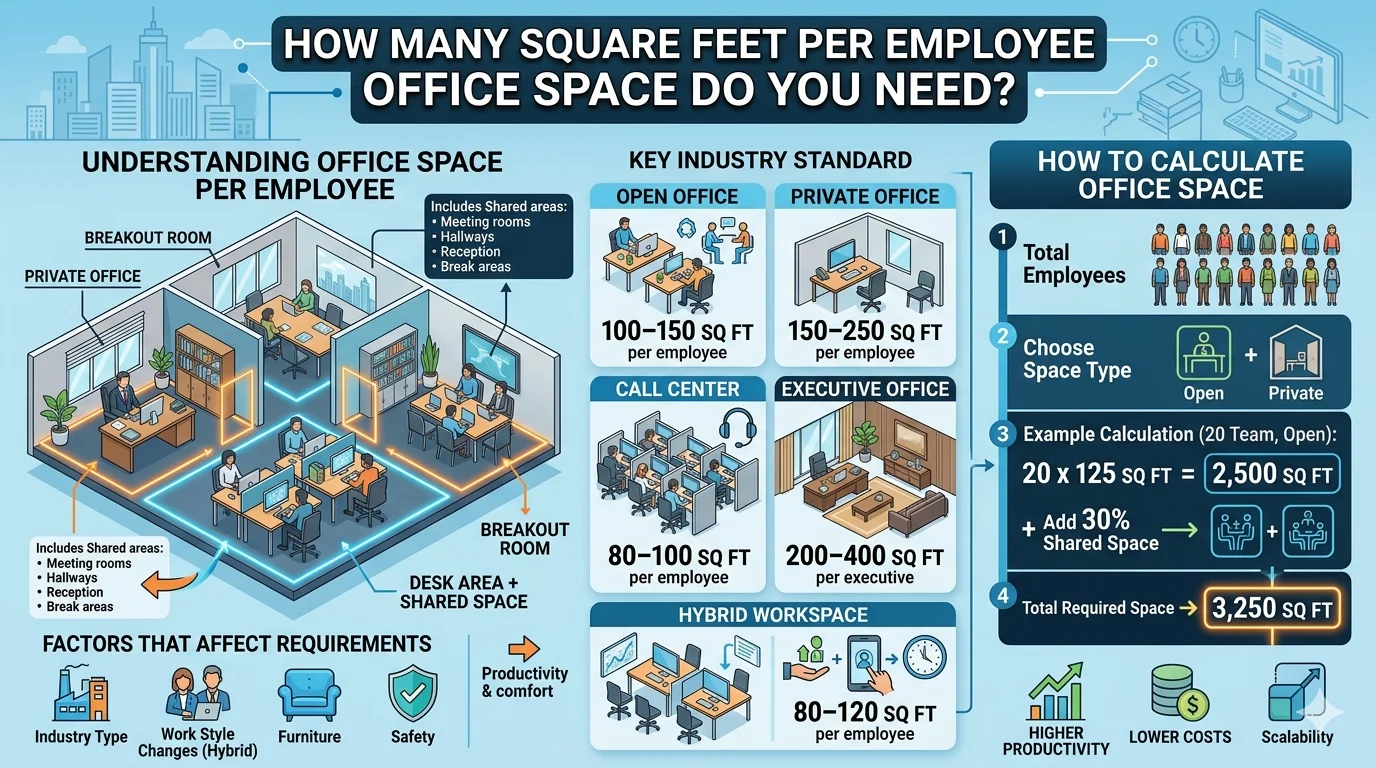
Office space per employee refers to the total square footage allocated to each worker in an office environment. It is not just the desk area. It also includes shared areas like meeting rooms, hallways, reception zones, break rooms, and storage spaces.
Why space planning matters
Proper space planning is essential for several reasons:
- Improves employee productivity
- Enhances comfort and focus
- Supports teamwork and collaboration
- Helps meet safety and building regulations
- Reduces unnecessary rental costs
A well-planned office layout can significantly improve how efficiently people work.
Impact on productivity and comfort
Employees perform better when they have enough personal space. Overcrowded offices can increase stress levels and reduce focus. On the other hand, balanced spacing creates a healthier, more organized, and more productive work environment.
Standard Square Feet Per Employee Guidelines
There is no single fixed number for everyone, but industry standards give a clear range for planning how many square feet per employee office space is appropriate.
Open office layouts
Open offices are common in startups and modern businesses.
- Recommended space: 100 to 150 sq ft per employee
This includes shared desks, circulation space, and collaborative zones.
Private offices
Traditional offices with enclosed rooms require more space.
- Recommended space: 150 to 250 sq ft per employee
This accounts for walls, privacy, and additional furniture.
Call centers and high-density offices
Call centers aim for maximum efficiency in limited space.
- Recommended space: 80 to 100 sq ft per employee
These setups prioritize compact seating and shared infrastructure.
Executive offices
Senior staff typically need more space for meetings and privacy.
- Recommended space: 200 to 400 sq ft per executive
Factors That Affect Office Space Requirements
Office space planning depends on several important factors.
Industry type
Different industries require different layouts:
- Tech companies prefer open, flexible spaces
- Legal firms need private offices
- Call centers use high-density seating
- Creative agencies often use hybrid layouts
Work style changes
Modern workplaces are shifting toward hybrid models:
- Fewer desks per employee
- Hot-desking systems
- More shared collaboration areas
Furniture and equipment
Large desks, multiple monitors, or special equipment increase space needs per employee.
Safety and legal requirements
Offices must follow regulations that include:
- Emergency exit access
- Minimum walkway widths
- Ventilation standards
- Accessibility compliance
How to Calculate Office Space per Employee
You can calculate office space requirements using a simple formula.
Step-by-step method
- Count total employees
- Choose space type (open, private, hybrid)
- Multiply employees by sq ft per person
- Add 25%–40% for shared areas
Example calculation
For a team of 20 employees in an open office:
- 20 × 125 sq ft = 2,500 sq ft
- Add 30% shared space = 750 sq ft
- Total required space = 3,250 sq ft
This ensures enough comfort and movement space.
Office Space Comparison Table
| Office Type | Space Per Employee | Description |
|---|---|---|
| Open Office | 100–150 sq ft | Shared desks, collaborative workspaces |
| Private Office | 150–250 sq ft | Individual rooms with privacy |
| Call Center | 80–100 sq ft | High-density seating arrangement |
| Executive Office | 200–400 sq ft | Larger private space for managers |
| Hybrid Workspace | 80–120 sq ft | Flexible hot-desking setup |
Common Mistakes in Office Space Planning
Many businesses struggle with space planning due to common errors.
1. Ignoring future growth
Planning only for current employees leads to quick overcrowding.
2. Overcrowding desks
Too many employees in a small area reduce productivity.
3. Wasting unused space
Too much empty space increases rent and maintenance costs.
4. Poor layout design
Bad design causes inefficient movement and reduced collaboration.
Expert Tips for Optimizing Office Space
To make the most of your workspace:
- Use modular furniture for flexibility
- Introduce hot-desking systems
- Create shared collaboration zones
- Reduce unnecessary partitions
- Use vertical storage solutions
- Design multi-purpose spaces
These strategies help improve efficiency without increasing office size.
Benefits of Proper Office Space Planning
Correct planning of how many square feet per employee office space brings several advantages:
Higher productivity
Employees work better in comfortable environments.
Lower costs
Avoid paying for unused space.
Better employee satisfaction
Comfort improves morale and retention.
Scalability
Easier to expand or reorganize workspace.
Improved teamwork
Smart layouts encourage communication and collaboration.
Conclusion
Knowing how many square feet per employee office space you need is essential for building a productive and cost-effective workplace. While most offices require between 80 and 250 square feet per employee depending on the setup, the right number depends on your industry, team size, and working style.
A well-planned office balances comfort, efficiency, and growth potential. When space is optimized properly, businesses save money while creating a better working environment for employees.
FAQs
1. How many square feet per employee office space is standard?
Most offices use 100 to 150 square feet per employee in open layouts.
2. Does hybrid work reduce space requirements?
Yes, hybrid models can reduce space needs by 20% to 40%.
3. What is the minimum office space per employee?
Call centers can operate with as little as 80 square feet per employee.
4. How do I calculate total office space needed?
Multiply employees by space per person and add 25%–40% for shared areas.
5. Why is office space planning important?
It improves productivity, reduces costs, and supports business growth.