
When planning any construction project, one of the most important measurements you need to understand is concrete coverage. A very common question builders and homeowners ask is one yard of concrete is how many square feet. This question seems simple, but the answer depends on one key factor: thickness.
A cubic yard of concrete is a volume measurement, while square feet measure area. Because of this, there is no single fixed number unless we know how thick the concrete layer will be. In this guide, you will learn exactly how to calculate it, see real examples, and avoid common mistakes so you can estimate concrete like a professional.
Understanding What a Cubic Yard of Concrete Means
Before answering one yard of concrete is how many square feet, you must understand what a cubic yard represents.
A cubic yard is a standard unit of volume used in construction. It equals:
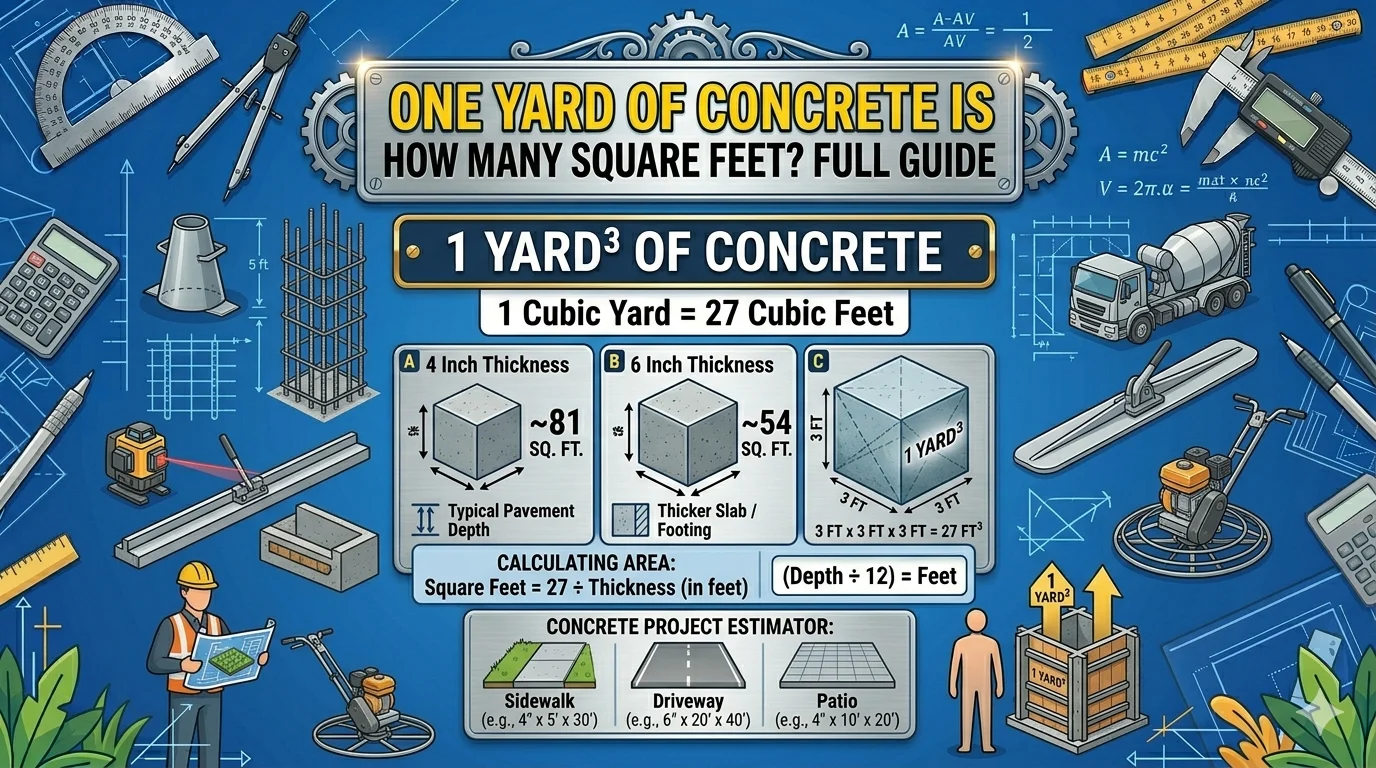
- 3 feet × 3 feet × 3 feet
- Total = 27 cubic feet
So, one cubic yard of concrete fills a space that is 3 feet long, 3 feet wide, and 3 feet deep.
Why thickness matters
Concrete is always poured in layers. The thinner the layer, the more surface area it can cover. The thicker the layer, the less area it will cover.
That is why the answer to one yard of concrete is how many square feet changes depending on slab thickness.
One Yard of Concrete is How Many Square Feet? (Exact Answer)
Now let’s answer the main question clearly.
At standard thickness (4 inches)
The most common residential slab thickness is 4 inches.
- 1 cubic yard of concrete covers approximately 81 square feet at 4 inches thickness
This is the most widely used standard in driveways, patios, and walkways.
At different thickness levels
Here is how coverage changes:
- 3 inches thick → 108 square feet
- 4 inches thick → 81 square feet
- 5 inches thick → 65 square feet
- 6 inches thick → 54 square feet
- 8 inches thick → 40 square feet
So when someone asks one yard of concrete is how many square feet, the correct answer always depends on depth.
Concrete Coverage Chart by Thickness
To make things easier, here is a quick reference chart:
| Thickness | Coverage per 1 Cubic Yard |
|---|---|
| 2 inches | 162 sq ft |
| 3 inches | 108 sq ft |
| 4 inches | 81 sq ft |
| 5 inches | 65 sq ft |
| 6 inches | 54 sq ft |
| 8 inches | 40 sq ft |
This chart helps you estimate any project quickly and avoid confusion.
How to Calculate Concrete Coverage Step-by-Step
If you want to calculate it yourself, you can use a simple formula.
Formula:
Area = 27 ÷ thickness (in feet)
Since 1 cubic yard = 27 cubic feet.
Example (4-inch slab)
Step 1: Convert inches to feet
- 4 inches = 0.33 feet
Step 2: Apply formula
- 27 ÷ 0.33 = 81 square feet
So again, one yard of concrete is how many square feet = 81 sq ft at 4 inches thickness.
Real-Life Uses of One Cubic Yard of Concrete
Understanding coverage helps in real construction planning.
Driveways
- Usually 4–6 inches thick
- 1 yard covers a small portion of a driveway
- Heavy load areas require more concrete
Sidewalks
- Usually 3–4 inches thick
- 1 yard covers a larger area compared to driveways
Foundations
- Usually 6–8 inches thick
- Coverage is smaller but strength is higher
So the answer to one yard of concrete is how many square feet depends heavily on usage type.
Common Mistakes in Concrete Estimation
Many people miscalculate concrete needs. Here are the most common mistakes:
1. Ignoring thickness
People assume square feet is fixed, but thickness changes everything.
2. Not adding extra material
Always add 5–10% extra concrete for:
- Waste
- Spillage
- Uneven surfaces
3. Incorrect unit conversion
Mixing inches, feet, and yards leads to wrong estimates.
Expert Tips for Accurate Measurement
Professionals always follow these rules:
Always measure thickness first
Thickness controls everything in concrete estimation.
Add safety buffer
Order at least 5–10% extra concrete.
Double-check dimensions
Measure length, width, and depth carefully before ordering.
Use consistent units
Keep everything in feet to avoid confusion.
These steps help you correctly determine one yard of concrete is how many square feet for any project.
Practical Example Calculation
Let’s say you want to pour a slab:
- Length = 12 feet
- Width = 6 feet
- Thickness = 4 inches (0.33 feet)
Step 1: Find area
12 × 6 = 72 square feet
Step 2: Check coverage
1 cubic yard = 81 square feet
Result: You need slightly less than 1 cubic yard, but you would still order 1 full yard for safety.
Why Understanding This Matters
Knowing one yard of concrete is how many square feet helps you:
- Avoid over-ordering expensive material
- Prevent shortages during construction
- Save money on projects
- Plan more accurately like a contractor
Even small mistakes in measurement can cost a lot in construction work.
FAQs
1. One yard of concrete is how many square feet at 4 inches?
It covers approximately 81 square feet.
2. Why does concrete coverage change?
Because thickness affects how far the volume spreads.
3. How many cubic feet are in one cubic yard?
There are 27 cubic feet in one cubic yard.
4. Can 1 yard of concrete build a driveway?
Only a small section depending on thickness and size.
5. What is the safest way to estimate concrete?
Always calculate volume first, then convert to cubic yards and add extra buffer.
Conclusion
Understanding one yard of concrete is how many square feet is essential for anyone working on construction, renovation, or DIY projects. The key takeaway is simple: there is no fixed number unless you know the thickness.
At standard 4-inch thickness, one cubic yard covers about 81 square feet. However, this value changes with every project type, whether it is a driveway, sidewalk, or foundation.
By learning this simple calculation, you can plan better, reduce waste, and manage construction costs more efficiently.