
If you’re planning a gardening project, one of the most common questions is: how many cubic feet in a 20 gallon pot? Understanding this conversion helps you purchase the right amount of soil, compost, or potting mix without wasting money or making multiple trips to the garden center.
Since many containers are measured in gallons while soil products are sold in cubic feet, knowing how to convert between the two is essential for gardeners, landscapers, and plant enthusiasts. In this guide, you’ll learn exactly how many cubic feet are in a 20-gallon pot, why the conversion matters, and how to estimate soil requirements accurately.
Understanding Gallons and Cubic Feet
Before diving into the conversion, it’s important to understand what these measurements mean.
What Is a Gallon?
A gallon is a unit of volume commonly used in the United States to measure liquids and container sizes. Garden pots, grow bags, and nursery containers are often labeled according to their gallon capacity.
What Is a Cubic Foot?
A cubic foot measures volume in three-dimensional space. It represents a space that is one foot long, one foot wide, and one foot high. Potting soil, mulch, compost, and landscaping materials are frequently sold by the cubic foot.
Because gardening products use both measurements, converting between gallons and cubic feet is often necessary.
How Many Cubic Feet in a 20 Gallon Pot?
The simple answer is:
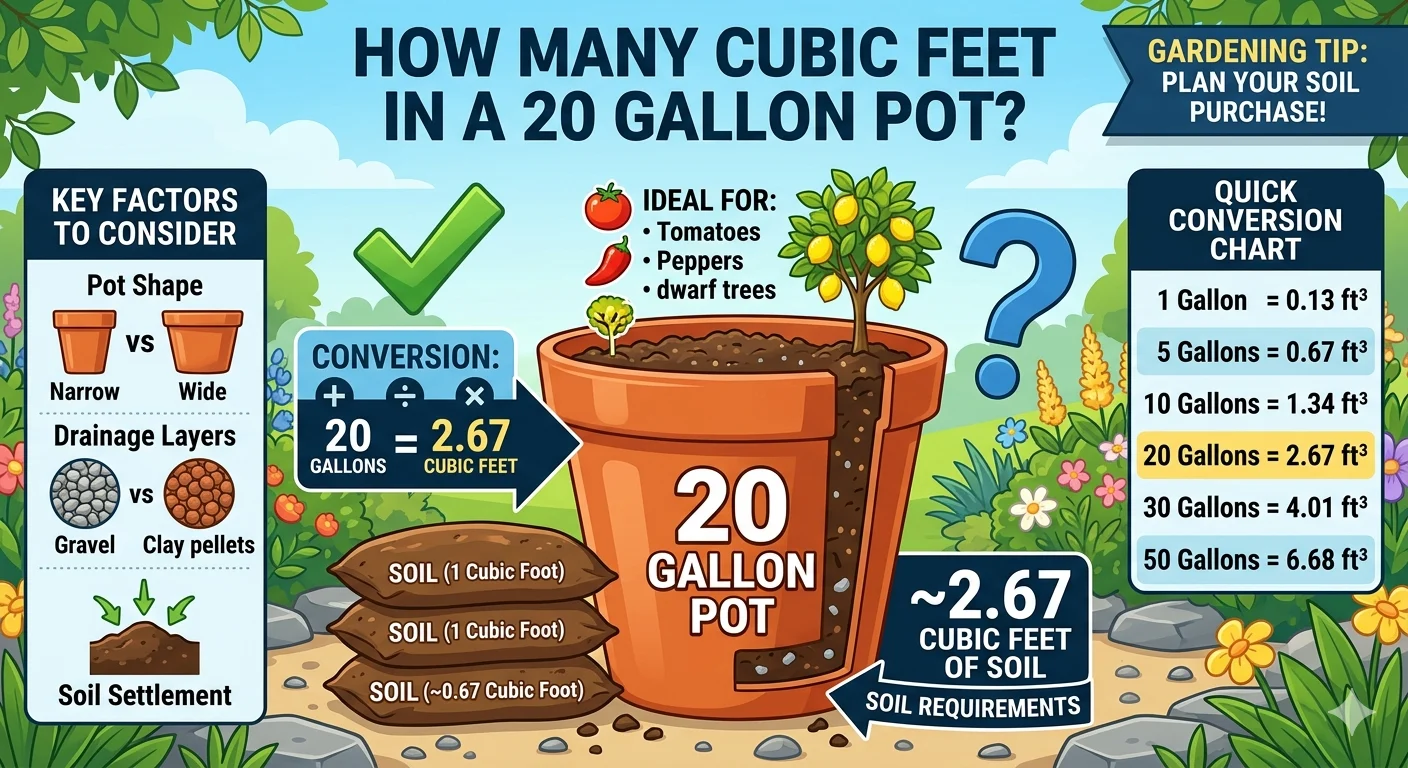
A 20-gallon pot equals approximately 2.67 cubic feet.
The standard conversion formula is:
1 cubic foot = 7.48 gallons
To calculate cubic feet from gallons:
Cubic Feet = Gallons ÷ 7.48
For a 20-gallon container:
20 ÷ 7.48 = 2.67 cubic feet
Therefore, a pot labeled as 20 gallons has a volume of approximately 2.67 cubic feet.
This conversion is widely used for gardening and landscaping calculations.
Gallons to Cubic Feet Conversion Chart
The following chart provides quick reference conversions:
Gallons| Cubic Feet
1 Gallon| 0.13 Cubic Feet
5 Gallons| 0.67 Cubic Feet
10 Gallons| 1.34 Cubic Feet
15 Gallons| 2.01 Cubic Feet
20 Gallons| 2.67 Cubic Feet
25 Gallons| 3.34 Cubic Feet
30 Gallons| 4.01 Cubic Feet
40 Gallons| 5.35 Cubic Feet
50 Gallons| 6.68 Cubic Feet
This chart can be useful when planning larger container gardens or purchasing soil in bulk.
Why This Conversion Matters
Many gardeners buy soil products sold in bags measured by cubic feet. If you only know the gallon size of your container, estimating how much soil you need can be difficult.
Knowing that a 20-gallon pot holds approximately 2.67 cubic feet helps you:
- Buy the correct amount of potting mix
- Avoid overspending on excess soil
- Prevent running out of soil during planting
- Plan large gardening projects more efficiently
- Estimate soil requirements for multiple containers
Whether you’re planting vegetables, flowers, herbs, or small trees, accurate calculations save both time and money.
How Much Soil Does a 20 Gallon Pot Need?
In theory, a 20-gallon pot requires approximately 2.67 cubic feet of soil to fill completely.
However, actual soil requirements can vary depending on several factors:
- Pot shape
- Drainage materials
- Soil settlement
- Plant root systems
Most gardeners find that around 2.5 to 2.7 cubic feet of potting mix fills a typical 20-gallon container.
To be safe, many people purchase approximately 3 cubic feet of soil, allowing for settling and future top-offs.
Common Uses for a 20 Gallon Pot
Twenty-gallon containers are versatile and popular among home gardeners because they provide ample root space for many plants.
Growing Vegetables
A 20-gallon pot is ideal for:
- Tomatoes
- Peppers
- Cucumbers
- Eggplants
- Potatoes
The larger volume helps retain moisture and supports healthy root development.
Growing Fruit Trees
Many dwarf fruit trees perform well in 20-gallon containers, including:
- Lemon trees
- Lime trees
- Fig trees
- Dwarf peach trees
These containers offer enough space for root growth while remaining manageable.
Ornamental Plants
Large flowering plants and shrubs also thrive in 20-gallon pots.
Examples include:
- Hydrangeas
- Roses
- Decorative grasses
- Evergreen shrubs
The generous size supports long-term growth and reduces watering frequency.
Factors That Affect Soil Quantity
Although a 20-gallon pot equals approximately 2.67 cubic feet, the actual amount of soil needed may differ.
Pot Shape and Design
Not all 20-gallon containers have identical dimensions.
Some are:
- Tall and narrow
- Short and wide
- Tapered
- Fabric grow bags
Manufacturers sometimes round container capacities, resulting in slight differences.
Drainage Layers
Some gardeners place materials at the bottom of containers, such as:
- Gravel
- Stones
- Clay pellets
These materials occupy space and reduce the amount of soil required.
Soil Settlement
Fresh potting mix naturally settles over time.
After watering and plant growth, soil volume may decrease by several inches, requiring occasional topping off.
Calculating Soil for Multiple 20 Gallon Pots
If you’re filling multiple containers, converting gallons to cubic feet becomes even more important.
Example 1: Three Pots
Three 20-gallon containers equal:
20 × 3 = 60 gallons
60 ÷ 7.48 = 8.02 cubic feet
You’ll need approximately 8 cubic feet of soil.
Example 2: Five Pots
Five 20-gallon containers equal:
20 × 5 = 100 gallons
100 ÷ 7.48 = 13.37 cubic feet
You’ll need approximately 13.4 cubic feet of soil.
These calculations help when purchasing soil in bulk quantities.
Common Mistakes to Avoid
When converting gallons to cubic feet, gardeners often make a few common mistakes.
Confusing Gallons with Cubic Feet
A 20-gallon container does not hold 20 cubic feet of soil.
The correct volume is approximately 2.67 cubic feet.
Ignoring Soil Settlement
Fresh potting mix often settles after watering.
Purchasing slightly more soil than calculated can prevent shortages later.
Forgetting Drainage Materials
If gravel or other drainage materials are added, less soil may be required.
Assuming Every Container Is Identical
Container dimensions vary between manufacturers, even when labeled with the same gallon capacity.
Always check product specifications if precise calculations are necessary.
Expert Tips for Filling a 20 Gallon Pot
To get the best results from your container garden, consider the following tips:
Use High-Quality Potting Mix
Avoid filling containers with heavy garden soil.
Instead, choose:
- Premium potting mix
- Compost blends
- Container-specific growing media
These materials improve drainage and root health.
Leave Space at the Top
Keep 1–2 inches of space between the soil surface and the rim of the pot.
This makes watering easier and prevents overflow.
Add Organic Matter
Mixing compost into potting soil improves:
- Water retention
- Nutrient availability
- Soil structure
Buy Extra Soil
Since a 20-gallon pot requires approximately 2.67 cubic feet, purchasing around 3 cubic feet provides a useful buffer for settling and future planting needs.
Frequently Asked Questions
How many cubic feet of soil fit in a 20 gallon pot?
A 20-gallon pot holds approximately 2.67 cubic feet of soil.
How many bags of potting soil do I need for a 20 gallon container?
If using 1-cubic-foot bags, you’ll typically need about three bags to fill the container completely.
Is a 20 gallon pot big enough for tomatoes?
Yes. A 20-gallon container provides ample space for most tomato varieties and supports strong root development.
Can a 20 gallon grow bag hold 2.67 cubic feet?
Yes. A true 20-gallon grow bag has a volume of approximately 2.67 cubic feet.
Why does my 20 gallon pot require less soil than expected?
Drainage materials, container shape, and soil compaction can reduce the amount of soil needed.
Conclusion
If you’ve been wondering how many cubic feet in a 20 gallon pot, the answer is straightforward: a 20-gallon container equals approximately 2.67 cubic feet. This conversion is extremely useful when purchasing potting soil, compost, or other gardening materials.
Understanding the relationship between gallons and cubic feet allows gardeners to plan more accurately, reduce waste, and ensure their plants have enough growing medium. Whether you’re filling a single planter or creating an entire container garden, using this simple conversion will make your gardening projects easier and more efficient.