

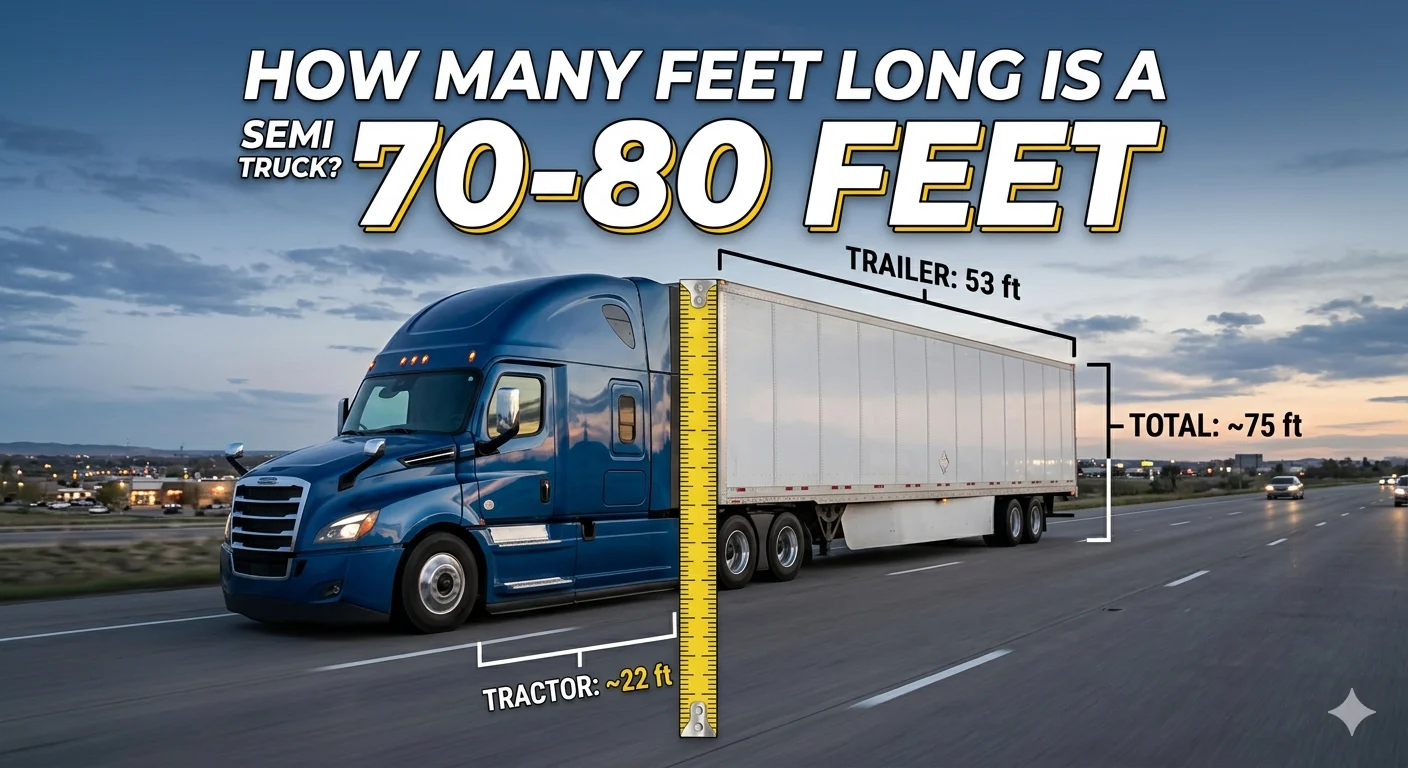
If you are wondering how many feet long is a semi truck, the simple answer is that most semi trucks are about 70 to 80 feet long when you combine the tractor and trailer. However, this is not a fixed number. The total length changes depending on the trailer type, cab style, and legal regulations in different regions.
Semi trucks are one of the most important vehicles in global logistics. They move goods across cities, states, and countries every single day. Because of this, understanding their size helps drivers, planners, and even regular people who see them on highways and want to know more.
A semi truck is not a single unit. It is a combination of two main parts:
- The tractor (front engine cab)
- The trailer (cargo container)
Both parts together determine the final length.
Understanding How Many Feet Long Is a Semi Truck
To fully understand how many feet long is a semi truck, you need to break it into components instead of thinking of it as one fixed vehicle size.
A semi truck, also called an 18-wheeler or tractor-trailer, is designed to pull different types of trailers depending on the cargo. That’s why the length is flexible.
The key idea is simple:
The trailer determines most of the length, not the truck cab.
A common modern semi truck like the Freightliner Cascadia is widely used in freight transport and usually paired with standard 53-foot trailers.
Why semi truck length is not fixed
Semi truck length varies because:
- Different trailer sizes are used (28 ft to 53 ft or more)
- Cab designs differ (day cab vs sleeper cab)
- Some states allow longer combinations
- Special cargo requires customized trailers
So instead of one exact number, we use an average range.
Average Length of a Semi Truck in Feet
The most commonly accepted measurement for how many feet long is a semi truck is:
70 to 80 feet in total length
This includes both tractor and trailer.
Tractor length
The tractor (front cab) is usually:
- 20 to 25 feet long
This includes the engine, driver cabin, and sometimes a sleeper compartment.
Trailer length
Common trailer sizes include:
- 28 feet (short haul)
- 48 feet (standard freight)
- 53 feet (most common in long-distance transport)
Total combined length
| Component | Average Length |
|---|---|
| Tractor | 20–25 ft |
| Trailer | 48–53 ft |
| Total | 70–80 ft |
This is the standard answer used in transportation and logistics industries.
Different Types of Semi Trucks and Their Lengths
Semi trucks come in different configurations depending on their use.
Day Cab Semi Trucks
These trucks do not have sleeping space and are used for short distances.
- Tractor: ~20–22 ft
- Trailer: 28–48 ft
- Total: 50–70 ft
Sleeper Cab Semi Trucks
These are designed for long-haul driving and include a sleeping compartment.
- Tractor: ~22–25 ft
- Trailer: 48–53 ft
- Total: 70–80+ ft
Specialized Freight Trucks
Used for oversized or multiple cargo loads.
- Can exceed 90 to 100+ feet depending on configuration
US Regulations for Semi Truck Length
Understanding how many feet long is a semi truck also requires knowing legal limits.
In the United States:
- There is no strict federal limit for overall truck length
- Trailer length is more regulated than total truck length
- Most highways allow 53-foot trailers
State differences
Different states may allow:
- Double trailers
- Longer combination vehicles
- Special permits for oversized loads
This means truck length can legally vary depending on the route.
Real-World Semi Truck Length Examples
Let’s look at real-world setups to make it easier to understand.
Standard highway truck
- Tractor: 22 ft
- Trailer: 53 ft
- Total: ~75 ft
This is the most common semi truck on highways.
Short-haul delivery truck
- Tractor: 20 ft
- Trailer: 28–40 ft
- Total: 50–60 ft
Used for city deliveries and regional transport.
Long combination vehicle
- Two trailers: 28 + 28 ft
- Total: 90–110+ ft
Used in specific freight corridors with permits.
Semi Truck Length Comparison Table
To better understand size differences:
| Vehicle Type | Average Length |
|---|---|
| Pickup truck | 17–20 ft |
| City bus | 35–40 ft |
| Semi truck (standard) | 70–80 ft |
| Double trailer truck | 90–110 ft |
This comparison clearly shows how large semi trucks are compared to everyday vehicles.
Why Semi Truck Length Matters
The size of a semi truck is not just a number. It affects real-world transportation systems.
Parking and loading
Truck stops and warehouses are designed based on standard semi truck lengths.
Road safety
Longer vehicles require:
- Wider turns
- More stopping distance
- Careful lane control
Fuel efficiency and cost
Long trucks:
- Carry more goods
- Reduce cost per shipment
- But consume more fuel
Common Misconceptions About Semi Truck Size
Many people misunderstand truck dimensions.
Common mistakes include:
- Thinking all semi trucks are the same length
- Ignoring trailer size variations
- Assuming cab length is insignificant
- Confusing buses with trucks in size
In reality, semi truck length is flexible and purpose-driven.
Expert Tips to Understand Semi Truck Size
If you want to better understand how many feet long is a semi truck, keep these tips in mind:
- Always include both tractor and trailer in measurements
- Use 53 feet as the standard trailer benchmark
- Remember sleeper cabs add extra length
- Check local transport regulations for accuracy
- Expect variation depending on cargo type
Conclusion
So, how many feet long is a semi truck? The most accurate and practical answer is that a standard semi truck is usually 70 to 80 feet long.
However, this length is not fixed. It changes depending on:
- Trailer size
- Cab type
- Cargo requirements
- Legal regulations
Semi trucks are designed to balance efficiency, safety, and transport capacity, making them essential to modern logistics systems worldwide.