

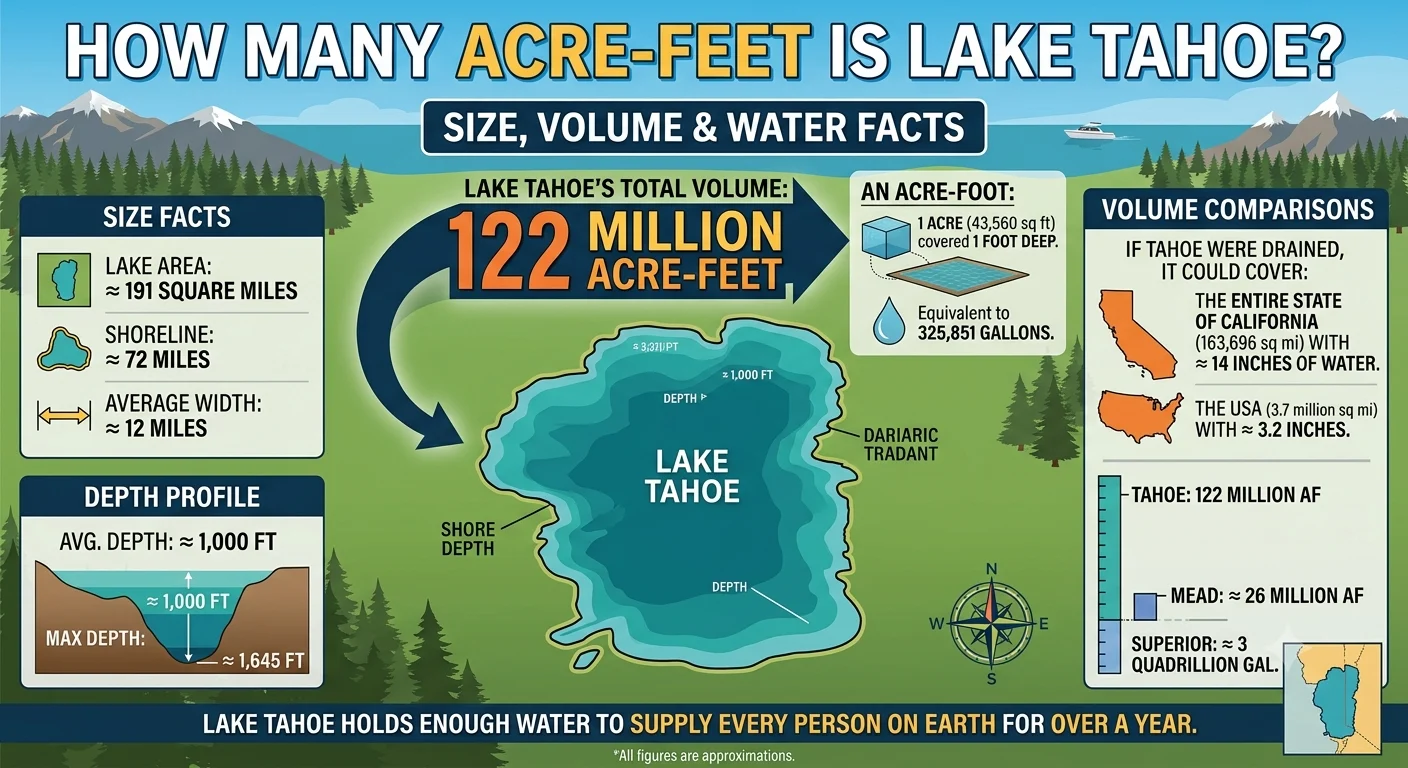
Lake Tahoe is one of the most beautiful and well-known freshwater lakes in North America. Located in the Sierra Nevada Mountains along the California–Nevada border, it attracts millions of visitors every year with its crystal-clear water, scenic landscapes, and outdoor recreation opportunities. Besides its natural beauty, many people are curious about its enormous size and often ask, how many acre feet is Lake Tahoe?
The answer is impressive: Lake Tahoe contains approximately 122 million acre-feet of water. This massive volume makes it one of the largest freshwater lakes in the United States by volume. Its incredible depth allows it to hold far more water than many lakes and reservoirs with larger surface areas.
In this guide, you’ll learn what an acre-foot is, why Lake Tahoe holds so much water, how scientists calculate its volume, and why this measurement is important for water management and conservation.
What Is an Acre-Foot?
Before understanding Lake Tahoe’s water volume, it’s helpful to know what an acre-foot means.
An acre-foot is a unit used to measure large amounts of water. It represents the amount of water needed to cover one acre of land to a depth of one foot.
One acre-foot equals:
- 43,560 cubic feet
- About 325,851 gallons
- Approximately 1,233 cubic meters
Water agencies, engineers, farmers, and environmental scientists use acre-feet because it provides a practical way to measure large lakes, reservoirs, and water supplies.
How Many Acre Feet Is Lake Tahoe?
Lake Tahoe holds approximately 122 million acre-feet of water.
This estimate has been calculated using detailed measurements of the lake’s surface area and underwater depth. Because Lake Tahoe is exceptionally deep, it stores an enormous amount of freshwater despite not being the largest lake by surface area.
Here are some quick facts about Lake Tahoe:
| Feature | Measurement |
|---|---|
| Water Volume | Approximately 122 million acre-feet |
| Surface Area | 191 square miles |
| Maximum Depth | 1,645 feet |
| Average Depth | About 989 feet |
| Shoreline Length | Around 72 miles |
| Elevation | 6,225 feet above sea level |
These numbers help explain why Lake Tahoe ranks among the deepest and most water-rich lakes in North America.
Why Does Lake Tahoe Hold So Much Water?
The main reason Lake Tahoe contains such a large volume of water is its depth.
Many lakes may have a wide surface area but remain relatively shallow. Lake Tahoe is different because its basin extends more than 1,600 feet below the surface at its deepest point. This allows it to store significantly more water than many lakes of similar size.
Lake Tahoe was formed millions of years ago through faulting, volcanic activity, and glacial movement. These natural geological processes created a deep basin that continues to hold an extraordinary amount of freshwater today.
How Scientists Calculate Lake Tahoe’s Water Volume
Determining the volume of a lake requires much more than measuring its length and width.
Scientists use several methods to estimate Lake Tahoe’s total water capacity.
Measuring the Surface Area
The first step is calculating the lake’s total surface area using satellite imagery and precise surveying techniques.
Mapping the Lake Floor
Researchers use sonar and other advanced technologies to measure thousands of points across the lake bed. These measurements create a detailed map of the underwater landscape.
Building Bathymetric Maps
Bathymetric maps show the contours and depth of the lake floor. These maps allow scientists to calculate the total amount of space occupied by water.
Converting the Measurements
Once the total volume is determined in cubic feet or cubic meters, it is converted into acre-feet for easier understanding and comparison.
Why Acre-Feet Are Used Instead of Gallons
Although gallons are familiar to most people, they become impractical when discussing enormous lakes.
For example:
- One acre-foot equals about 325,851 gallons.
- Lake Tahoe contains roughly 122 million acre-feet.
- That equals nearly 40 trillion gallons of water.
Using gallons would require extremely large numbers, making comparisons difficult. Acre-feet provide a much simpler way to describe large water supplies.
Lake Tahoe Compared to Other Water Bodies
Lake Tahoe’s water volume is impressive, especially when compared to other lakes and reservoirs.
| Water Body | Approximate Water Volume |
|---|---|
| Lake Tahoe | 122 million acre-feet |
| Lake Mead (Full Capacity) | Around 26 million acre-feet |
| Crater Lake | Significantly smaller |
| Great Salt Lake | Volume varies depending on water levels |
| Lake Superior | Much larger than Lake Tahoe |
Although Lake Superior contains more water overall, Lake Tahoe holds far more water than many famous reservoirs in the western United States.
Real-World Examples of Lake Tahoe’s Water Volume
Large numbers can be difficult to visualize. Here are some examples that help put Lake Tahoe’s size into perspective.
Enough Water for Millions of Homes
A typical household uses less than one acre-foot of water annually. Lake Tahoe contains enough water to supply millions of households for many years.
Millions of Swimming Pools
Lake Tahoe’s water volume could fill tens of millions of Olympic-sized swimming pools.
Agricultural Irrigation
One acre-foot is often enough to irrigate about one acre of farmland during a growing season. Lake Tahoe contains enough water to irrigate enormous agricultural regions for decades.
These comparisons demonstrate just how massive Lake Tahoe truly is.
Why Lake Tahoe Is Important
Lake Tahoe is more than a tourist destination. It is an important natural resource with significant environmental, recreational, and economic value.
Its water supports:
- Local ecosystems
- Wildlife habitats
- Recreation and tourism
- Scientific research
- Water quality studies
- Regional environmental conservation
Because the lake stores such a large amount of freshwater, protecting its health is a priority for both California and Nevada.
Interesting Facts About Lake Tahoe
Lake Tahoe has many remarkable features beyond its water volume.
One of the Clearest Lakes in the World
The lake is famous for its exceptional water clarity. On calm days, visibility can exceed 60 feet.
Second Deepest Lake in the United States
At 1,645 feet deep, Lake Tahoe ranks among the deepest lakes in North America.
High Mountain Lake
Lake Tahoe sits at an elevation of more than 6,200 feet above sea level in the Sierra Nevada Mountains.
Water Remains in the Lake for Centuries
Water entering Lake Tahoe stays there for approximately 650 years before eventually flowing out through the Truckee River.
Shared by Two States
About two-thirds of Lake Tahoe lies in California, while the remaining one-third is in Nevada.
Common Misconceptions About Lake Tahoe
There are several misunderstandings about Lake Tahoe’s size and water volume.
A Larger Surface Area Means More Water
Not always. A deeper lake can hold much more water than a larger but shallower lake.
Lake Tahoe Is the Largest Lake in America
Lake Tahoe is not the largest by surface area or total volume, but it is among the largest freshwater lakes in the United States by water volume due to its depth.
Gallons Are Better Than Acre-Feet
Gallons are useful for everyday measurements, but acre-feet are much more practical when discussing lakes, reservoirs, and water resources.
Tips for Understanding Acre-Feet
If you’re learning about lakes, reservoirs, or water conservation, these tips can help.
- Focus on water volume rather than surface area alone.
- Remember that deeper lakes usually contain much more water.
- Learn the relationship between acre-feet and gallons.
- Use acre-feet when comparing reservoirs and large lakes.
- Consider both depth and surface area to understand total capacity.
These concepts make it easier to interpret reports about water resources and conservation.
Frequently Asked Questions
How many acre-feet of water does Lake Tahoe contain?
Lake Tahoe contains approximately 122 million acre-feet of freshwater.
How many gallons of water are in Lake Tahoe?
The lake holds nearly 40 trillion gallons of water.
Why is Lake Tahoe so deep?
Lake Tahoe formed through geological faulting, volcanic activity, and glacial processes over millions of years, creating a deep mountain basin.
Why do scientists use acre-feet?
Acre-feet provide a practical way to measure and compare large amounts of water stored in lakes and reservoirs.
Is Lake Tahoe larger than Lake Mead?
Lake Tahoe holds significantly more water than Lake Mead when the reservoir is at full capacity, even though the two water bodies differ in purpose and shape.
Conclusion
If you’ve been wondering how many acre feet is Lake Tahoe, the answer is approximately 122 million acre-feet. This enormous volume highlights why Lake Tahoe is considered one of the most significant freshwater lakes in the United States. Its exceptional depth, pristine water, and unique geological history make it a remarkable natural landmark.
Understanding acre-feet not only helps answer this common question but also provides valuable insight into how scientists measure water resources. Whether you’re studying geography, planning a visit, or simply satisfying your curiosity, Lake Tahoe’s immense water capacity is one of its most fascinating characteristics.