
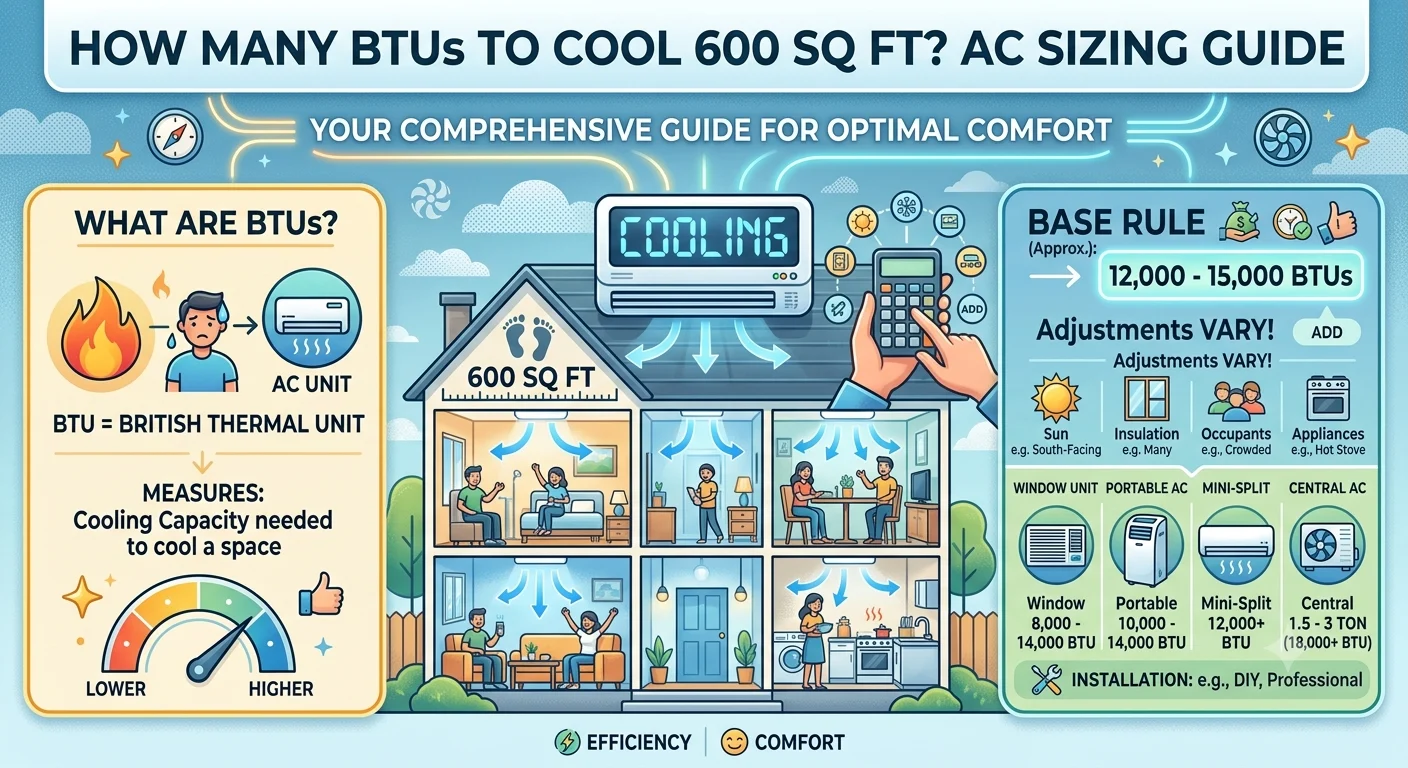
Cooling a 600-square-foot room requires more than simply buying the largest air conditioner available. The right BTU rating depends on room size, ceiling height, insulation, climate, sun exposure, and how the space is used. Choosing the correct BTU capacity helps your air conditioner cool efficiently, reduce electricity costs, and last longer.
For most homes, 12,000 to 14,000 BTUs is suitable for cooling a well-insulated 600-square-foot room under average conditions. However, some spaces may require as little as 10,000 BTUs or as much as 18,000 BTUs depending on several important factors.
In this guide, you’ll learn exactly how many BTUs to cool 600 square feet, how BTUs are calculated, and how to choose the best air conditioner for your home.
What Does BTU Mean?
BTU stands for British Thermal Unit. It measures the amount of heat an air conditioner can remove from a room in one hour.
Simply put:
- Higher BTUs = More cooling power
- Lower BTUs = Less cooling power
Choosing the correct BTU rating is important because both undersized and oversized air conditioners create problems.
How Many BTUs to Cool 600 Square Feet?
A typical 600-square-foot room generally requires:
| Room Size | Recommended BTUs |
|---|---|
| 550 sq ft | 12,000 BTUs |
| 600 sq ft | 12,000–14,000 BTUs |
| 650 sq ft | 14,000 BTUs |
| 700 sq ft | 14,000–15,000 BTUs |
For most residential applications:
- Average room: 12,000–14,000 BTUs
- Very sunny room: 14,000–16,000 BTUs
- Poor insulation: 15,000–18,000 BTUs
BTU Calculation for 600 Square Feet
Many HVAC professionals use this simple estimation:
Square Feet × 20 BTUs
For a 600-square-foot room:
600 × 20 = 12,000 BTUs
This is the baseline calculation.
However, it assumes:
- 8-foot ceilings
- Average insulation
- Moderate climate
- Two occupants
- Normal sunlight
Real-world conditions often require adjustments.
Factors That Affect BTU Requirements
Room size is only one part of the calculation.
Ceiling Height
Most BTU charts assume an 8-foot ceiling.
If your ceiling is higher:
| Ceiling Height | Recommended Increase |
|---|---|
| 9 ft | Add 10% |
| 10 ft | Add 20–25% |
| Vaulted Ceiling | Add 30–50% |
Higher ceilings mean more air volume to cool.
Sun Exposure
Large windows dramatically increase cooling needs.
North-facing room
Little direct sunlight.
Recommended:
- 12,000 BTUs
South-facing room
Receives strong afternoon sunlight.
Recommended:
- 14,000–16,000 BTUs
West-facing room
Usually the hottest.
Recommended:
- 15,000–18,000 BTUs
Insulation Quality
Well-insulated homes retain cool air much better.
Excellent insulation
- Lower BTU requirements
- Reduced electricity use
Average insulation
Standard recommendation:
- 12,000–14,000 BTUs
Poor insulation
Heat enters more easily.
Recommended:
- Add 10–20% more BTUs
Number of Occupants
Each person generates body heat.
General guideline:
- Add about 600 BTUs for each additional person beyond two occupants.
Example:
Four people regularly use the room.
Base:
12,000 BTUs
Extra occupants:
2 × 600 = 1,200 BTUs
Recommended:
13,200 BTUs or approximately a 14,000-BTU unit.
Kitchen or Living Room?
Rooms containing cooking appliances require additional cooling.
If your 600-square-foot space includes a kitchen:
Add approximately:
- 3,000–4,000 BTUs
Cooking appliances produce significant heat throughout the day.
Electronics and Appliances
Large electronics also increase cooling demand.
Examples include:
- Gaming PCs
- Multiple televisions
- Home theaters
- Servers
- Exercise equipment
If your room contains many electronics, increase BTU capacity accordingly.
Climate Matters
Where you live has a major impact.
Cooler climates
Examples:
- Northern states
- Mountain regions
You may only need:
- 12,000 BTUs
Hot climates
Examples:
- Arizona
- Texas
- Florida
- Gulf Coast
You may require:
- 14,000–18,000 BTUs
BTU Recommendations by Room Conditions
| Room Condition | Suggested BTUs |
|---|---|
| Average room | 12,000 |
| Sunny room | 14,000 |
| Poor insulation | 15,000 |
| High ceilings | 15,000 |
| Kitchen area | 16,000 |
| Hot climate | 14,000–18,000 |
Window AC vs Portable AC
Different air conditioners cool differently.
| Feature | Window AC | Portable AC |
|---|---|---|
| Cooling efficiency | Higher | Lower |
| Energy efficiency | Better | Moderate |
| Noise | Quieter | Louder |
| Installation | Window required | Flexible |
| Cost | Usually lower | Often higher |
Portable air conditioners often need higher BTU ratings because they are generally less efficient than window units.
Mini-Split Systems for 600 Square Feet
Mini-split systems are among the most efficient cooling options.
Benefits include:
- Quiet operation
- High energy efficiency
- Better humidity control
- Zoned cooling
- Long lifespan
For a 600-square-foot room, a 12,000- to 18,000-BTU mini-split is commonly recommended depending on room conditions.
Central Air Conditioning
If the room is part of a whole-house HVAC system, sizing is based on the entire home’s cooling load rather than one room.
HVAC contractors typically perform a Manual J load calculation, which considers:
- Insulation
- Windows
- Climate
- Air leakage
- Orientation
- Ceiling height
- Occupancy
This provides a much more accurate recommendation than square footage alone.
Is 10,000 BTUs Enough for 600 Square Feet?
Usually not.
A 10,000-BTU air conditioner is generally best suited for rooms around:
- 400–450 square feet
Using it in a 600-square-foot room can lead to:
- Longer run times
- Higher electricity bills
- Poor cooling
- Excess wear on the unit
Is 12,000 BTUs Enough?
Yes, in many situations.
A 12,000-BTU unit works well if your room has:
- Good insulation
- Standard ceilings
- Limited sunlight
- Moderate outdoor temperatures
This is one of the most common recommendations for a 600-square-foot room.
Is 18,000 BTUs Too Much?
Not always.
An 18,000-BTU air conditioner can be appropriate if:
- The room receives intense sunlight
- Ceilings are very high
- Insulation is poor
- Multiple people occupy the room
- The room includes a kitchen
- You live in a very hot climate
However, an oversized unit may cool the room too quickly without removing enough humidity, leaving the space feeling damp and uncomfortable.
Common BTU Sizing Mistakes
Many homeowners make the following errors:
Buying the Largest Unit Available
Bigger is not always better.
Oversized units cycle on and off too frequently.
Ignoring Sunlight
A west-facing room can require thousands more BTUs than a shaded room.
Forgetting Ceiling Height
Higher ceilings increase the amount of air that must be cooled.
Overlooking Insulation
Drafty rooms need more cooling capacity.
Not Considering Occupancy
More people generate more heat.
Energy-Saving Tips
Choosing the correct BTU rating is only one part of efficient cooling.
You can reduce energy costs by:
- Closing curtains during the afternoon
- Using blackout shades
- Sealing window leaks
- Replacing dirty air filters
- Running ceiling fans
- Keeping doors closed
- Scheduling regular AC maintenance
- Installing weather stripping
- Using programmable thermostats
These simple steps can significantly improve cooling performance.
Quick BTU Sizing Chart
| Room Size | Recommended BTUs |
|---|---|
| 300 sq ft | 6,000–7,000 |
| 400 sq ft | 8,000–10,000 |
| 500 sq ft | 10,000–12,000 |
| 600 sq ft | 12,000–14,000 |
| 700 sq ft | 14,000–15,000 |
| 800 sq ft | 16,000–18,000 |
| 1,000 sq ft | 18,000–21,000 |
Expert Tips for Choosing the Right AC
- Measure the room accurately before shopping.
- Consider insulation and window placement.
- Check the unit’s Energy Efficiency Ratio (EER) or SEER rating.
- Look for ENERGY STAR-certified models.
- Read manufacturer sizing guidelines.
- If unsure, consult an HVAC professional for a load calculation.
A properly sized air conditioner provides better comfort, lower utility bills, and a longer service life.
Frequently Asked Questions
How many BTUs do I need to cool 600 square feet?
Most 600-square-foot rooms require 12,000 to 14,000 BTUs under average conditions. Rooms with high ceilings, poor insulation, or heavy sunlight may need 15,000 to 18,000 BTUs.
Is a 12,000-BTU air conditioner enough for 600 square feet?
Yes. A 12,000-BTU unit is suitable for many average-sized, well-insulated rooms with standard ceiling heights and moderate sun exposure.
Can a 10,000-BTU AC cool 600 square feet?
Generally no. A 10,000-BTU unit is typically intended for rooms around 400–450 square feet and may struggle to cool a 600-square-foot space effectively.
What happens if I buy an air conditioner with too many BTUs?
An oversized unit may cool the room too quickly, causing short cycling and poor humidity removal. This can reduce comfort and increase wear on the system.
Should I choose a portable AC or a window AC for 600 square feet?
A window AC is usually more energy-efficient and provides stronger cooling. Portable air conditioners offer greater flexibility but often require a higher BTU rating to achieve similar performance.
Conclusion
Knowing how many BTUs to cool 600 square feet helps you choose an air conditioner that delivers efficient, comfortable, and cost-effective cooling. While 12,000 BTUs is the standard starting point for a 600-square-foot room, factors such as ceiling height, insulation, climate, sunlight, occupancy, and room usage can increase the required capacity to 14,000–18,000 BTUs. By considering these variables and selecting the right-sized unit, you’ll enjoy better temperature control, improved energy efficiency, and lower long-term operating costs.