

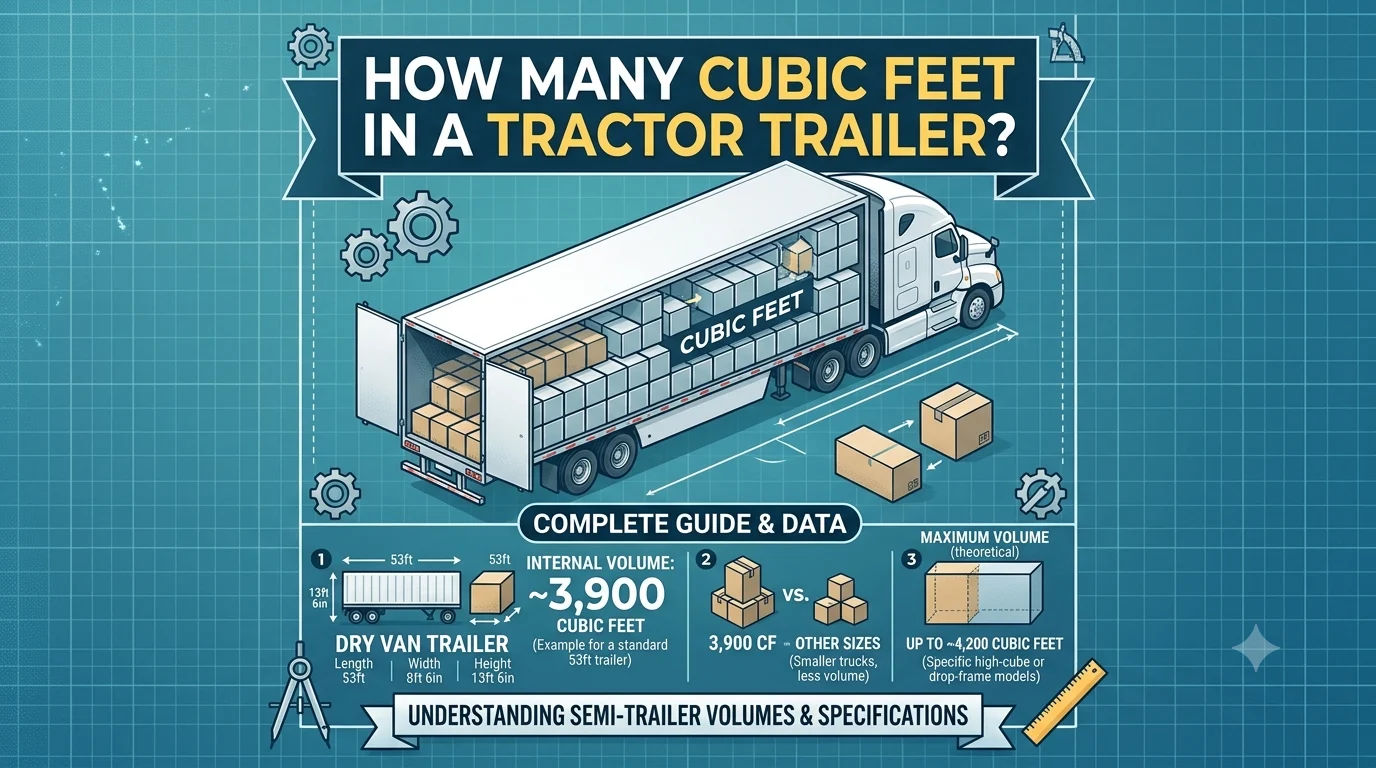
If you’re shipping goods, moving inventory, or simply curious about freight transportation, you may be asking how many cubic feet in a tractor trailer. The answer depends on the trailer’s size and interior dimensions, but the most common 53-foot dry van tractor trailer offers approximately 3,400 to 3,900 cubic feet of cargo space, with an average usable capacity of about 3,700 cubic feet.
Understanding trailer volume is important for businesses, freight brokers, warehouse managers, and anyone involved in shipping. It helps estimate shipping costs, maximize cargo space, improve loading efficiency, and avoid costly mistakes.
This guide explains everything you need to know about tractor trailer capacity, including how cubic feet are calculated, common trailer sizes, practical examples, and tips for using trailer space efficiently.
What Is a Tractor Trailer?
A tractor trailer, also called a semi-truck or semi-trailer, consists of two separate parts:
- The tractor: The powered vehicle that pulls the trailer.
- The trailer: The cargo compartment that carries freight.
There are several trailer types, including dry vans, refrigerated trailers, flatbeds, and tank trailers. However, the standard dry van trailer is the most common for transporting packaged goods.
Since cargo doesn’t just have weight but also occupies space, shipping companies often measure trailer capacity in cubic feet.
What Is a Cubic Foot?
A cubic foot is a unit of volume that measures three-dimensional space.
One cubic foot equals:
- 12 inches long
- 12 inches wide
- 12 inches high
The basic formula is:
Cubic Feet = Length × Width × Height
When calculating trailer capacity, always use the trailer’s interior dimensions, not the outside measurements.
How Many Cubic Feet Are in a Standard Tractor Trailer?
Most freight companies use a 53-foot dry van trailer.
Typical interior dimensions include:
- Length: 53 feet
- Width: 8.5 feet
- Height: 8.5 to 9 feet
This provides approximately:
53 × 8.5 × 8.5 = 3,828 cubic feet
Because different manufacturers design trailers slightly differently, actual usable cargo space generally ranges from 3,400 to 3,900 cubic feet.
For most planning purposes, you can safely estimate 3,700 cubic feet.
Cubic Feet by Trailer Size
Different trailer lengths offer different cargo capacities.
Trailer Length| Approximate Cubic Feet
28-foot trailer| 1,700–1,900
40-foot trailer| 2,500–2,900
48-foot trailer| 3,000–3,400
53-foot trailer| 3,400–3,900
These values are averages and may vary depending on the trailer’s interior height and manufacturer.
How Trailer Volume Is Calculated
Calculating trailer capacity is straightforward.
Formula:
Length × Width × Height
Example:
- Length = 53 ft
- Width = 8.5 ft
- Height = 8.5 ft
Calculation:
53 × 8.5 × 8.5 = 3,828 cubic feet
If the interior height is only 8 feet, the capacity becomes:
53 × 8.5 × 8 = 3,604 cubic feet
Even a small change in height can significantly affect total cargo volume.
Why Cubic Feet Matter
Knowing trailer volume provides several advantages.
Better Shipping Estimates
Businesses can estimate whether one trailer is enough for a shipment.
Lower Transportation Costs
Efficient loading reduces wasted space and may decrease shipping expenses.
Improved Warehouse Planning
Warehouse staff can prepare shipments that match trailer capacity.
Easier Freight Quotes
Many freight companies calculate pricing using cargo dimensions as well as weight.
Reduced Loading Problems
Understanding available volume helps prevent last-minute surprises when loading freight.
Cubic Feet vs. Weight Capacity
Many people confuse volume with weight.
They are different measurements.
Measurement| What It Measures
Cubic Feet| Cargo volume
Weight Capacity| Maximum legal cargo weight
A trailer may have plenty of empty space but still reach its maximum legal weight.
For example:
- A trailer full of pillows may use nearly all available cubic feet while remaining lightweight.
- A trailer carrying steel beams may reach its weight limit long before filling the available space.
Successful shipping requires balancing both volume and weight.
How Many Pallets Fit in a Tractor Trailer?
Pallet capacity is another common measurement.
Typical capacities include:
Trailer Size| Standard 48×40 Pallets
28-foot| 14–16
48-foot| 24
53-foot| 26–30
The actual number depends on:
- Pallet dimensions
- Product shape
- Stacking height
- Loading method
- Weight restrictions
Real-World Example
Suppose you’re shipping storage boxes.
Each box occupies:
- 15 cubic feet
Trailer capacity:
- 3,750 cubic feet
Calculation:
3,750 ÷ 15 = 250 boxes
In reality, loading patterns, securing cargo, and irregular package shapes reduce usable capacity slightly.
Different Types of Tractor Trailers
Not every trailer has the same purpose.
Dry Van Trailer
The most common enclosed trailer.
Best for:
- Retail goods
- Consumer products
- Electronics
- Furniture
- Packaged food
Refrigerated Trailer (Reefer)
Uses temperature control for:
- Frozen food
- Dairy products
- Fresh produce
- Pharmaceuticals
Interior volume is slightly lower because refrigeration equipment occupies space.
Flatbed Trailer
Has no enclosed cargo area.
Used for:
- Machinery
- Steel
- Lumber
- Construction materials
Since it is open, cubic-foot calculations usually aren’t applicable.
Step Deck Trailer
Designed for taller cargo that cannot fit inside a standard trailer.
Factors That Affect Usable Trailer Space
Although trailers have a theoretical maximum volume, usable space may be lower because of several factors.
Cargo Shape
Odd-shaped products create empty spaces.
Packaging
Oversized boxes reduce efficiency.
Load Securing
Straps, braces, and protective materials occupy space.
Stackability
Some products can be stacked safely, while others cannot.
Airflow Requirements
Temperature-sensitive cargo often requires gaps for proper airflow.
Tips to Maximize Trailer Capacity
If you’re responsible for shipping goods, these tips can help.
- Measure products accurately before shipping.
- Use uniform box sizes whenever possible.
- Stack freight safely.
- Eliminate unnecessary packaging.
- Place heavy items on the bottom.
- Fill empty spaces efficiently.
- Use pallet patterns that maximize floor space.
- Plan loading before the trailer arrives.
Proper planning saves time and transportation costs.
Common Mistakes
Avoid these common errors when estimating trailer capacity.
Using Exterior Dimensions
Always calculate using the trailer’s interior measurements.
Ignoring Height
Many people calculate floor area but forget cargo height.
Forgetting Weight Limits
Volume alone doesn’t determine whether a shipment is legal.
Overestimating Usable Space
Doors, wheel wells, and cargo securing equipment reduce available capacity.
Not Considering Cargo Shape
Perfect mathematical volume rarely matches real-world loading.
Quick Reference Chart
Trailer Type| Approximate Cubic Feet| Typical Pallets
28-foot| 1,800| 14–16
40-foot| 2,700| 20
48-foot| 3,200| 24
53-foot| 3,700| 26–30
This table provides quick estimates for most shipping situations.
When Is Trailer Volume Most Important?
Trailer volume becomes especially important for:
- E-commerce businesses
- Furniture shipping
- Moving companies
- Manufacturing
- Wholesale distribution
- Warehouse logistics
- Freight brokerage
- International shipping
Businesses that understand trailer capacity can improve shipping efficiency and reduce costs over time.
Final Thoughts
Understanding how many cubic feet in a tractor trailer is essential for efficient freight planning and logistics. While the exact capacity depends on the trailer’s interior dimensions, a standard 53-foot dry van typically holds between 3,400 and 3,900 cubic feet, with about 3,700 cubic feet being a practical average.
Whether you’re calculating shipment sizes, comparing trailer options, or estimating freight costs, knowing how to measure cubic feet helps you make smarter decisions. By combining accurate measurements with efficient loading practices, you can maximize cargo space, improve transportation efficiency, and reduce unnecessary shipping expenses.