
Have you ever heard someone say the Earth curves 8 inches per mile and wondered if that’s true? The short answer is yes—but it’s only part of the story. The actual amount of Earth’s curvature depends on how far you’re measuring, and the relationship isn’t perfectly linear over long distances.
Understanding how many feet does the Earth curve per mile is useful in surveying, engineering, aviation, photography, construction, and even everyday discussions about visibility over long distances.
In this guide, you’ll learn the real math behind Earth’s curvature, why the “8 inches per mile” rule exists, and how to calculate curvature over different distances.
What Is Earth’s Curvature?
Earth is not flat. It is an oblate spheroid, meaning it is almost spherical but slightly flattened at the poles and wider around the equator.
Because Earth is curved, the surface gradually drops away from a straight horizontal line. This drop is what people refer to as Earth’s curvature.
The average radius of Earth is approximately:
- 3,959 miles
- 6,371 kilometers
- 20.9 million feet
Since the radius is enormous, the curvature over short distances is very small and difficult to notice without precise measurements.
How Many Feet Does the Earth Curve Per Mile?
A commonly quoted rule is:
- About 8 inches after 1 mile
Since there are 12 inches in a foot:
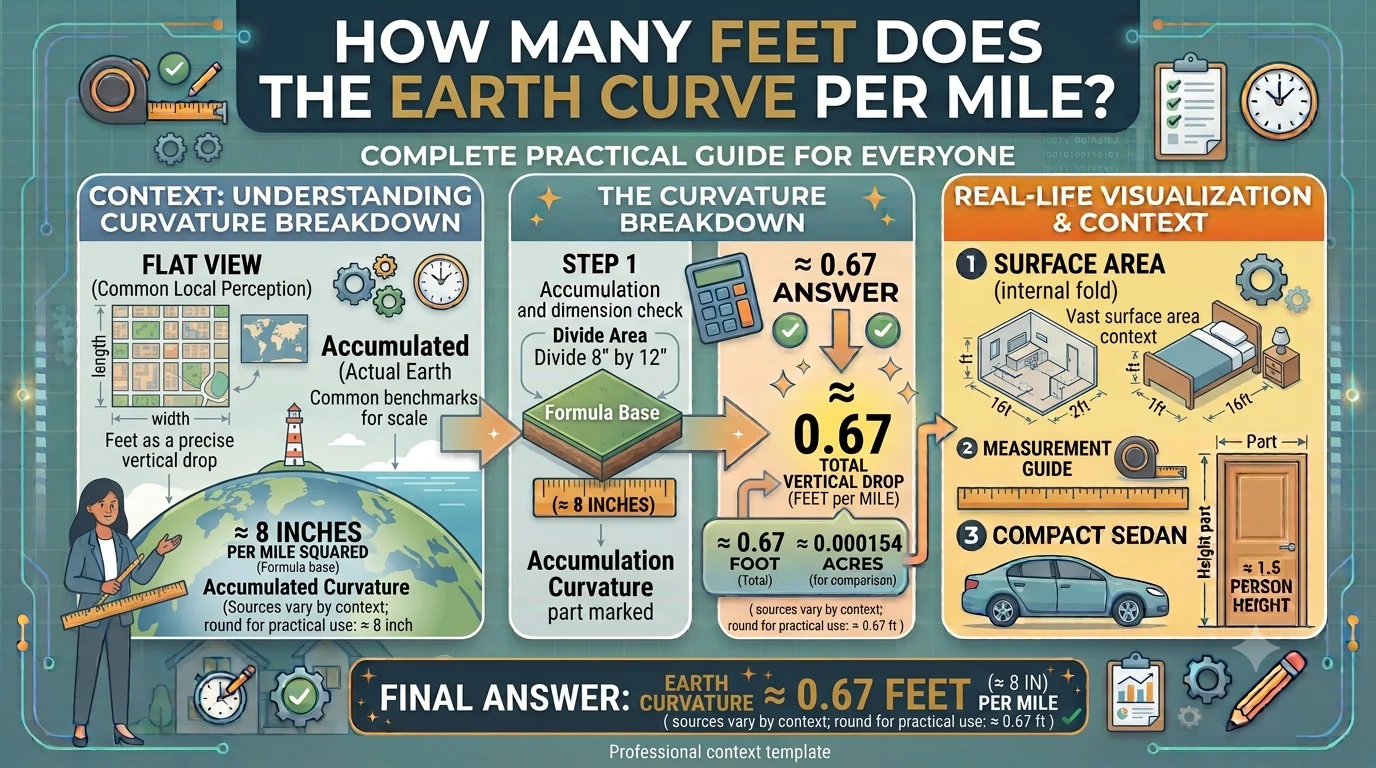
- 8 inches = 0.67 feet
So after one mile, Earth’s surface curves approximately:
0.67 feet (8 inches)
However, this only describes the drop over the first mile. As distance increases, the curvature grows much faster than adding another 8 inches each mile.
Earth Curvature Chart
| Distance | Approximate Curvature |
|---|---|
| 1 mile | 8 inches (0.67 ft) |
| 2 miles | 2.67 feet |
| 3 miles | 6 feet |
| 4 miles | 10.67 feet |
| 5 miles | 16.67 feet |
| 10 miles | 66.7 feet |
| 20 miles | 266.7 feet |
| 50 miles | 1,666.7 feet |
| 100 miles | 6,666.7 feet |
Notice that the curvature increases much faster than a simple “8 inches per mile.”
Why Doesn’t the Curvature Increase by Only 8 Inches Every Mile?
Many people mistakenly believe:
- 1 mile = 8 inches
- 2 miles = 16 inches
- 3 miles = 24 inches
This is incorrect.
Earth’s surface is curved like part of a giant circle. Because of this geometry, the drop increases approximately with the square of the distance.
A useful approximation is:
Curvature (in inches) ≈ 8 × (distance in miles)²
Examples:
- 1 mile → 8 inches
- 2 miles → 32 inches
- 3 miles → 72 inches
- 5 miles → 200 inches
This formula provides a close estimate for relatively short distances.
Earth Curvature Formula
A commonly used approximation is:
Drop = 8 × (Distance²)
Where:
- Drop is measured in inches.
- Distance is measured in miles.
To convert inches to feet:
Feet = Inches ÷ 12
Example 1
Distance = 4 miles
8 × 4²
8 × 16
128 inches
128 ÷ 12
≈ 10.67 feet
Example 2
Distance = 10 miles
8 × 10²
8 × 100
800 inches
800 ÷ 12
≈ 66.7 feet
Why Is the Formula Only an Approximation?
The “8 inches per mile squared” formula is accurate enough for everyday calculations.
However, professionals often use more precise geometry:
Curvature = Earth’s Radius − √(Earth’s Radius² − Distance²)
Surveyors, civil engineers, and scientists use this formula when very high precision is required.
Real-World Examples
Surveying
Surveyors account for Earth’s curvature when measuring long distances.
Ignoring curvature can introduce noticeable errors in large construction projects.
Railroads
Railway engineers consider curvature when designing long tracks to ensure accurate alignment.
Bridges
Long bridges require precise calculations because Earth’s surface curves underneath them.
Famous bridges involve advanced surveying techniques that include Earth’s curvature.
Aviation
Pilots generally don’t manually calculate curvature during flight.
Aircraft instruments and navigation systems already account for Earth’s shape.
Photography
Landscape photographers sometimes notice distant mountains disappearing below the horizon because of Earth’s curvature.
Atmospheric conditions can also affect what is visible.
Curvature vs. Horizon Distance
People often confuse Earth’s curvature with the distance to the horizon.
They are related but different.
- Curvature measures how much the Earth’s surface drops.
- Horizon distance measures how far you can see before Earth blocks your view.
For someone standing about 6 feet tall, the horizon is roughly 3 miles away.
From higher elevations, the horizon extends much farther.
Earth Curvature at Common Distances
1 Mile
- 8 inches
- 0.67 feet
Barely noticeable.
5 Miles
- 16.7 feet
Large buildings may begin disappearing from the bottom upward.
10 Miles
- 66.7 feet
The curvature becomes significant for surveying and engineering.
25 Miles
- About 417 feet
Very important for long-distance visibility calculations.
50 Miles
- About 1,667 feet
Atmospheric refraction often affects observations at this distance.
Curvature in Feet vs. Inches
| Distance | Inches | Feet |
|---|---|---|
| 1 mile | 8 | 0.67 |
| 2 miles | 32 | 2.67 |
| 3 miles | 72 | 6 |
| 5 miles | 200 | 16.67 |
| 10 miles | 800 | 66.67 |
Feet are generally easier to understand over longer distances.
Common Misunderstandings
“The Earth Curves Exactly 8 Inches Every Mile”
Not true.
The drop increases with the square of the distance.
“Curvature Is Easy to See”
Usually not.
Over short distances, the curvature is extremely small compared to hills, buildings, waves, and atmospheric effects.
“Water Doesn’t Curve”
Large bodies of water follow Earth’s curvature because gravity pulls water toward Earth’s center.
Factors That Affect What You See
Earth’s curvature is only one factor affecting visibility.
Other factors include:
- Atmospheric refraction
- Air temperature
- Humidity
- Elevation
- Terrain
- Waves on water
- Trees
- Buildings
These can make distant objects appear higher or lower than expected.
Practical Uses of Earth Curvature Calculations
Knowing Earth’s curvature helps in many fields, including:
- Land surveying
- Civil engineering
- Bridge construction
- Road design
- Aviation
- Marine navigation
- Geographic mapping
- Satellite communication
- Long-distance photography
- Scientific research
Expert Tips
- Use the 8-inch rule only for quick estimates.
- Use the full geometric formula for engineering projects.
- Remember that atmospheric refraction can change observed results.
- Don’t confuse curvature with the horizon distance.
- Always use consistent units when calculating.
Common Calculation Mistakes
Avoid these common errors:
- Adding 8 inches for every mile instead of squaring the distance.
- Mixing feet and inches.
- Ignoring elevation differences.
- Forgetting atmospheric refraction.
- Using rounded values when precision is required.
Frequently Asked Questions
How many feet does the Earth curve after 1 mile?
Earth curves approximately 0.67 feet, which equals 8 inches, after one mile.
Is the Earth really 8 inches lower every mile?
Only for the first mile. Over longer distances, the curvature increases according to the square of the distance.
How much does the Earth curve after 10 miles?
The approximate drop is 66.7 feet.
Why does the curvature increase faster over longer distances?
Because Earth is a sphere, the drop follows circular geometry rather than increasing at a constant rate.
Do engineers account for Earth’s curvature?
Yes. Surveyors, engineers, and mapping professionals include Earth’s curvature in projects that span long distances.
Conclusion
If you’ve ever wondered how many feet does the Earth curve per mile, the commonly accepted estimate is 8 inches (0.67 feet) after the first mile. However, this does not mean the Earth drops another 8 inches for every additional mile. Instead, the amount of curvature increases with the square of the distance, making the drop much greater over longer measurements.
Understanding Earth’s curvature is valuable for surveying, engineering, aviation, mapping, and long-distance visibility. While the simple 8-inch rule is useful for quick estimates, more precise calculations rely on Earth’s radius and geometric formulas when accuracy matters.