

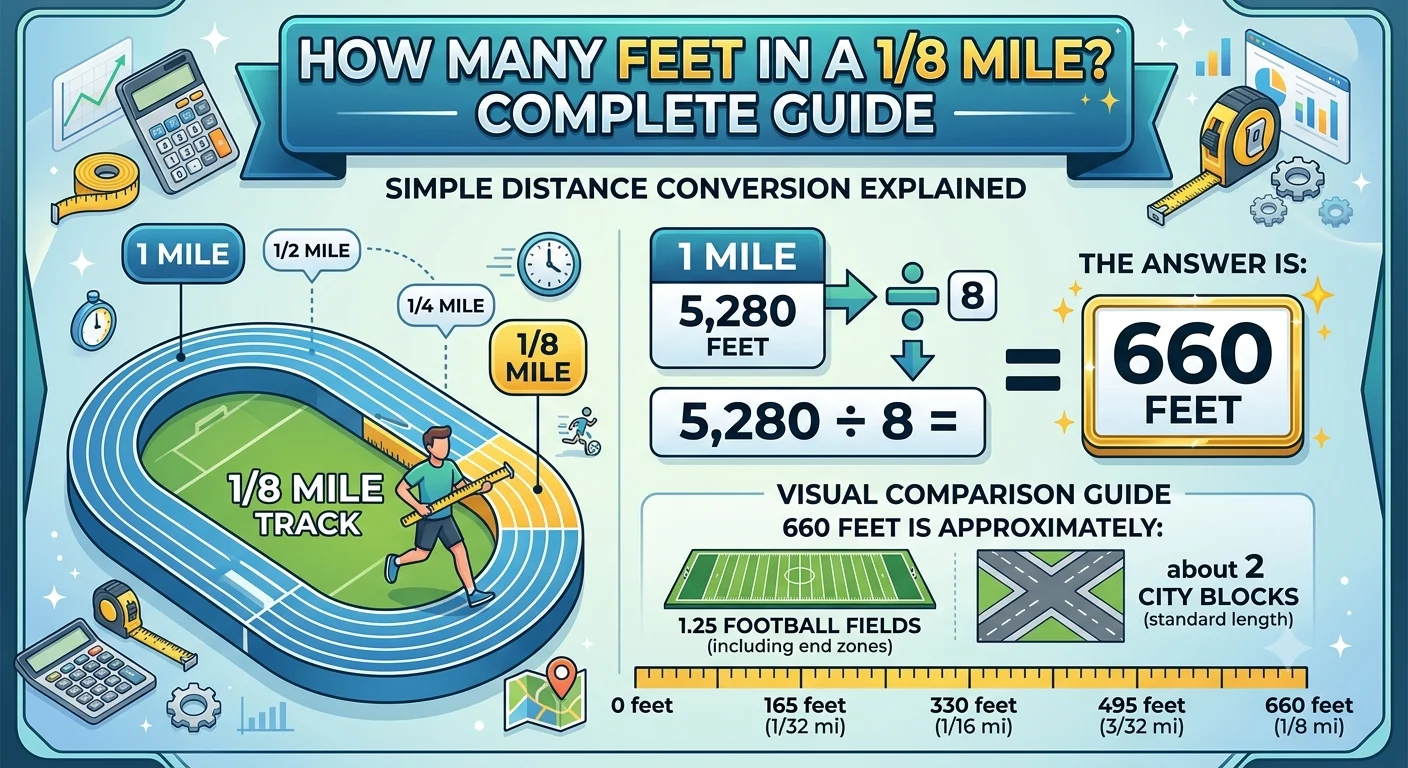
Understanding how many feet in a 1 8 mile is useful for students, drivers, runners, engineers, and anyone working with distance measurements. Whether you’re solving a math problem, planning a race track, or estimating land distance, this conversion helps you work faster and more accurately.
A mile is a standard unit in the imperial system, and converting it into feet breaks it into smaller, more practical measurements. In this guide, you will learn the exact value, how to calculate it, and where it is used in real life.
What Does 1/8 Mile Mean in Distance Measurement?
A 1/8 mile means one part out of eight equal parts of a full mile.
Since:
- 1 mile = 5280 feet
- 1/8 mile = one-eighth of a mile
So it is simply a fraction of the full mile divided into 8 equal sections.
This measurement is commonly used in:
- Drag racing tracks
- Short-distance running
- Construction layout planning
- Land surveying
It helps break large distances into smaller, manageable units.
How Many Feet in a 1/8 Mile (Exact Answer Explained)
The exact answer to how many feet in a 1 8 mile is:
660 feet
This is a fixed and standard conversion.
Step-by-Step Calculation
- 1 mile = 5280 feet
- 1/8 mile = 5280 ÷ 8
- 5280 ÷ 8 = 660 feet
So:
1/8 mile = 660 feet
Why This Conversion Works
The imperial system defines:
- 1 mile = 5280 feet
So any fraction of a mile must be divided from this base number. That’s why dividing by 8 gives the correct result for 1/8 mile.
Quick Mile to Feet Conversion Table
| Distance | Feet |
|---|---|
| 1/8 mile | 660 feet |
| 1/4 mile | 1320 feet |
| 1/2 mile | 2640 feet |
| 3/4 mile | 3960 feet |
| 1 mile | 5280 feet |
This makes quick comparisons much easier without recalculating every time.
Real-World Uses of 1/8 Mile (660 Feet)
The 1/8 mile distance is not just theory—it is widely used in real life.
Drag Racing
- Used in short-distance racing events
- Measures acceleration and speed
- Common in beginner racing tracks
Cars cover 660 feet in just a few seconds at high speed.
Fitness and Running
- Used for sprint intervals
- Helps track short-distance speed
- Common in athletic training drills
Coaches often use 1/8 mile runs to build stamina and speed.
Construction and Surveying
- Used for dividing land sections
- Helps in planning roads and layouts
- Useful for distance estimation in projects
Engineers prefer smaller units like this for precision.
Common Mistakes in Conversion
Many people make errors when converting miles to feet:
- Forgetting 1 mile = 5280 feet
- Dividing by wrong numbers (like 10 instead of 8)
- Mixing yards and feet
- Incorrect rounding
Even small mistakes can lead to inaccurate results.
Easy Mental Shortcut
To quickly remember how many feet in a 1 8 mile, use this:
- 1 mile = 5280 feet
- Divide by 8
- Result = 660 feet
You can also remember:
1/4 mile = 1320 feet → half of that is 660 feet
Real-Life Comparison
To visualize the distance:
- A football field (with end zones) ≈ 360 feet
- 1/8 mile = 660 feet
- That is almost two football fields long
This helps you understand the real size of 1/8 mile easily.
Why Accurate Conversion Matters
Knowing the correct value of how many feet in a 1 8 mile is important because:
- It improves measurement accuracy
- Helps in engineering and construction work
- Useful in sports timing and performance tracking
- Prevents calculation mistakes
Small errors in distance can cause big issues in real projects.
Conclusion
A 1/8 mile equals 660 feet, and this is a fixed conversion in the imperial system. Once you understand that 1 mile equals 5280 feet, the rest becomes simple.
Whether you are working in academics, sports, or real-world measurement tasks, this conversion helps you save time and improve accuracy.
4