
Many people search for 2000 cubic feet how many square feet when planning landscaping, construction, flooring, or material coverage projects. The answer is not always straightforward because cubic feet measures volume, while square feet measures area.
To convert 2000 cubic feet into square feet, you must know the depth or thickness of the material. Without depth, there is no single correct answer.
This guide explains the conversion formula, provides practical examples, and includes easy-to-use charts so you can determine exactly how many square feet 2000 cubic feet will cover.
Understanding the Difference Between Cubic Feet and Square Feet
Before making any conversion, it is important to understand these two measurements.
What Is a Cubic Foot?
A cubic foot is a measurement of volume. It represents a space that is:
- 1 foot long
- 1 foot wide
- 1 foot high
In mathematical terms:
1 Cubic Foot = 1 ft × 1 ft × 1 ft
Cubic feet are commonly used to measure:
- Soil
- Mulch
- Concrete
- Gravel
- Storage space
- Water volume
What Is a Square Foot?
A square foot measures area rather than volume.
A square foot equals:
1 foot × 1 foot = 1 square foot
Square feet are commonly used for:
- Flooring
- Lawns
- Rooms
- Landscaping areas
- Roofing
- Walls
The key difference is that square feet do not include depth, while cubic feet do.
Can You Convert 2000 Cubic Feet Directly to Square Feet?
No.
You cannot directly convert 2000 cubic feet into square feet unless you know the depth.
Think about pouring soil onto a field:
- A thin layer covers a large area.
- A thick layer covers a smaller area.
The same 2000 cubic feet can produce many different square footage results depending on depth.
Formula to Convert Cubic Feet to Square Feet
The formula is:
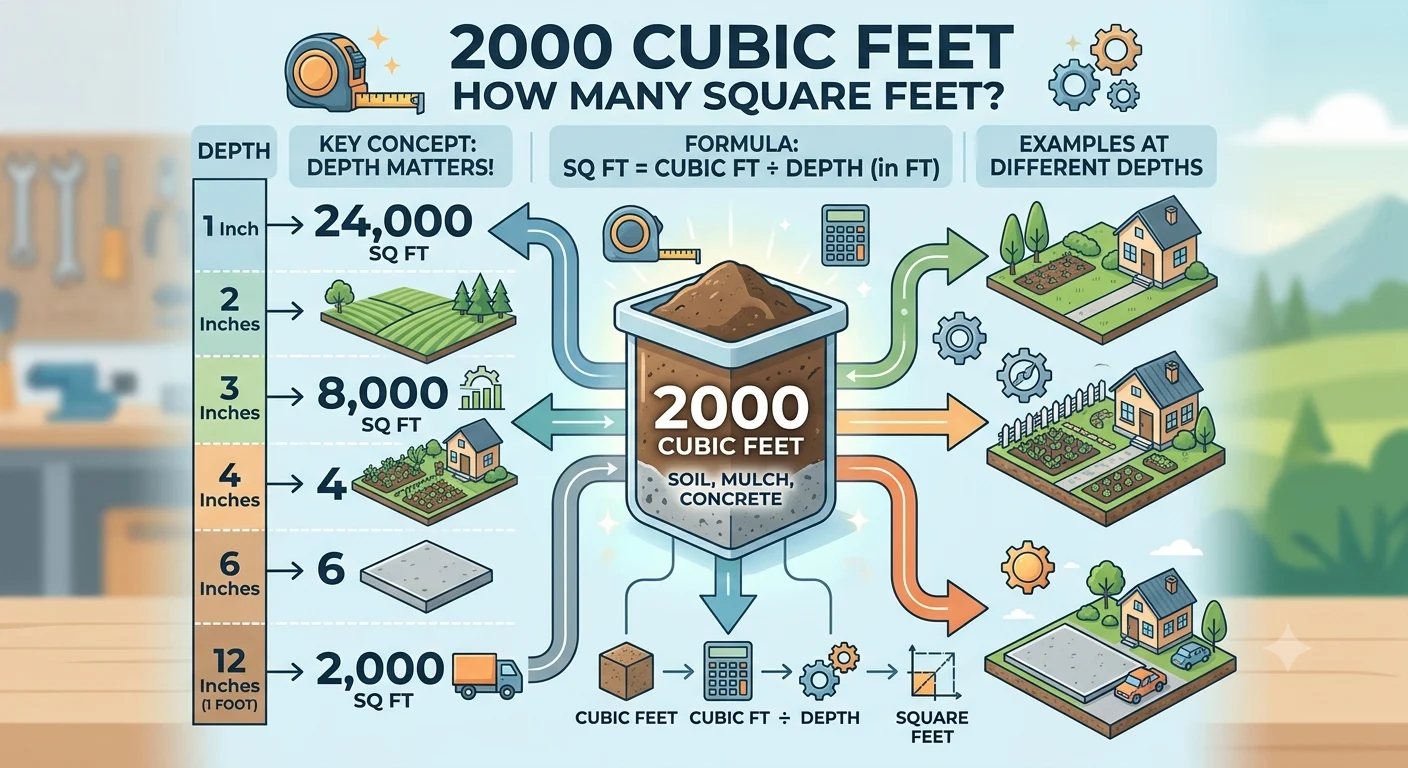
Square Feet = Cubic Feet ÷ Depth (in Feet)
Where:
- Cubic Feet = Total volume
- Depth = Thickness of material in feet
For this article:
Square Feet = 2000 ÷ Depth
This formula allows you to calculate coverage for any depth.
2000 Cubic Feet How Many Square Feet at Different Depths?
The following examples show the most common depths used in landscaping and construction.
1 Inch Deep
Convert inches to feet:
1 ÷ 12 = 0.0833 feet
Calculation:
2000 ÷ 0.0833 = 24,000 square feet
Answer: Approximately 24,000 square feet
2 Inches Deep
Depth:
2 ÷ 12 = 0.1667 feet
Calculation:
2000 ÷ 0.1667 = 12,000 square feet
Answer: Approximately 12,000 square feet
3 Inches Deep
Depth:
3 ÷ 12 = 0.25 feet
Calculation:
2000 ÷ 0.25 = 8,000 square feet
Answer: Approximately 8,000 square feet
4 Inches Deep
Depth:
4 ÷ 12 = 0.3333 feet
Calculation:
2000 ÷ 0.3333 = 6,000 square feet
Answer: Approximately 6,000 square feet
6 Inches Deep
Depth:
6 ÷ 12 = 0.5 feet
Calculation:
2000 ÷ 0.5 = 4,000 square feet
Answer: Approximately 4,000 square feet
12 Inches Deep
Depth:
12 ÷ 12 = 1 foot
Calculation:
2000 ÷ 1 = 2,000 square feet
Answer: Exactly 2,000 square feet
Conversion Chart for 2000 Cubic Feet
| Depth | Depth in Feet | Coverage Area |
|---|---|---|
| 1 inch | 0.0833 ft | 24,000 sq ft |
| 2 inches | 0.1667 ft | 12,000 sq ft |
| 3 inches | 0.25 ft | 8,000 sq ft |
| 4 inches | 0.3333 ft | 6,000 sq ft |
| 5 inches | 0.4167 ft | 4,800 sq ft |
| 6 inches | 0.5 ft | 4,000 sq ft |
| 8 inches | 0.6667 ft | 3,000 sq ft |
| 10 inches | 0.8333 ft | 2,400 sq ft |
| 12 inches | 1 ft | 2,000 sq ft |
This chart provides quick estimates for common project depths.
Real-World Examples
Understanding how this conversion works in practical situations makes it easier to use.
Mulch Coverage
Mulch is commonly applied at 2–4 inches deep.
Using 2000 cubic feet:
| Mulch Depth | Coverage |
|---|---|
| 2 inches | 12,000 sq ft |
| 3 inches | 8,000 sq ft |
| 4 inches | 6,000 sq ft |
A homeowner covering garden beds with a 3-inch mulch layer could cover approximately 8,000 square feet.
Soil Coverage
Topsoil is often spread at 4–6 inches.
With 2000 cubic feet:
| Soil Depth | Coverage |
|---|---|
| 4 inches | 6,000 sq ft |
| 6 inches | 4,000 sq ft |
This is useful for lawn renovations and landscape grading projects.
Concrete Projects
Concrete slabs are usually measured in both area and thickness.
If a slab is 6 inches thick:
2000 cubic feet covers:
4,000 square feet
Examples include:
- Warehouse floors
- Driveways
- Parking areas
- Commercial foundations
Step-by-Step Calculation Example
Suppose you have 2000 cubic feet of topsoil and need a depth of 5 inches.
Step 1: Convert Inches to Feet
5 ÷ 12 = 0.4167 feet
Step 2: Use the Formula
Square Feet = Cubic Feet ÷ Depth
Square Feet = 2000 ÷ 0.4167
Step 3: Calculate
Square Feet ≈ 4,800
Result
You can cover approximately 4,800 square feet with 2000 cubic feet of soil at a depth of 5 inches.
Common Mistakes When Converting Cubic Feet to Square Feet
Many people make errors during volume-to-area conversions.
Forgetting to Convert Inches to Feet
Always convert inches into feet before using the formula.
Example:
- 4 inches = 0.3333 feet
- Not 4 feet
Ignoring Depth
Without depth, square footage cannot be calculated accurately.
Rounding Too Early
Perform calculations using full decimal values and round only at the final step.
Mixing Units
Keep all measurements in the same unit system.
Avoid combining:
- Feet and inches
- Meters and feet
- Yards and feet
Tips for Accurate Measurements
Follow these best practices:
Measure Carefully
Use a measuring tape or laser distance tool.
Verify Material Depth
Different projects require different depths.
Typical recommendations:
- Mulch: 2–4 inches
- Topsoil: 4–6 inches
- Gravel: 3–6 inches
- Concrete: 4–8 inches
Add Extra Material
Most professionals order 5–10% more material to account for waste and uneven surfaces.
Double-Check Calculations
Even small mistakes can result in ordering too much or too little material.
When Is This Conversion Useful?
Converting 2000 cubic feet to square feet is useful in many situations.
Landscaping
Calculate coverage for:
- Mulch
- Decorative rock
- Compost
- Soil
Construction
Estimate:
- Concrete slabs
- Foundation fills
- Gravel bases
Agriculture
Determine coverage for:
- Soil amendments
- Fertilizer applications
- Raised garden beds
Property Maintenance
Plan projects involving:
- Ground leveling
- Drainage improvements
- Lawn restoration
Understanding the relationship between cubic feet and square feet helps improve planning and budgeting.
Frequently Asked Questions
How many square feet is 2000 cubic feet?
It depends on depth. At 1 foot deep, 2000 cubic feet equals 2000 square feet. At shallower depths, the coverage area increases.
Can cubic feet be converted directly to square feet?
No. You must know the depth or thickness before converting volume to area.
How many square feet does 2000 cubic feet cover at 4 inches deep?
At 4 inches deep, 2000 cubic feet covers approximately 6,000 square feet.
What formula converts cubic feet to square feet?
Use:
Square Feet = Cubic Feet ÷ Depth (in Feet)
Why do different answers exist for 2000 cubic feet?
Because coverage changes based on depth. The same volume spreads over larger or smaller areas depending on thickness.
Conclusion
When calculating 2000 cubic feet how many square feet, the most important factor is depth. Since cubic feet measure volume and square feet measure area, there is no single conversion without knowing the thickness of the material.
Using the formula:
Square Feet = Cubic Feet ÷ Depth (in Feet)
you can quickly determine coverage for landscaping, construction, soil, mulch, gravel, and concrete projects. For example, 2000 cubic feet covers about 24,000 square feet at 1 inch deep, 8,000 square feet at 3 inches deep, and 2,000 square feet at 12 inches deep. Understanding this relationship ensures accurate material estimates, lower costs, and more successful project planning.