

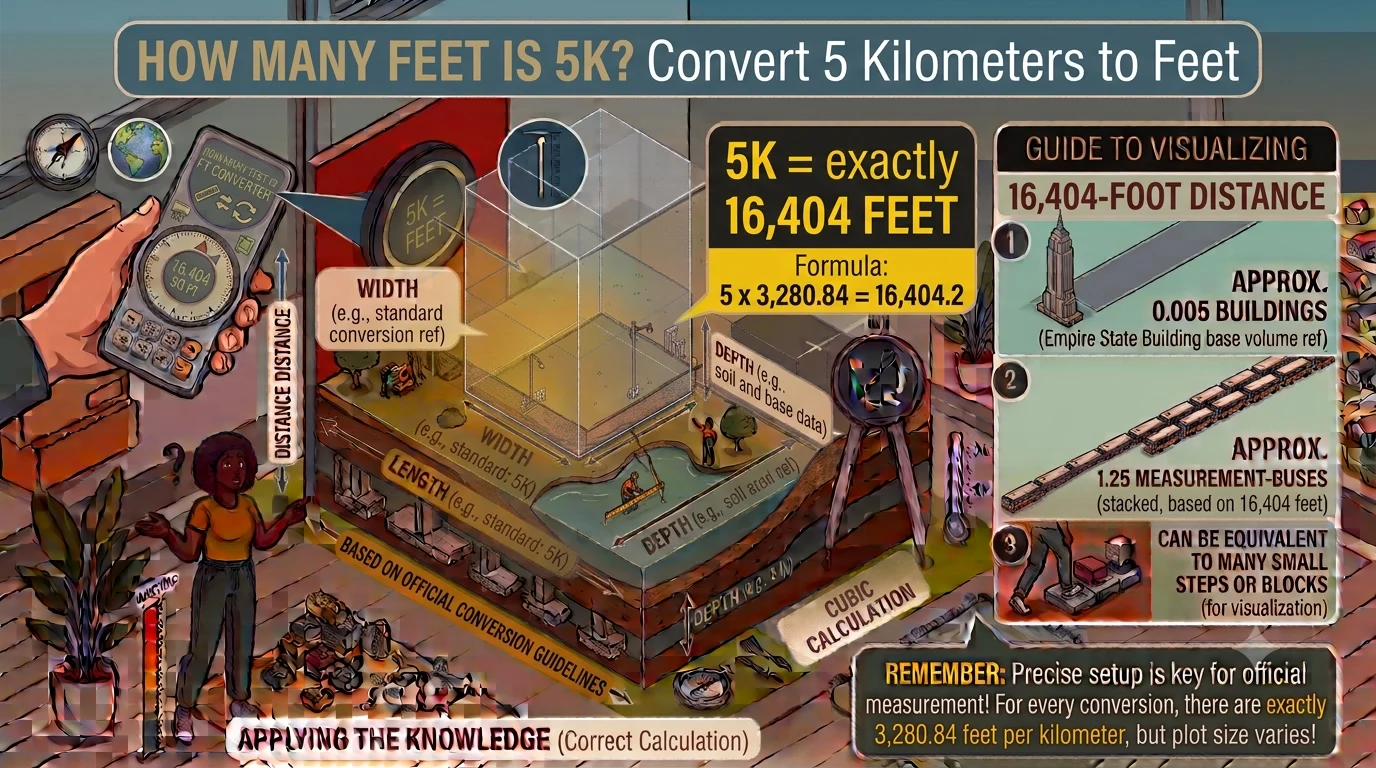
If you are wondering how many feet is 5K, the answer is simple: a 5K distance equals 16,404.2 feet. A 5K is one of the most popular running and walking distances, especially in races, fitness events, and training programs. Understanding the conversion from kilometers to feet can help runners, students, travelers, and anyone working with distance measurements.
A 5K means 5 kilometers, and kilometers are part of the metric system, while feet are commonly used in the United States and a few other countries. Since these two systems use different units, converting between them makes distance easier to understand.
In this guide, you will learn exactly how many feet are in a 5K, how the conversion works, examples, comparisons, and practical uses of this measurement.
How Many Feet Is 5K?
5K equals 16,404.2 feet.
To understand this conversion, you need to know the relationship between kilometers and feet:
- 1 kilometer = 3,280.84 feet
- 5 kilometers = 5 × 3,280.84 feet
- 5 kilometers = 16,404.2 feet
Therefore:
5K = 16,404.2 feet
This means that if you complete a 5K race, you have traveled more than sixteen thousand feet from start to finish.
What Does 5K Mean?
The term 5K refers to a distance of 5 kilometers. The letter “K” stands for kilometer, which equals 1,000 meters.
A 5K race is one of the most common running events because it is suitable for beginners while still providing a challenge for experienced athletes.
A 5K distance equals:
| Measurement Unit | Equivalent Distance |
|---|---|
| Kilometers | 5 km |
| Meters | 5,000 meters |
| Miles | 3.11 miles |
| Feet | 16,404.2 feet |
| Yards | 5,468 yards |
| Inches | 196,850.4 inches |
Whether you are training for a race or simply comparing distances, knowing these conversions gives you a better understanding of the actual length.
How to Convert 5 Kilometers to Feet
Converting kilometers into feet requires a simple multiplication formula.
Kilometer to Feet Conversion Formula
Kilometers × 3,280.84 = Feet
For a 5K:
5 × 3,280.84 = 16,404.2 feet
So:
5 km × 3,280.84 = 16,404.2 feet
This formula works for any kilometer measurement.
For example:
- 2 km = 6,561.68 feet
- 3 km = 9,842.52 feet
- 10 km = 32,808.4 feet
Why Is a 5K Equal to 16,404 Feet?
The reason a 5K equals 16,404 feet is because kilometers and feet are different units from different measurement systems.
Kilometers belong to the metric system, which is based on meters. Feet belong to the imperial system.
The conversion relationship is:
- 1 meter = 3.28084 feet
- 1 kilometer = 1,000 meters
- Therefore, 1 kilometer = 3,280.84 feet
Since a 5K contains five kilometers:
5 × 3,280.84 = 16,404.2 feet
This fixed conversion allows people to switch between metric and imperial measurements accurately.
5K Distance Compared to Other Common Distances
Understanding how far a 5K is becomes easier when comparing it with familiar distances.
| Distance | Feet |
|---|---|
| 1 kilometer | 3,280.84 feet |
| 2 kilometers | 6,561.68 feet |
| 5K | 16,404.2 feet |
| 10K | 32,808.4 feet |
| Half marathon | 69,125 feet |
| Marathon | 138,435 feet |
A 5K is much shorter than a marathon but long enough to provide a meaningful fitness challenge.
How Long Does It Take to Complete a 5K?
The time needed to complete a 5K depends on fitness level, running experience, age, and pace.
Typical 5K completion times:
| Person Type | Average Time |
|---|---|
| Beginner walker | 45–60 minutes |
| Casual walker | 40–50 minutes |
| Beginner runner | 30–40 minutes |
| Regular runner | 20–30 minutes |
| Competitive runner | Under 20 minutes |
Since a 5K equals 16,404 feet, your speed determines how quickly you cover that distance.
Real-Life Examples of 5K Distance
A measurement like 16,404 feet can feel abstract, so here are some practical examples.
Walking a 5K
Most people walk around 3 miles per hour. At that pace, completing 16,404 feet takes approximately 45–60 minutes.
Running a 5K
Many recreational runners complete a 5K in 25–35 minutes. Professional athletes can finish much faster.
Comparing 5K to Buildings
The height of very tall buildings is often measured in feet. While a 5K is not vertical, if you lined up the distance:
- 5K is about 16,404 feet long
- It is several times longer than many skyscraper heights
This comparison helps visualize how far a 5K actually stretches.
Why Do People Need to Convert 5K to Feet?
There are many reasons someone may need to know how many feet is 5K.
Fitness and Running Training
Runners often track distance using miles or feet, especially when training on tracks, treadmills, or GPS devices.
Education
Students may need kilometer-to-feet conversions for math problems, science projects, or geography lessons.
Travel and Mapping
Maps and navigation tools sometimes display distances in different units depending on the country.
Construction and Planning
Professionals working with land, roads, or outdoor spaces may need accurate distance conversions.
5K vs 5 Miles: What Is the Difference?
A common mistake is confusing 5K with 5 miles. They are not the same distance.
| Distance | Feet |
|---|---|
| 5 kilometers | 16,404.2 feet |
| 5 miles | 26,400 feet |
A 5-mile distance is much longer than a 5K.
The difference is:
26,400 feet − 16,404.2 feet = 9,995.8 feet
So, 5 miles is almost 10,000 feet longer than a 5K.
Common Mistakes When Converting 5K to Feet
Many people make errors when converting kilometers to feet. Here are the most common mistakes.
Mistake 1: Using the Wrong Conversion Number
Some people incorrectly use 1 kilometer = 1,000 feet. This is wrong.
The correct conversion is:
1 kilometer = 3,280.84 feet
Mistake 2: Confusing Kilometers and Miles
A 5K is not 5 miles. A kilometer is shorter than a mile.
- 5K = 3.11 miles
- 5 miles = 8.05 kilometers
Mistake 3: Forgetting Decimal Accuracy
For everyday use, rounding 5K to 16,404 feet is acceptable. However, scientific or professional calculations may require the exact value of 16,404.2 feet.
Expert Tips for Remembering 5K Conversion
If you frequently work with distance conversions, these tips can help:
- Remember that 1 kilometer is about 3,281 feet.
- Multiply kilometers by 3,280 for quick estimates.
- Use online conversion tools for exact calculations.
- Keep common race distances memorized.
For example:
5 kilometers × 3,280 ≈ 16,400 feet
This quick calculation is usually accurate enough for everyday situations.
How Many Feet Is a 5K Run on a Track?
A standard outdoor running track is usually 400 meters per lap.
A 5K race equals:
- 5,000 meters
- 12.5 track laps
- 16,404.2 feet
This means runners completing a 5K on a standard track need to run twelve full laps plus half of another lap.
Frequently Asked Questions
How many feet is 5K exactly?
A 5K equals exactly 16,404.2 feet when converted using the standard conversion rate of 1 kilometer = 3,280.84 feet.
Is a 5K the same as 5 miles?
No. A 5K equals about 3.11 miles, while 5 miles equals about 8.05 kilometers. A 5-mile distance is significantly longer.
How many steps are in a 5K?
The number of steps depends on stride length, but most people take around 6,000 to 7,500 steps to complete a 5K.
How many feet are in 10K?
A 10K equals 32,808.4 feet because it is twice the distance of a 5K.
Why is a 5K race called a 5K?
A 5K race is called a 5K because it covers 5 kilometers. The “K” represents kilometers, and the number represents the distance.
Conclusion
Knowing how many feet is 5K helps you understand one of the most popular running and walking distances. A 5K equals 16,404.2 feet, which is the same as 5 kilometers, 3.11 miles, or 5,468 yards.
Whether you are preparing for a race, studying measurements, planning routes, or simply curious about distance conversions, converting kilometers to feet is a useful skill. By remembering that one kilometer equals 3,280.84 feet, you can quickly calculate any kilometer measurement with confidence.