

Choosing the right amount of string is important when restringing a tennis racquet. If you are wondering how many feet of string for tennis racquet replacement, the answer depends on your racquet size, string pattern, and whether you are stringing the racquet yourself or using a professional stringer.
Most standard tennis racquets require around 35 to 40 feet of tennis string for a complete restring. However, some racquets may need slightly more or less depending on the head size and stringing method. Knowing the correct string length helps avoid wasted material, saves money, and ensures your racquet performs at its best.
Whether you are a beginner learning about tennis equipment or an experienced player preparing for your next restring, this guide explains everything you need to know about tennis racquet string length, measurements, types of strings, and common mistakes to avoid.
How Many Feet of String for Tennis Racquet?
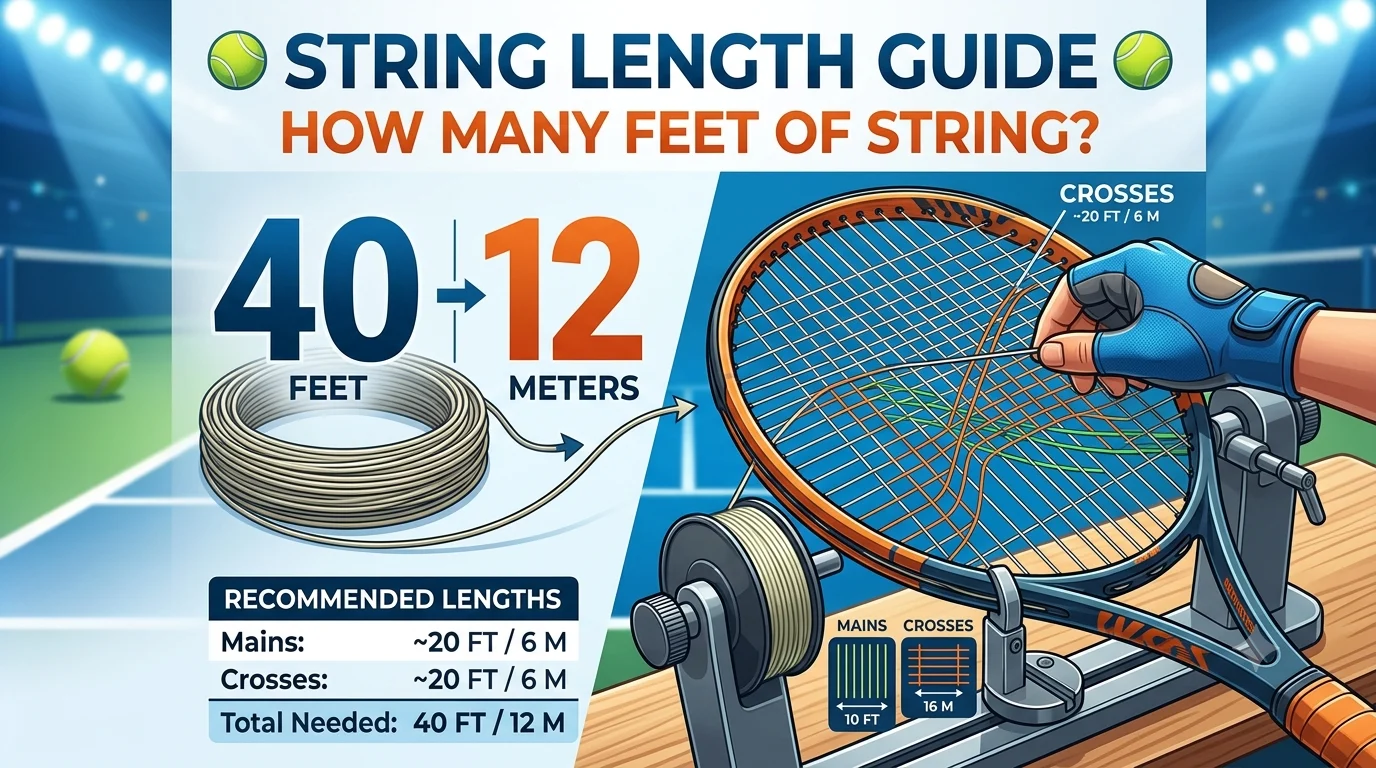
The average tennis racquet requires approximately 40 feet of string for a full restring. Most players and stringers use a standard 40-foot set because it provides enough material for both the main strings and cross strings.
A typical breakdown looks like this:
| Racquet Type | Recommended String Length |
|---|---|
| Standard adult tennis racquet | 35–40 feet |
| Oversized tennis racquet | 40–45 feet |
| Smaller junior racquet | 20–30 feet |
| Two-piece stringing method | 18–22 feet mains + 18–20 feet crosses |
For most modern adult tennis racquets, purchasing a 40-foot set of tennis string is the safest option.
Understanding Tennis Racquet String Length Requirements
A tennis racquet is made up of two groups of strings:
- Main strings: The vertical strings running from the top of the racquet head to the bottom.
- Cross strings: The horizontal strings woven through the mains.
Both sections require different amounts of string.
When using a one-piece stringing method, the entire racquet is strung using one continuous piece of string. This usually requires about 35–40 feet.
With a two-piece stringing method, the string is divided into two sections:
- One piece for the mains
- One piece for the crosses
Many professional stringers prefer the two-piece method because it provides more control over tension and makes replacing damaged sections easier.
Factors That Affect How Many Feet of String a Tennis Racquet Needs
The exact amount of string needed is not the same for every racquet. Several factors influence the required length.
1. Racquet Head Size
The size of the racquet head has the biggest impact on string length.
A larger racquet head has more space to cover, meaning it requires more string.
Examples:
- A 95–98 square inch racquet may need around 35 feet.
- A 100–110 square inch racquet may need around 38–40 feet.
- An oversized 115+ square inch racquet may require 40–45 feet.
Players who use oversized racquets should always buy extra string to avoid running short.
2. String Pattern
The string pattern refers to how many main and cross strings a racquet has.
Common patterns include:
- 16×19 (16 mains and 19 crosses)
- 18×20 (18 mains and 20 crosses)
- 16×18
A dense string pattern like 18×20 usually needs more string because there are more individual strings to install.
A more open pattern like 16×19 may require slightly less string.
3. Racquet Length
Standard adult tennis racquets are usually 27 inches long. However, extended-length racquets are available.
Longer racquets require additional string because the strings cover a larger area.
For example:
- 27-inch racquet: around 38–40 feet
- 28-inch extended racquet: may need 40+ feet
4. Stringing Technique
The stringing method also affects how much string is needed.
Professional stringers often leave extra string for pulling, clamping, and tying knots.
Extra length helps prevent problems during installation.
Tennis Racquet String Length Chart
The following chart provides general estimates:
| Racquet Size | Approximate String Needed |
|---|---|
| 90–95 sq in | 35–38 feet |
| 96–100 sq in | 38–40 feet |
| 101–110 sq in | 40–42 feet |
| 111+ sq in | 42–45 feet |
These measurements are estimates. Always check your racquet manufacturer’s recommended string length when possible.
How Much String Is Needed for Mains and Crosses?
If you are stringing a tennis racquet using the two-piece method, the string is usually divided into two sections.
A common setup:
| Section | Required String Length |
|---|---|
| Main strings | 18–22 feet |
| Cross strings | 17–20 feet |
| Total | 35–42 feet |
The exact amount depends on the racquet frame and string pattern.
One-Piece vs Two-Piece Tennis Stringing
Both methods are commonly used by players and professionals.
One-Piece Stringing
One-piece stringing uses a single continuous string for the entire racquet.
Advantages:
- Uses slightly less string
- Faster installation
- Common for recreational players
Disadvantages:
- Some players prefer the feel of two-piece stringing
- Limited flexibility for changing string types
Two-Piece Stringing
Two-piece stringing uses separate strings for mains and crosses.
Advantages:
- Allows different strings for mains and crosses
- Easier tension management
- Popular among competitive players
Disadvantages:
- Requires more cutting and preparation
- Uses slightly more string
How to Measure Tennis String Before Restringing
If you are restringing your own racquet, accurate measurement is important.
Follow these steps:
- Check your racquet specifications.
- Identify the head size and string pattern.
- Measure the required string length.
- Add extra length for pulling and knots.
- Cut the string carefully.
Most players should start with a 40-foot string set because it provides enough room for mistakes.
What Happens If You Use Too Little String?
Using too little string can create problems during restringing.
Common issues include:
- Running out of string before finishing
- Incorrect tension
- Difficulty tying knots
- Wasted time and money
If you are unsure, it is better to use slightly more string rather than risk being short.
Can You Use Leftover Tennis String?
Yes, leftover tennis string can sometimes be reused.
Short pieces may work for:
- Junior racquets
- Smaller frames
- Repairing certain sections
However, leftover string may not be enough for a full adult racquet.
Professional players usually avoid using old leftover string because tension consistency may be affected.
How Often Should You Restring a Tennis Racquet?
The general rule is:
Restring your racquet as many times per year as you play per week.
Examples:
- Playing once a week: restring about once a year
- Playing three times a week: restring about three times a year
- Competitive players: restring much more frequently
String loses tension over time, even if it does not break.
Old strings can affect:
- Power
- Control
- Spin
- Comfort
Tennis String Types and Their Impact
The type of string you choose also affects performance.
Polyester Strings
Popular among advanced players.
Benefits:
- More control
- Better durability
- Good spin potential
Drawbacks:
- Less power
- Can feel stiff
Multifilament Strings
Good for comfort-focused players.
Benefits:
- Soft feel
- More power
- Arm-friendly
Drawbacks:
- Less durable
Natural Gut Strings
Premium option used by many professionals.
Benefits:
- Excellent feel
- Maximum power
- Great tension stability
Drawbacks:
- Expensive
- Less resistant to moisture
Common Mistakes When Buying Tennis String
Many players make mistakes when purchasing replacement string.
Buying Too Little String
The most common mistake is buying a short length that does not cover the entire racquet.
A standard 40-foot set is usually the safest choice.
Ignoring Racquet Specifications
Two racquets may look similar but require different string lengths.
Always check:
- Head size
- String pattern
- Racquet length
Choosing String Only Based on Price
Cheaper strings may save money but may not provide the performance or comfort you need.
Consider:
- Playing style
- Skill level
- Frequency of play
Expert Tips for Choosing Tennis String Length
Follow these tips to avoid problems:
- Buy a little extra string if you are new to stringing.
- Keep your racquet specifications available.
- Use manufacturer recommendations when possible.
- Measure carefully before cutting.
- Store unused string properly to protect quality.
Frequently Asked Questions
How many feet of string does a tennis racquet need?
Most adult tennis racquets need about 35 to 40 feet of string for a complete restring. Larger racquets may require 40–45 feet.
Is 40 feet of tennis string enough?
Yes, 40 feet is enough for most standard adult tennis racquets. It provides enough material for both main and cross strings.
How much string is needed for a 16×19 tennis racquet?
A typical 16×19 tennis racquet requires around 35–40 feet of string, depending on head size and racquet length.
How much string do professional tennis players use?
Professional players usually use similar string lengths as recreational players, but they restring much more often due to heavy use.
Can I restring a tennis racquet with less than 40 feet?
Some smaller racquets can be restrung with less than 40 feet, but most adult racquets require close to 40 feet to complete the job safely.
Conclusion
Knowing how many feet of string for tennis racquet replacement helps players make smarter equipment decisions and avoid wasting money. In most cases, a standard adult tennis racquet requires around 35 to 40 feet of string, while larger frames may need additional length.
Factors such as racquet head size, string pattern, racquet length, and stringing method all affect the final amount needed. For most players, purchasing a 40-foot set is the easiest and most reliable option.
Whether you string your own racquet or use a professional service, choosing the correct string length ensures better performance, improved comfort, and a more consistent playing experience.