
When people ask how many square feet in the world, they are usually referring to the total surface area of Earth expressed in square feet. While scientists commonly measure Earth’s size in square kilometers or square miles, converting it into square feet helps put the planet’s enormous size into a unit that many people are familiar with.
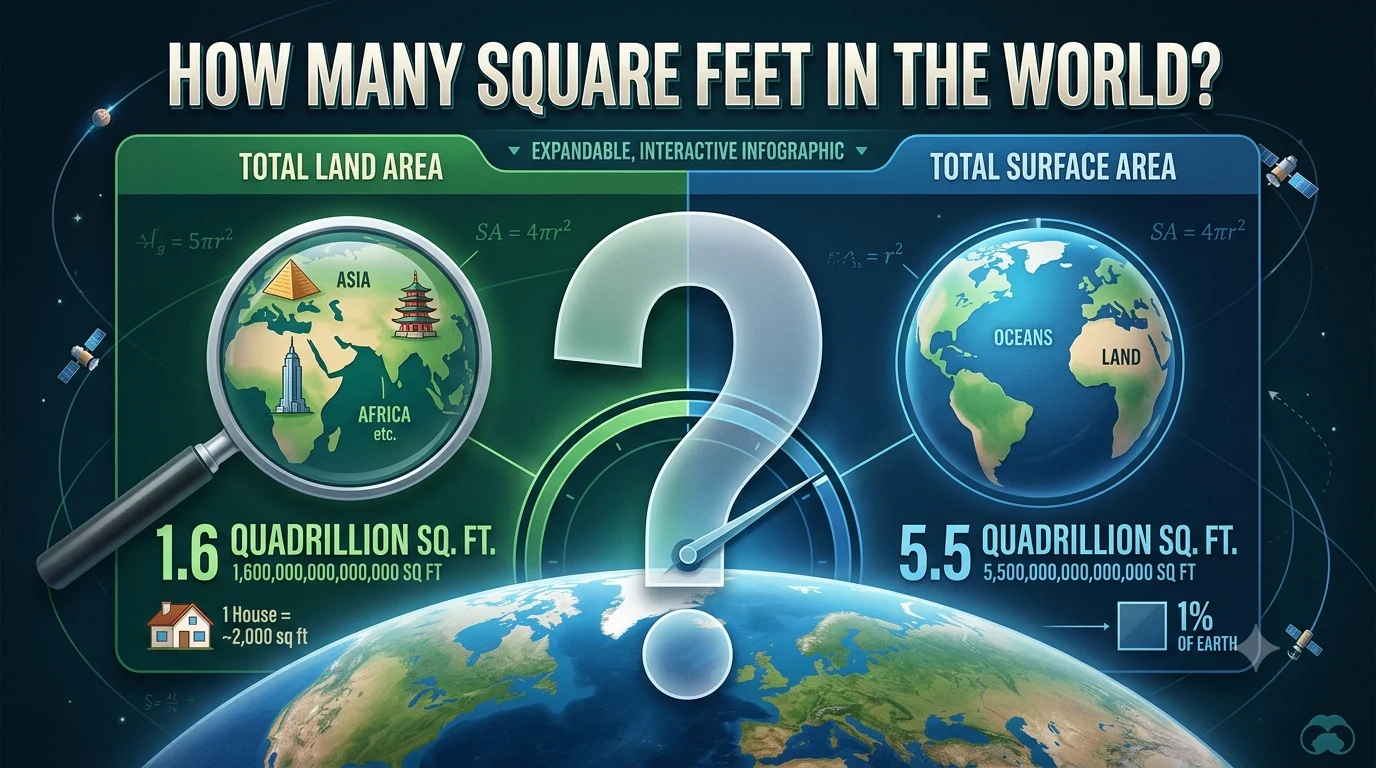
The Earth has an estimated total surface area of about 196.9 million square miles. When converted, this equals approximately 5.49 quadrillion square feet.
That means:
The Earth’s total surface area is approximately 5,490,000,000,000,000 square feet (5.49 quadrillion square feet).
This figure includes both land and oceans.
Understanding the Question
The phrase how many square feet in the world can have different meanings depending on the context. Some people may mean the Earth’s total surface area, the total land area only, or even the habitable land available for people. Unless otherwise specified, the accepted interpretation is the Earth’s entire surface area, including land and water.
Understanding this distinction is important because Earth’s oceans cover the majority of the planet. If you’re calculating the world’s total size, both land and water must be included.
What Is Earth’s Total Surface Area?
Earth is an oblate spheroid, meaning it is slightly flattened at the poles rather than being a perfect sphere. Scientists use an average surface measurement to calculate the planet’s area.
The accepted measurements are:
| Measurement | Value |
|---|---|
| Total surface area | 196.9 million square miles |
| Total surface area | 510 million square kilometers |
| Land area | 57.5 million square miles |
| Water area | 139.4 million square miles |
These figures are widely used in geography, environmental science, education, and mapping.
Converting Earth’s Surface Area to Square Feet
To answer how many square feet are in the world, we need to convert square miles into square feet.
Step 1: Start with Earth’s Surface Area
Earth’s total surface area is approximately:
196.9 million square miles
Step 2: Convert Square Miles to Square Feet
One square mile equals:
27,878,400 square feet
This number comes from multiplying 5,280 feet by 5,280 feet.
Step 3: Perform the Calculation
196,900,000 × 27,878,400
= 5,489,250,960,000,000 square feet
Rounded for simplicity:
Approximately 5.49 quadrillion square feet
This enormous number demonstrates just how vast our planet truly is.
How Much of the World Is Land?
Although Earth appears large, only about 29% of its surface consists of land. The remaining 71% is covered by oceans, seas, lakes, and other bodies of water.
Earth’s land includes:
- Asia
- Africa
- North America
- South America
- Europe
- Australia
- Antarctica
- Thousands of islands
Because water covers most of the planet, the total surface area is much greater than the land area alone.
Land Area in Square Feet
If you’re interested only in Earth’s land, the calculation is much smaller than the total surface area.
Land area:
57.5 million square miles
Converted into square feet:
57,500,000 × 27,878,400
= Approximately 1,603,008,000,000,000 square feet
This is about 1.60 quadrillion square feet of land.
Even though this number is smaller than the total surface area, it is still an unimaginably large amount of space.
Ocean Area in Square Feet
Earth’s oceans cover roughly:
139.4 million square miles
Converting this into square feet gives:
139,400,000 × 27,878,400
= Approximately 3.89 quadrillion square feet
This includes the Pacific, Atlantic, Indian, Southern, and Arctic Oceans.
The oceans are essential for regulating Earth’s climate, supporting marine life, and producing much of the oxygen we breathe.
Earth Surface Area Comparison
| Area | Square Miles | Square Feet |
|---|---|---|
| Entire Earth | 196.9 million | 5.49 quadrillion |
| Land | 57.5 million | 1.60 quadrillion |
| Water | 139.4 million | 3.89 quadrillion |
These figures are rounded for easier understanding and comparison.
Why Measure the World in Square Feet?
Scientists typically use square kilometers or square miles when discussing Earth’s size because these units are much more practical. However, converting the planet into square feet can be useful in several situations.
For example, teachers often use this conversion in classrooms to help students understand measurement concepts. Engineers and architects may also use square feet when comparing smaller spaces with much larger areas.
Additionally, trivia enthusiasts and curious learners often enjoy seeing familiar units applied to extraordinary scales.
Practical Examples
Large numbers can be difficult to visualize, so comparing Earth’s area with familiar objects makes it easier to understand.
Average Home
An average home measures about 2,000 square feet.
Earth’s surface could theoretically hold about:
2.74 trillion homes
if they were placed side by side without any gaps.
Football Fields
A standard American football field, including end zones, covers approximately 57,600 square feet.
Earth’s total surface equals roughly:
95 billion football fields
This comparison highlights the incredible scale of our planet.
Basketball Courts
A professional basketball court measures about 4,700 square feet.
Earth’s surface area would equal more than:
1.16 trillion basketball courts
These examples make the enormous size of Earth easier to imagine.
Why Scientists Prefer Larger Units
Although square feet are useful for everyday measurements, they become impractical for planetary calculations.
Instead, scientists commonly use:
- Square kilometers
- Square miles
- Hectares
- Acres
These larger units simplify calculations and reduce the need to work with extremely large numbers.
Nevertheless, converting Earth’s area into square feet remains an interesting educational exercise.
Common Mistakes When Calculating Earth’s Area
Many people make simple errors when converting large measurements.
Confusing Distance with Area
A mile is a unit of length, while a square mile is a unit of area.
Since area is two-dimensional, the conversion must also be squared.
Using the Wrong Conversion
Some people mistakenly multiply by 5,280 only once.
The correct conversion is:
5,280 × 5,280
= 27,878,400 square feet per square mile
Mixing Land and Total Surface Area
Another common mistake is assuming that Earth’s land area equals its total surface area.
Remember that about 71% of Earth is covered by water.
Interesting Facts About Earth’s Surface
Earth’s surface is filled with fascinating geographical features.
- Earth covers approximately 510 million square kilometers.
- More than two-thirds of the planet is covered by water.
- The Pacific Ocean is larger than all of Earth’s land combined.
- Antarctica contains nearly 90% of the world’s ice.
- Asia is the largest continent by both land area and population.
- Only a relatively small percentage of Earth’s land is suitable for agriculture.
- Forests cover nearly one-third of Earth’s land surface.
These facts help explain why Earth’s geography is so diverse.
Understanding Quadrillions
The number 5.49 quadrillion is difficult to picture.
Here’s how large numbers increase:
- Thousand
- Million
- Billion
- Trillion
- Quadrillion
Earth’s surface area exceeds five quadrillion square feet, making it one of the largest measurements most people will ever encounter.
Written in full, it is:
5,489,250,960,000,000 square feet
This number contains sixteen digits.
Everyday Comparisons
Here is another way to understand Earth’s enormous size.
| Object | Approximate Area |
|---|---|
| Small bedroom | 120 sq ft |
| Studio apartment | 600 sq ft |
| Average home | 2,000 sq ft |
| Basketball court | 4,700 sq ft |
| Football field | 57,600 sq ft |
| Entire Earth | 5.49 quadrillion sq ft |
The comparison shows just how tiny everyday spaces are compared to our planet.
Real-World Uses of Earth’s Surface Area
Knowing Earth’s total surface area is valuable in many fields.
Scientists, researchers, and governments use these measurements for:
- Climate change studies
- Environmental conservation
- Population density calculations
- Urban planning
- Agriculture
- Ocean research
- Satellite mapping
- Natural resource management
- Disaster planning
Accurate measurements help experts better understand how humans interact with the planet and how Earth’s environment changes over time.
Expert Tips for Area Conversions
When converting very large measurements, keep these tips in mind:
- Always verify whether you’re converting length or area.
- Remember that square units require squaring the conversion factor.
- Use a calculator for extremely large numbers.
- Round only after completing the full calculation.
- Double-check your units before reporting results.
Following these practices helps avoid common conversion mistakes.
Conclusion
If you’ve ever wondered how many square feet in the world, the answer is approximately 5.49 quadrillion square feet, representing Earth’s total surface area, including both land and oceans. Of this, roughly 1.60 quadrillion square feet is land, while 3.89 quadrillion square feet is covered by water.
Although scientists usually measure Earth’s size in square kilometers or square miles, expressing it in square feet provides a fascinating perspective on the immense scale of our planet. Whether you’re studying geography, teaching students, solving a conversion problem, or simply satisfying your curiosity, understanding Earth’s surface area helps you appreciate the remarkable size and diversity of the world we call home.