
If you are planning a roofing project, estimating material costs, or comparing contractor quotes, one of the first questions that comes up is how many square feet is a roof. The answer is not always simple because roof size depends on more than just the house’s floor area.
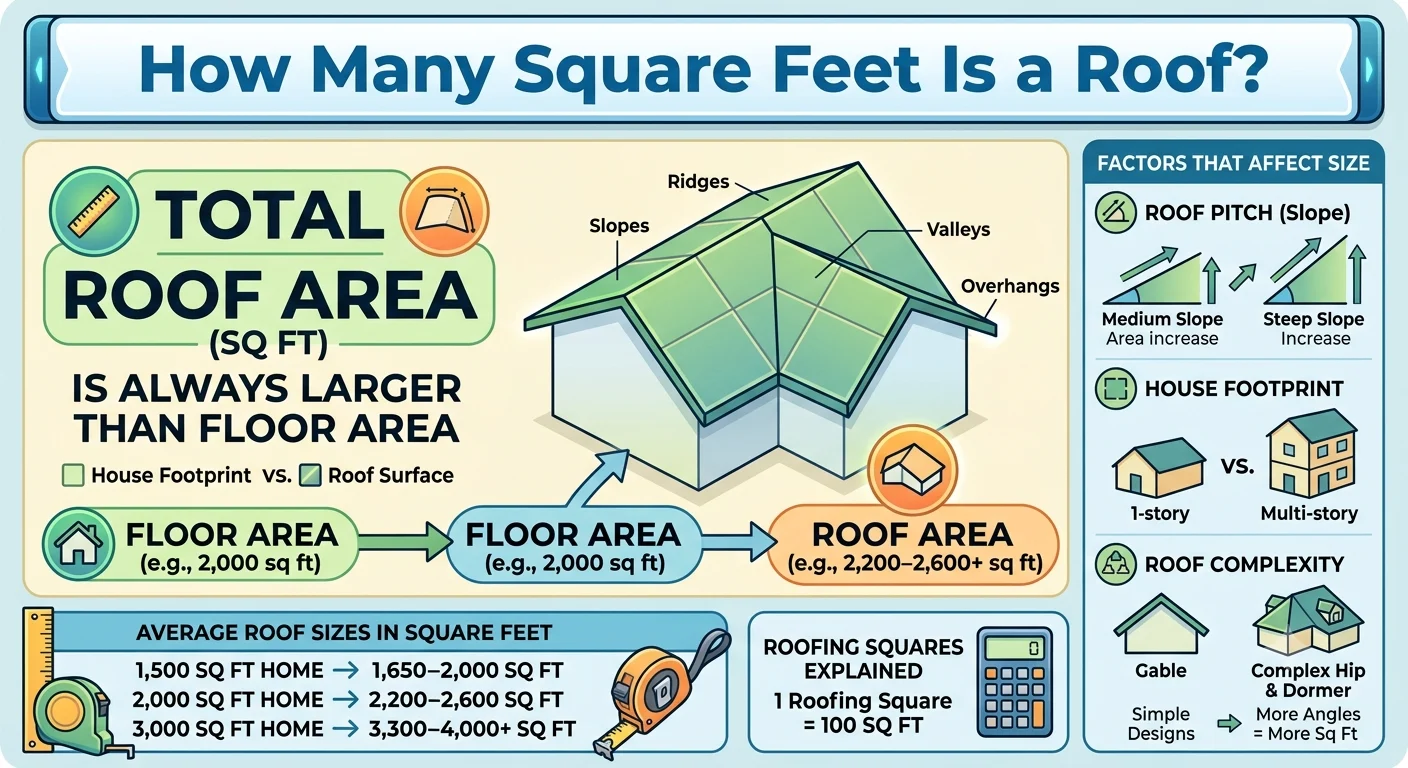
A roof is measured based on its total surface area, which includes slopes, angles, overhangs, and multiple sections. That means a roof is almost always larger than the actual living space of a home. Understanding this difference helps you avoid overbuying materials or underestimating costs.
In most residential cases, roof sizes range from 1,500 to 3,000 square feet, but this can vary widely depending on design and structure.
Understanding How Many Square Feet Is a Roof
To understand how many square feet is a roof, you first need to know what roof square footage means.
Roof square footage is the total area of all sloped surfaces combined. It is not the same as the house’s interior size.
A roof includes:
- Sloped surfaces
- Ridges and peaks
- Valleys and joints
- Overhangs beyond walls
- Attached structures like garages or porches
For example, a 2,000-square-foot house might have a roof between 2,200 and 2,600 square feet depending on pitch and design.
This difference is important because roofing materials are always calculated based on roof surface area, not floor space.
Average Roof Sizes in Square Feet
The answer to how many square feet is a roof depends heavily on home size. Below are typical estimates for residential homes:
| Home Size (Living Area) | Estimated Roof Size |
|---|---|
| 1,000 sq ft home | 1,100–1,300 sq ft |
| 1,500 sq ft home | 1,650–2,000 sq ft |
| 2,000 sq ft home | 2,200–2,600 sq ft |
| 2,500 sq ft home | 2,750–3,300 sq ft |
| 3,000 sq ft home | 3,300–4,000 sq ft |
These are averages based on standard roof designs and moderate pitch levels.
Factors That Affect Roof Size
Several important factors influence how many square feet is a roof, and ignoring them can lead to inaccurate estimates.
1. Roof Pitch (Slope)
Roof pitch is one of the biggest factors.
- Flat roofs have less surface area
- Steep roofs increase total square footage
A steep roof can add 20%–40% more surface area than the home’s footprint.
2. House Footprint
A single-story home usually has a larger roof area than a multi-story home with the same living space because it spreads across more ground.
3. Roof Design Complexity
Simple roofs are easier to measure, while complex designs increase size.
Common complex designs include:
- Hip roofs
- Gable roofs with extensions
- Multiple dormers
- Cross-hip layouts
More angles = more square footage.
4. Overhangs and Extensions
Roof edges often extend beyond walls for protection. These overhangs add extra square feet that must be included in calculations.
How to Calculate Roof Square Feet
If you want to estimate how many square feet is a roof, you can follow a simple step-by-step method.
Step 1: Measure the Building
Measure length and width of the home.
Example:
- Length = 50 ft
- Width = 40 ft
Step 2: Find the Ground Area
Multiply length × width.
50 × 40 = 2,000 sq ft
This is the base footprint.
Step 3: Adjust for Roof Pitch
Roof slope increases surface area.
- Mild slope: +5% to +10%
- Medium slope: +10% to +20%
- Steep slope: +20% to +40%
Example:
2,000 × 1.15 = 2,300 sq ft roof area
Step 4: Add Extra Sections
Include:
- Garage roofs
- Porches
- Extensions
- Separate roof sections
Each should be measured separately.
Roofing Squares Explained
Roofing professionals use a unit called a roofing square.
- 1 roofing square = 100 square feet
This makes calculations easier.
| Roof Size (sq ft) | Roofing Squares |
|---|---|
| 1,000 sq ft | 10 squares |
| 2,000 sq ft | 20 squares |
| 2,500 sq ft | 25 squares |
| 3,000 sq ft | 30 squares |
So when asking how many square feet is a roof, contractors often think in “squares” instead.
Example Roof Calculations
Example 1: Small Home
- House size: 1,200 sq ft
- Roof size: ~1,300 sq ft
- Roofing squares: 13
Example 2: Medium Home
- House size: 2,000 sq ft
- Roof pitch: medium
- Roof size: ~2,300 sq ft
- Roofing squares: 23
Example 3: Large Home
- House size: 3,000 sq ft
- Complex roof design
- Roof size: 3,500+ sq ft
Why Knowing Roof Size Matters
Understanding how many square feet is a roof helps you:
- Estimate material costs accurately
- Avoid over-ordering shingles
- Compare contractor quotes fairly
- Plan roofing budgets
- Reduce waste and delays
Even a small miscalculation can increase costs significantly.
Common Mistakes in Roof Measurement
Many homeowners make errors when estimating roof size:
Ignoring Roof Pitch
Only measuring the ground area leads to underestimation.
Forgetting Add-On Structures
Garages and porches are often missed.
Not Adding Waste Factor
Always include 10%–15% extra materials.
Relying Only on Online Estimates
Tools are helpful but not always accurate for complex roofs.
Expert Tips for Accurate Roof Estimation
Professionals use these strategies:
- Break roof into sections
- Measure each slope separately
- Use aerial measurement tools
- Double-check calculations
- Add buffer for material waste
These steps ensure accuracy and reduce costly mistakes.
Conclusion
So, how many square feet is a roof? The answer depends on your home’s size, roof pitch, and design complexity. Most residential roofs fall between 1,500 and 3,000 square feet, but larger or more complex homes can exceed that range.
The key takeaway is simple: a roof is always larger than the home’s floor area. By understanding how roof measurements work and applying basic calculation methods, you can estimate materials more accurately, save money, and plan your roofing project with confidence.