
If you are planning a landscaping or construction project, one of the most common questions is how many square feet will a yard of gravel cover. Since gravel is sold in cubic yards but projects are measured in square feet, understanding this conversion is essential for accurate planning and budgeting.
A cubic yard of gravel does not cover a fixed area. Instead, its coverage depends entirely on how thick (deep) you spread it. The deeper the layer, the less area it will cover.
This guide breaks everything down in a simple, practical way so you can calculate gravel needs without confusion.
Understanding a Cubic Yard of Gravel
Before calculating how many square feet will a yard of gravel cover, you need to understand what a cubic yard actually means.
A cubic yard is a volume measurement:
- 1 yard = 3 feet
- 1 cubic yard = 3 ft × 3 ft × 3 ft
- So, 1 cubic yard = 27 cubic feet
Gravel is measured by volume because it fills space in three dimensions. But your project area is flat (square feet), so you must include depth in your calculation.
Square Feet vs Cubic Yards
- Square feet measure surface area
- Cubic yards measure volume
To convert between them, depth becomes the key factor.
How Many Square Feet Will a Yard of Gravel Cover?
Here is the simple answer:
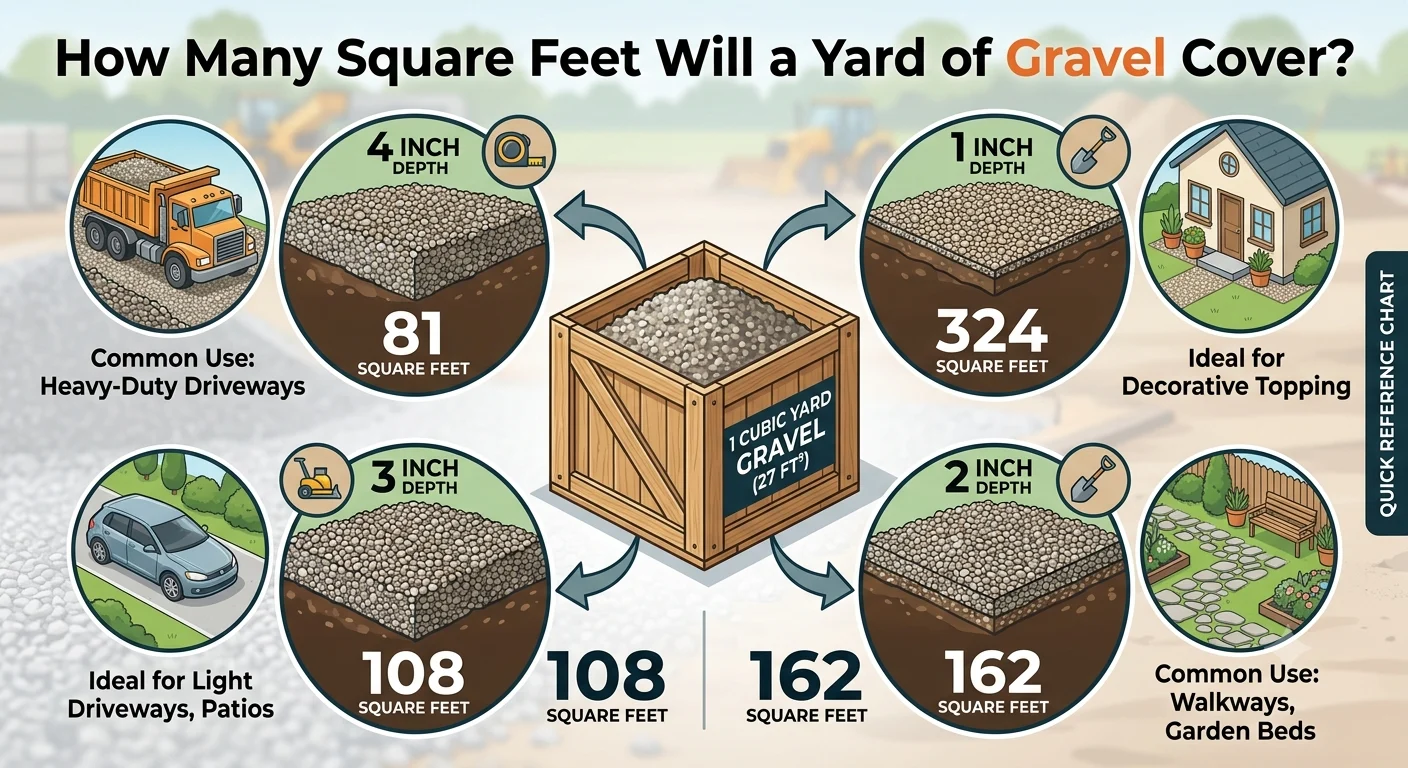
- At 1 inch depth → about 324 sq ft
- At 2 inches depth → about 162 sq ft
- At 3 inches depth → about 108 sq ft
- At 4 inches depth → about 81 sq ft
So, the exact answer to how many square feet will a yard of gravel cover depends on how thick you spread it.
Gravel Coverage Chart (Quick Reference)
| Depth | Coverage of 1 Cubic Yard | Common Use |
|---|---|---|
| 1 inch | 324 sq ft | Decorative topping |
| 2 inches | 162 sq ft | Walkways, garden beds |
| 3 inches | 108 sq ft | Light driveways, patios |
| 4 inches | 81 sq ft | Heavy-duty driveways |
Simple Formula to Calculate Gravel Coverage
You can calculate coverage using this formula:
Square Feet = 27 ÷ Depth (in feet)
Example
If you want a 3-inch layer:
- Convert inches to feet: 3 inches = 0.25 ft
- Apply formula: 27 ÷ 0.25 = 108 sq ft
So, one cubic yard covers 108 square feet at 3 inches depth.
Real-Life Example Calculations
Driveway Example
- Size: 10 ft × 30 ft = 300 sq ft
- Depth: 3 inches (0.25 ft)
- Coverage per yard: 108 sq ft
Calculation:
- 300 ÷ 108 = 2.77
- You need about 3 cubic yards
Garden Path Example
- Size: 5 ft × 20 ft = 100 sq ft
- Depth: 2 inches
Coverage:
- 1 cubic yard = 162 sq ft
Result:
- Less than 1 cubic yard is needed
Factors That Affect Gravel Coverage
Even though calculations are straightforward, real-world conditions can change results.
1. Compaction
Gravel settles over time due to:
- Foot traffic
- Vehicles
- Rain
This reduces volume slightly.
2. Gravel Type
- Fine gravel packs tightly
- Large stones leave gaps
- Crushed stone locks together better
3. Ground Condition
Uneven or soft ground can increase gravel usage.
Common Mistakes to Avoid
Many people miscalculate when estimating how many square feet will a yard of gravel cover.
1. Ignoring depth changes
Even a small difference in depth changes total coverage significantly.
2. Not accounting for settling
Gravel compresses after installation.
3. Ordering exact quantity
Always order extra material to avoid shortages.
Expert Tips for Better Estimation
- Always add 5–10% extra gravel
- Measure area carefully before ordering
- Use a gravel calculator for large projects
- Double-check depth before final calculation
Conclusion
Understanding how many square feet will a yard of gravel cover helps you plan landscaping and construction projects accurately. A single cubic yard can cover anywhere from 81 to 324 square feet depending on depth, making it important to calculate carefully.
By using simple formulas, coverage charts, and real-world examples, you can avoid mistakes, save money, and ensure your project is completed smoothly.