
If you are shopping for an air conditioner or heater, you may wonder: how many BTUs for 200 square feet do you actually need?
Choosing the right BTU size is important. A unit that is too small will struggle to cool or heat the room. On the other hand, a unit that is too large may waste energy and create uneven temperatures.
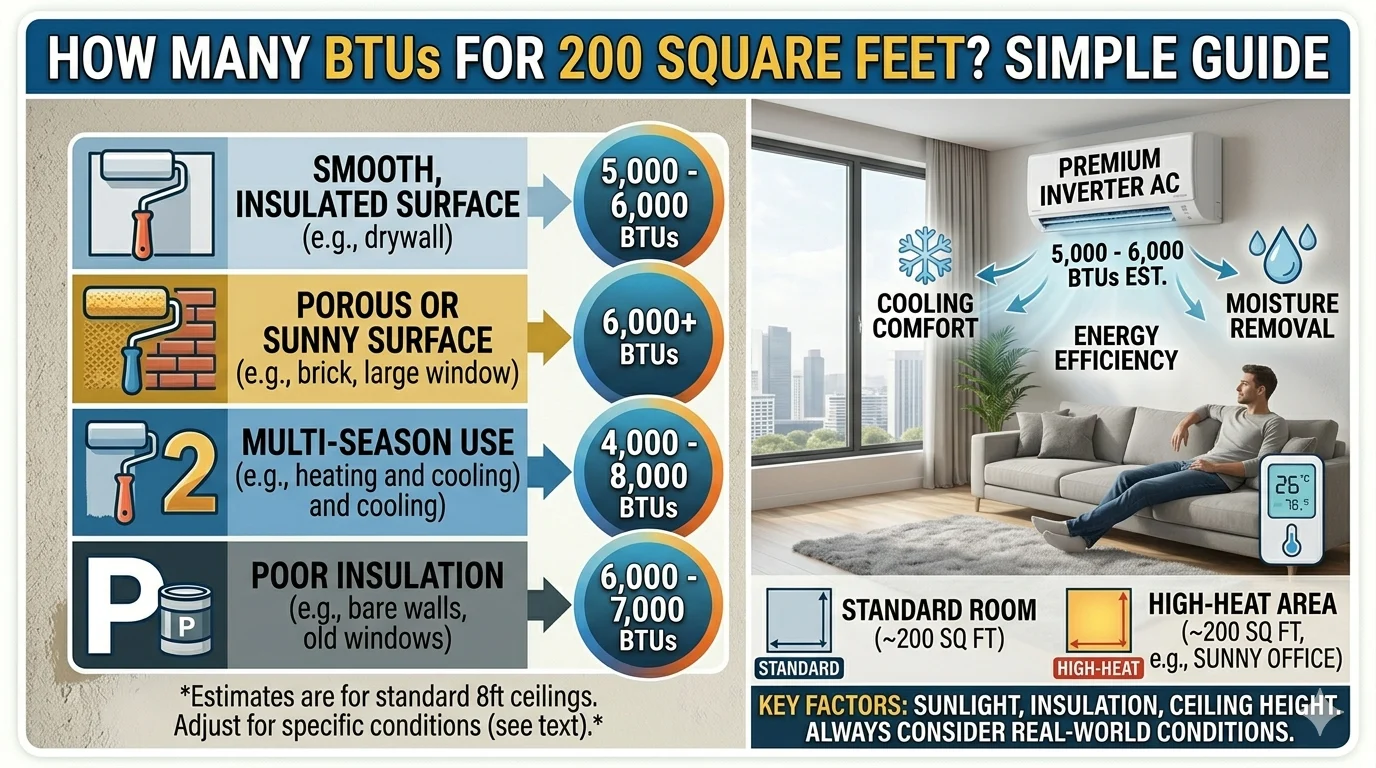
For most rooms around 200 square feet, you typically need between 5,000 and 6,000 BTUs for cooling. However, several factors can increase or reduce that number. Things like sunlight, insulation, ceiling height, and room usage all matter.
This guide explains everything you need to know about BTUs for a 200 sq ft room. You will also learn how to choose the best air conditioner or heater size for maximum comfort and efficiency.
What Does BTU Mean?
BTU stands for British Thermal Unit. It measures how much heat an air conditioner or heater can remove or produce.
In simple terms:
- Higher BTUs = more cooling or heating power
- Lower BTUs = less cooling or heating power
When buying an AC unit, BTU ratings help determine whether the appliance can handle your room size effectively.
Why BTUs Matter for Cooling and Heating
Correct BTU sizing helps you:
- Maintain comfortable temperatures
- Reduce electricity bills
- Improve energy efficiency
- Prevent excessive wear on HVAC systems
- Keep humidity levels balanced
An incorrectly sized unit often causes poor performance and higher energy costs.
How BTUs Affect Comfort and Energy Use
A properly sized AC cools steadily and removes humidity efficiently. Oversized units cool too quickly without removing moisture, making the room feel damp.
Undersized units run constantly and still fail to cool the space properly.
That is why accurate BTU calculations matter.
How Many BTUs for 200 Square Feet?
For most standard rooms, the recommended cooling capacity is:
In general:
| Room Size | Recommended BTUs |
|---|---|
| 100 sq ft | 4,000 BTUs |
| 150 sq ft | 5,000 BTUs |
| 200 sq ft | 5,000–6,000 BTUs |
| 250 sq ft | 6,000 BTUs |
| 300 sq ft | 7,000–8,000 BTUs |
A 5,000 BTU air conditioner is usually enough for a well-insulated bedroom or office around 200 square feet.
If the room gets lots of sunlight or contains several electronics, you may need closer to 6,000 BTUs.
Standard BTU Recommendation
The general HVAC rule is:
Using this formula:
However, most experts recommend increasing the number slightly for real-world conditions. That is why 5,000–6,000 BTUs is usually ideal.
Quick BTU Chart
| Room Type | Suggested BTUs |
|---|---|
| Small bedroom | 5,000 BTUs |
| Home office | 5,000 BTUs |
| Kitchen | 6,000 BTUs |
| Sunny room | 6,000 BTUs |
| Poorly insulated room | 6,000–7,000 BTUs |
Factors That Change BTU Requirements
Not every 200 square foot room needs the exact same BTU rating.
Several conditions affect cooling and heating performance.
Room Insulation
Good insulation keeps cool air inside and hot air outside.
If your room has:
- Insulated walls
- Double-pane windows
- Sealed doors
You can usually stay near the lower BTU range.
Poor insulation often requires additional cooling power.
Sunlight Exposure
Rooms with direct sunlight heat up much faster.
South-facing rooms or rooms with large windows may need:
- An extra 10–20% cooling capacity
- Stronger airflow
- Better window coverings
For sunny rooms, 6,000 BTUs is often better than 5,000.
Ceiling Height
Standard BTU recommendations assume an 8-foot ceiling.
If your room has:
- Vaulted ceilings
- High ceilings
- Open loft designs
You may need more BTUs because there is more air volume to cool.
Number of People
More people generate more body heat.
Add around 600 BTUs for each additional person regularly using the room.
For example:
- Bedroom for one person = 5,000 BTUs
- Shared office for three people = 6,000+ BTUs
Appliances and Electronics
Electronics create heat continuously.
Rooms with:
- Gaming PCs
- TVs
- Kitchen appliances
- Multiple monitors
may require higher BTU ratings.
A small office with powerful computers can become surprisingly warm.
Best AC Types for a 200 Square Foot Room
Several air conditioner styles work well for small rooms.
The best option depends on your budget, installation needs, and long-term goals.
Window Air Conditioners
Window AC units are popular because they:
- Cost less
- Cool efficiently
- Save floor space
Most 5,000 BTU window units are perfect for 200 square feet.
Benefits:
- Affordable
- Energy efficient
- Easy to find
Drawbacks:
- Require window installation
- Can block natural light
Portable AC Units
Portable air conditioners are easy to move between rooms.
They work well for:
- Apartments
- Rental homes
- Temporary cooling
However, portable units are often less efficient than window models.
For 200 sq ft rooms:
- Choose at least 6,000 BTUs
- Ensure proper venting
Mini Split Systems
Mini split systems provide:
- Quiet operation
- Excellent efficiency
- Strong cooling performance
They cost more upfront but save energy over time.
Mini splits are ideal for:
- Bedrooms
- Home offices
- Studio apartments
BTU Recommendations for Heating
BTU sizing also matters for heating systems.
Heating requirements depend heavily on climate.
Climate Considerations
Colder climates need more heating power.
General estimates:
- Mild climates: 20–25 BTUs per sq ft
- Moderate climates: 30–35 BTUs per sq ft
- Cold climates: 40+ BTUs per sq ft
For a 200 square foot room:
| Climate | Recommended Heating BTUs |
|---|---|
| Mild | 4,000–5,000 BTUs |
| Moderate | 6,000–7,000 BTUs |
| Cold | 8,000+ BTUs |
Heater Sizing Tips
When choosing a heater:
- Check insulation quality
- Consider window size
- Avoid oversized space heaters
- Use programmable thermostats
Electric heaters, infrared heaters, and mini splits all have different efficiency levels.
Common BTU Sizing Mistakes
Many people buy the wrong size air conditioner or heater.
Here are the most common mistakes.
Choosing an Oversized Unit
Bigger is not always better.
Oversized units:
- Short cycle frequently
- Waste electricity
- Increase humidity problems
- Wear out faster
An AC that cools too quickly does not remove enough moisture from the air.
Choosing an Undersized Unit
Small units struggle to maintain temperature.
Problems include:
- Constant operation
- High energy bills
- Uneven cooling
- Reduced lifespan
If your room has high heat exposure, avoid choosing the minimum BTU size.
Energy Saving Tips for a 200 Sq Ft Room
The right BTU size helps, but energy-saving habits matter too.
Improve Insulation
Seal:
- Window gaps
- Door cracks
- Air leaks
Good insulation reduces cooling and heating loss.
Use Smart Thermostats
Smart thermostats help:
- Control temperatures automatically
- Reduce unnecessary usage
- Lower monthly utility bills
Even portable AC systems can benefit from timer settings.
Reduce Heat Sources
Try to:
- Turn off unused electronics
- Use LED bulbs
- Close blinds during hot afternoons
Small changes can reduce room temperature noticeably.
BTU Chart by Room Size
This quick chart helps compare cooling needs.
| Square Feet | Recommended BTUs |
|---|---|
| 100 | 4,000 |
| 150 | 5,000 |
| 200 | 5,000–6,000 |
| 300 | 7,000–8,000 |
| 400 | 9,000–10,000 |
| 500 | 10,000–12,000 |
Use this as a starting point, then adjust for room conditions.
Frequently Asked Questions
Is 5,000 BTUs enough for 200 square feet?
Yes, 5,000 BTUs is usually enough for a standard 200 sq ft room with average insulation and moderate sunlight.
Should I get 6,000 BTUs instead?
Choose 6,000 BTUs if your room:
- Gets strong sunlight
- Has high ceilings
- Contains multiple electronics
- Has poor insulation
Can a portable AC cool 200 square feet?
Yes, but portable units are less efficient than window ACs. A 6,000 BTU portable AC is often recommended.
How many BTUs do I need for heating 200 sq ft?
Most rooms need between 4,000 and 8,000 BTUs for heating depending on climate and insulation.
Does ceiling height affect BTU requirements?
Yes. Higher ceilings increase room volume, which requires more cooling or heating capacity.
Conclusion
So, how many BTUs for 200 square feet do you need?
For most standard rooms, the ideal range is between 5,000 and 6,000 BTUs for cooling. A well-insulated room with normal sunlight can usually work perfectly with a 5,000 BTU unit. Rooms with extra heat, sunlight, or poor insulation may require closer to 6,000 BTUs.
When choosing an air conditioner or heater, always consider:
- Room insulation
- Sunlight exposure
- Ceiling height
- Number of occupants
- Electronics and appliances
Proper BTU sizing improves comfort, lowers energy bills, and helps your HVAC system last longer. By understanding your room’s needs, you can choose the perfect cooling or heating solution for a 200 square foot space.