

Introduction
If you have ever wondered how many bones are in our feet, the answer may surprise you. The human foot is one of the most complex and well-engineered parts of the body. It is designed to support your entire body weight, absorb shock, and help you move efficiently through walking, running, jumping, and balancing.
The feet are not just simple body parts—they are powerful structures made of multiple small bones working together in perfect coordination. Every step you take involves a chain reaction of bones, muscles, and joints all functioning in harmony.
Understanding how many bones are in our feet helps you appreciate how important foot health is in everyday life. Whether you are standing still or sprinting, your feet are constantly working without rest.
In this article, you will learn the exact number of bones in the human feet, their structure, their function, and why they matter so much for movement and health.
How Many Bones Are in Our Feet?
Let’s answer the main question directly:
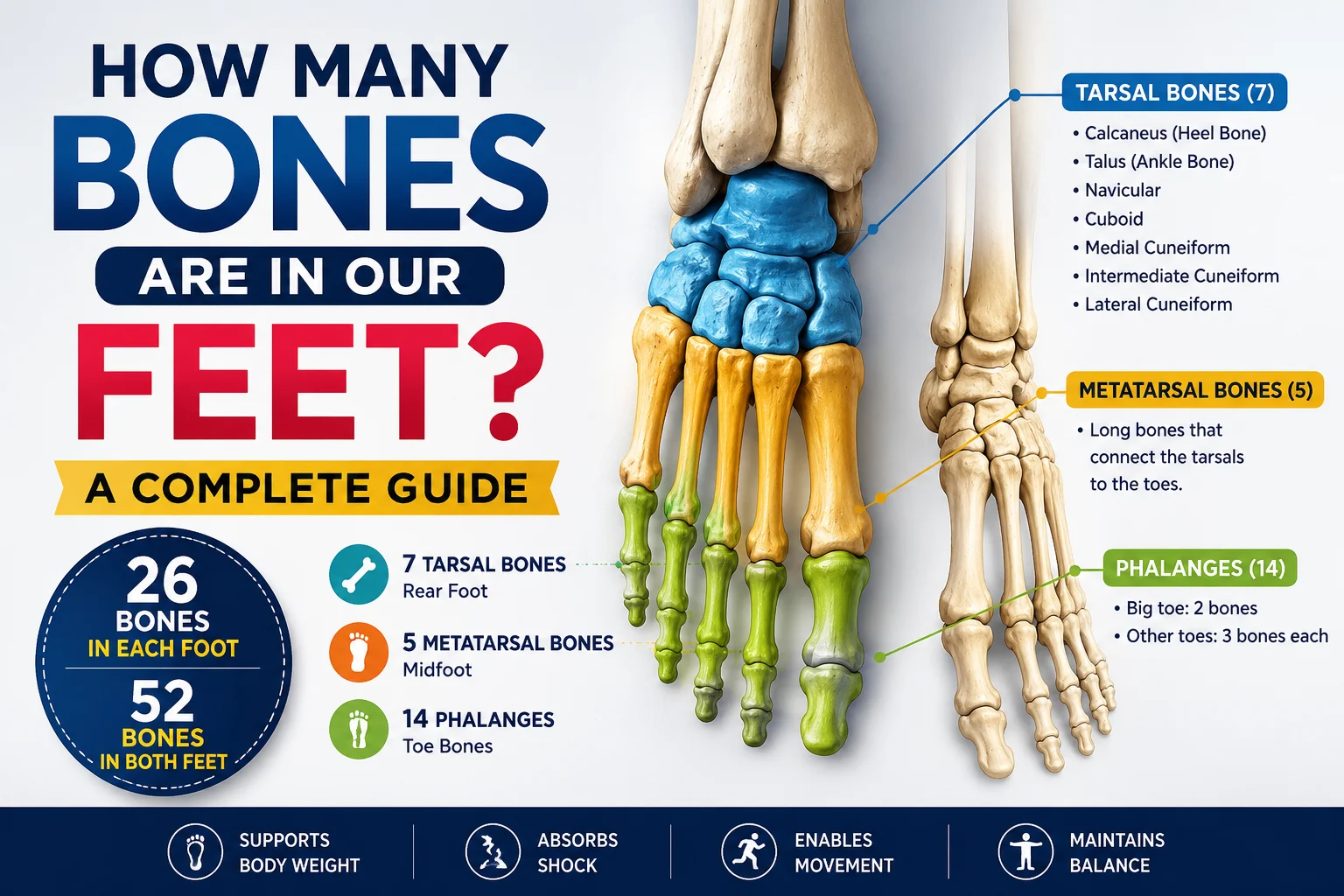
A human foot contains 26 bones in each foot.
Since we have two feet, the total number of bones in both feet combined is:
52 bones in total
This means nearly one-quarter of all the bones in your body are located in your feet.
Bone Count Breakdown
Each foot is divided into three main sections:
- Tarsal bones: 7
- Metatarsal bones: 5
- Phalanges (toe bones): 14
So when you understand how many bones are in our feet, it becomes clear that these small structures form a highly organized system designed for movement and balance.
Structure of Foot Bones
To fully understand how many bones are in our feet, it is important to break down the structure of the foot.
The foot is divided into three major regions:
1. Tarsal Bones (Rear Foot)
The tarsal bones form the back part of the foot and connect it to the ankle. There are 7 tarsal bones in each foot.
These include:
- Calcaneus (heel bone)
- Talus (ankle bone)
- Navicular
- Cuboid
- Medial cuneiform
- Intermediate cuneiform
- Lateral cuneiform
The calcaneus is the largest bone in the foot and plays a key role in absorbing shock when your heel touches the ground.
The talus connects the foot to the leg and allows movement at the ankle joint.
Together, these bones form the foundation of stability and balance.
2. Metatarsal Bones (Midfoot)
The metatarsals are 5 long bones located in the middle of the foot. They connect the tarsal bones to the toes.
Each metatarsal supports a toe and helps distribute body weight evenly across the foot.
Functions of metatarsals include:
- Supporting body weight
- Maintaining the arch of the foot
- Providing flexibility during walking
Without metatarsals, walking would feel stiff and unbalanced.
3. Phalanges (Toe Bones)
The phalanges are the bones in your toes. There are 14 phalanges in each foot.
Structure:
- Big toe: 2 bones
- Other toes: 3 bones each
Phalanges help with:
- Pushing the body forward while walking
- Maintaining balance
- Gripping the ground for stability
Even though they are small, they play a very important role in movement efficiency.
How Foot Bones Work Together
Knowing how many bones are in our feet is only part of the story. The real magic happens when these bones work together.
Walking is a highly coordinated process involving all 26 bones in each foot.
Walking Cycle Explained:
- Heel strike: The calcaneus absorbs impact
- Mid stance: Weight shifts through metatarsals
- Toe-off: Phalanges push the body forward
This process repeats thousands of times daily without you even noticing.
The foot acts like a natural shock absorber and spring system, making movement smooth and energy-efficient.
Why Do Feet Have So Many Bones?
A common question after learning how many bones are in our feet is: why so many?
The answer lies in function.
1. Flexibility
More bones mean more joints, which allows your feet to adapt to uneven surfaces like sand, roads, or stairs.
2. Shock Absorption
Each bone helps distribute pressure, protecting your knees, hips, and spine.
3. Balance
Small adjustments between bones help you stay upright and stable.
4. Efficient Movement
The structure allows smooth walking, running, and jumping with minimal energy loss.
Without this complex structure, human movement would be stiff and inefficient.
Importance of Foot Bone Health
Since the feet carry your entire body weight, foot bone health is extremely important.
When foot bones are healthy:
- Walking feels easy
- Balance improves
- Injury risk decreases
But when they are weak or damaged:
- Pain increases
- Movement becomes difficult
- Long-term problems may develop
That is why understanding how many bones are in our feet also helps you value proper foot care.
Common Foot Bone Problems
Foot bones are strong, but they are also exposed to daily stress. Some common issues include:
1. Fractures
Breaks in bones caused by accidents or heavy impact.
2. Stress Fractures
Tiny cracks caused by overuse, especially in athletes.
3. Sprains
Ligament injuries around bones due to twisting or sudden movement.
4. Plantar Fasciitis
Heel pain caused by strain on tissues connected to foot bones.
Ignoring these issues can lead to long-term complications.
Foot Bone Development in Humans
At birth, humans do not have fully developed foot bones.
Babies have more separated bone structures that gradually fuse together as they grow.
By adulthood:
- The foot stabilizes
- Bones fully form
- The final count becomes 26 bones per foot
This development is essential for walking and standing properly.
Interesting Facts About Foot Bones
Here are some fascinating facts related to how many bones are in our feet:
- Feet contain about 25% of all bones in the human body
- Each foot has more than 30 joints
- Walking applies force 1.5 times your body weight
- Feet are both strong and flexible at the same time
This makes the foot one of the most advanced biological structures in the human body.
Expert Tips for Strong Foot Bones
To keep your foot bones healthy and strong:
- Wear comfortable, supportive shoes
- Avoid standing for long periods without rest
- Exercise your feet regularly
- Maintain a healthy body weight
- Stretch your toes and ankles daily
Simple habits can protect your bones for years.
Common Mistakes That Damage Foot Health
Many people harm their foot bones without realizing it.
Avoid these mistakes:
- Wearing tight or high-heeled shoes for long hours
- Ignoring foot pain
- Walking barefoot on hard surfaces too often
- Overusing feet without rest
- Poor posture while walking or standing
These habits can lead to serious long-term damage.
Final Summary
So, how many bones are in our feet? The answer is simple yet fascinating: each foot has 26 bones, making a total of 52 bones in both feet.
These bones are divided into tarsals, metatarsals, and phalanges, all working together to support movement, balance, and stability.
Every step you take depends on this complex system functioning perfectly. Understanding your foot structure not only answers a biological question but also helps you take better care of your body.
Your feet are the foundation of your movement—treat them with care, and they will support you for a lifetime.