

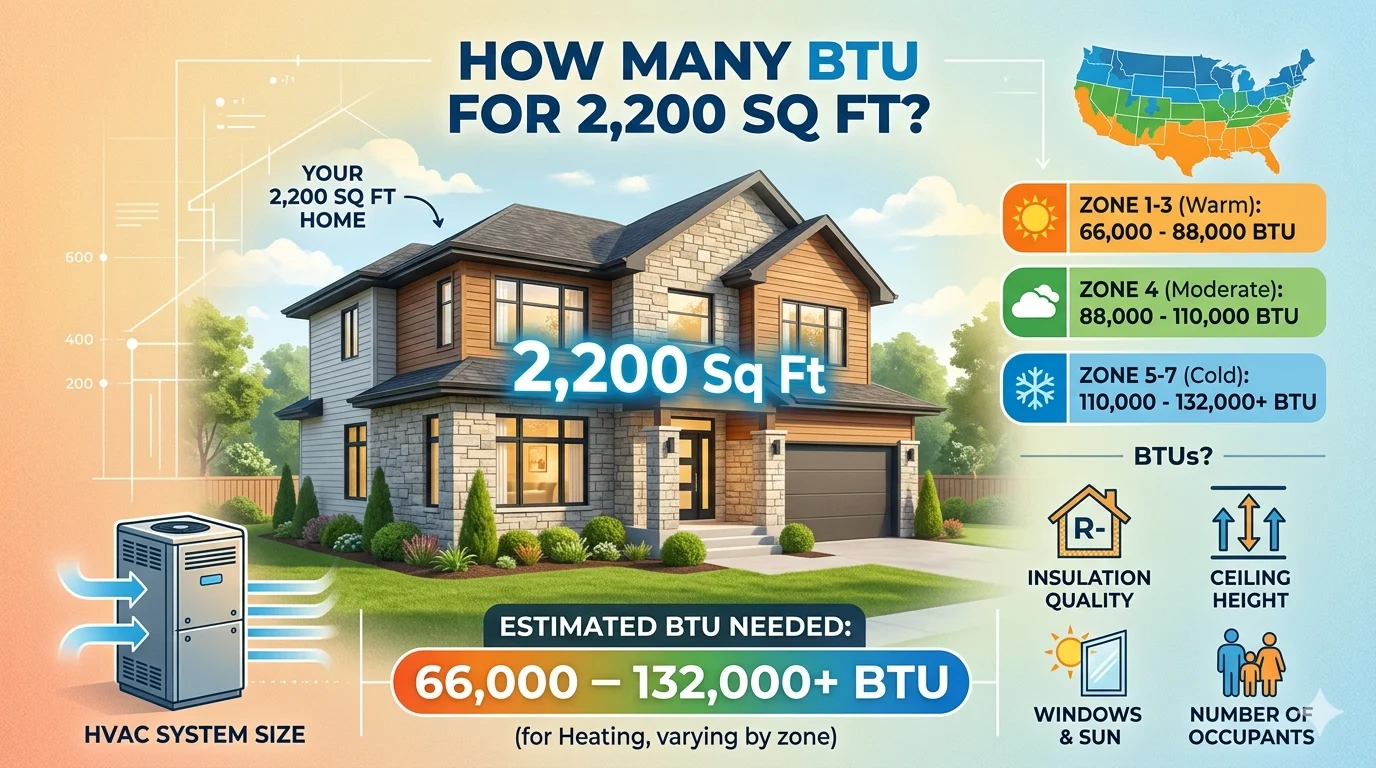
Choosing the correct HVAC size is one of the most important decisions for home comfort and energy efficiency. If you are wondering how many BTU for 2200 square feet you need, the answer depends on several factors like climate, insulation, ceiling height, and whether you are heating or cooling the home.
In general, a 2200 square foot home usually requires:
- Cooling: 48,000–60,000 BTU
- Heating: 60,000–100,000 BTU
However, these numbers are only estimates. The ideal BTU requirement changes based on your location and your home’s construction.
This guide explains everything you need to know about BTU sizing for a 2200 sq ft house, including charts, examples, HVAC tonnage, and expert sizing tips.
What Does BTU Mean?
BTU stands for British Thermal Unit. It measures the amount of heat an HVAC system can remove or produce.
In simple terms:
- Higher BTU = more heating or cooling power
- Lower BTU = less heating or cooling power
Air conditioners use BTUs to show cooling capacity, while furnaces use BTUs to measure heating output.
For example:
- A small bedroom AC may use 6,000 BTU
- A whole-home HVAC system may use 60,000 BTU or more
Choosing the correct BTU is important because an oversized or undersized system can create comfort and energy problems.
How Many BTU for 2200 Square Feet?
The average home needs around 20–30 BTU per square foot for cooling and 30–60 BTU per square foot for heating, depending on climate conditions.
Standard BTU Estimates
| Home Size | Cooling BTU | Heating BTU |
|---|---|---|
| 1800 sq ft | 36,000–48,000 | 50,000–80,000 |
| 2000 sq ft | 42,000–54,000 | 60,000–90,000 |
| 2200 sq ft | 48,000–60,000 | 60,000–100,000 |
| 2500 sq ft | 60,000–72,000 | 80,000–120,000 |
For most homes, a 2200 square foot house needs about 4 to 5 tons of cooling capacity because:
- 1 ton of AC = 12,000 BTU
- 48,000 BTU = 4 tons
- 60,000 BTU = 5 tons
Heating vs Cooling BTU Needs
Many people assume heating and cooling need the same BTU size, but that is not true.
Cooling BTU Needs
Cooling depends heavily on:
- Sunlight exposure
- Humidity
- Window size
- Indoor heat sources
A hot climate home may require significantly more cooling power.
Heating BTU Needs
Heating depends on:
- Outdoor winter temperature
- Insulation quality
- Air leaks
- Ceiling height
Homes in colder regions need much larger furnace capacities.
BTU Chart by Home Size
Here is a quick HVAC sizing reference chart.
| Square Feet | AC Size (Tons) | Cooling BTU |
|---|---|---|
| 1000 | 1.5–2 | 18,000–24,000 |
| 1500 | 2.5–3 | 30,000–36,000 |
| 2000 | 3.5–4.5 | 42,000–54,000 |
| 2200 | 4–5 | 48,000–60,000 |
| 3000 | 5–6 | 60,000–72,000 |
These are general estimates and should not replace a professional load calculation.
Factors That Affect BTU Requirements
A 2200 square foot home in one state may need a completely different HVAC size than a similar home somewhere else.
Here are the biggest factors.
Climate Zone
Climate has a major impact on BTU needs.
Hot Climate Areas
Homes in hot regions need larger cooling systems.
Examples:
- Texas
- Arizona
- Florida
Cold Climate Areas
Homes in colder regions need stronger heating systems.
Examples:
- Minnesota
- Canada
- Northern states
Ceiling Height
Standard calculations assume 8-foot ceilings.
If your ceilings are:
- 10 feet
- Vaulted
- Cathedral-style
You may need additional BTUs because there is more air volume to condition.
Insulation Quality
Good insulation reduces heat transfer and lowers BTU requirements.
Well-insulated homes:
- Stay cooler in summer
- Stay warmer in winter
- Use less energy
Poor insulation increases HVAC workload.
Windows and Sun Exposure
Large windows create heat gain.
South-facing windows can increase cooling demand, especially in sunny climates.
Homes with:
- Skylights
- Glass walls
- Older windows
often need more BTUs.
Number of Occupants
People generate body heat.
A home with many occupants may need more cooling capacity.
Appliances and Electronics
Kitchen appliances, computers, televisions, and lighting all create indoor heat.
This increases cooling load requirements.
Air Conditioner Size for 2200 Square Feet
If your main concern is cooling, you are probably looking for the correct air conditioner size.
Recommended AC Tons
For a 2200 sq ft house:
- Mild climate: 4 tons
- Hot climate: 5 tons
That equals:
So:
- 4 tons = 48,000 BTU
- 5 tons = 60,000 BTU
Central AC vs Mini Split
Central Air Conditioning
Best for:
- Whole-home cooling
- Existing ductwork
- Larger homes
Pros:
- Even cooling
- Quiet operation
- Better resale value
Cons:
- Higher installation cost
- Duct maintenance needed
Mini Split Systems
Best for:
- Zoned cooling
- Homes without ducts
- Additions or renovations
Pros:
- Energy efficient
- Flexible installation
- Individual room control
Cons:
- Higher cost per zone
- Indoor wall units visible
Furnace Size for 2200 Square Feet
Heating systems use different BTU recommendations than air conditioners.
Recommended Furnace BTU
For a 2200 sq ft home:
| Climate | Recommended Furnace Size |
|---|---|
| Warm climate | 60,000–70,000 BTU |
| Moderate climate | 80,000–90,000 BTU |
| Cold climate | 90,000–100,000+ BTU |
Gas vs Electric Heating
Gas Furnaces
Advantages:
- Faster heating
- Lower operating cost
- Better for cold climates
Disadvantages:
- Gas line required
- Higher installation cost
Electric Heating
Advantages:
- Lower upfront cost
- Easier installation
- Cleaner operation
Disadvantages:
- Higher electricity bills
- Less efficient in extreme cold
How to Calculate BTU More Accurately
General sizing charts help, but professional calculations are more precise.
Basic Formula
A simple cooling estimate uses:
For 2200 square feet:
However, this is only a rough estimate.
Manual J Load Calculation
Professional HVAC contractors use a method called Manual J.
It considers:
- Climate zone
- Insulation
- Windows
- Ductwork
- Home orientation
- Occupancy
- Air leakage
This gives the most accurate HVAC size recommendation.
Common HVAC Sizing Mistakes
Many homeowners choose the wrong HVAC size. Here are the most common mistakes.
Buying an Oversized System
Too much BTU can cause:
- Short cycling
- Uneven temperatures
- High humidity
- Higher energy bills
Choosing a System That Is Too Small
An undersized unit may:
- Run constantly
- Struggle in extreme weather
- Wear out faster
- Fail to maintain comfort
Ignoring Insulation
Insulation quality changes HVAC requirements dramatically.
Using Square Footage Alone
Two homes with identical square footage can need very different BTU capacities.
Energy Efficiency Tips for Better Performance
A properly sized HVAC system works best when combined with good energy-saving habits.
Seal Air Leaks
Check:
- Windows
- Doors
- Attics
- Crawl spaces
Air leaks waste conditioned air.
Upgrade Insulation
Better insulation lowers heating and cooling costs year-round.
Install a Smart Thermostat
Smart thermostats:
- Reduce energy waste
- Improve comfort
- Automatically adjust temperatures
Replace Dirty Filters
Dirty filters reduce airflow and force HVAC systems to work harder.
Maintain Your HVAC System
Annual maintenance improves:
- Efficiency
- Lifespan
- Performance
When to Call an HVAC Professional
You should contact an HVAC expert if:
- Your current system struggles to cool or heat
- Energy bills are unusually high
- Some rooms feel uncomfortable
- You are replacing an old unit
- You want a Manual J calculation
A professional assessment helps prevent expensive mistakes.
FAQs
How many BTU do I need for a 2200 square foot house?
Most 2200 sq ft homes need between 48,000 and 60,000 BTU for cooling and 60,000 to 100,000 BTU for heating.
What size AC unit is best for 2200 square feet?
Typically, a 4 to 5 ton air conditioner is recommended for a 2200 sq ft home.
Is 60,000 BTU enough for 2200 square feet?
It may be enough for cooling in moderate climates, but heating needs depend heavily on insulation and winter temperatures.
Can an oversized HVAC system cause problems?
Yes. Oversized systems can short cycle, waste energy, and reduce humidity control.
What is the most accurate way to size HVAC equipment?
A professional Manual J load calculation is the most accurate method for determining HVAC size.
Conclusion
If you are asking how many BTU for 2200 square feet you need, the general answer is:
- 48,000–60,000 BTU for cooling
- 60,000–100,000 BTU for heating
However, the ideal HVAC size depends on climate, insulation, windows, ceiling height, and many other factors.
A properly sized system improves:
- Comfort
- Energy efficiency
- Equipment lifespan
- Indoor air quality
While online charts and formulas provide a helpful starting point, a professional HVAC load calculation is the best way to choose the right system for your home.