

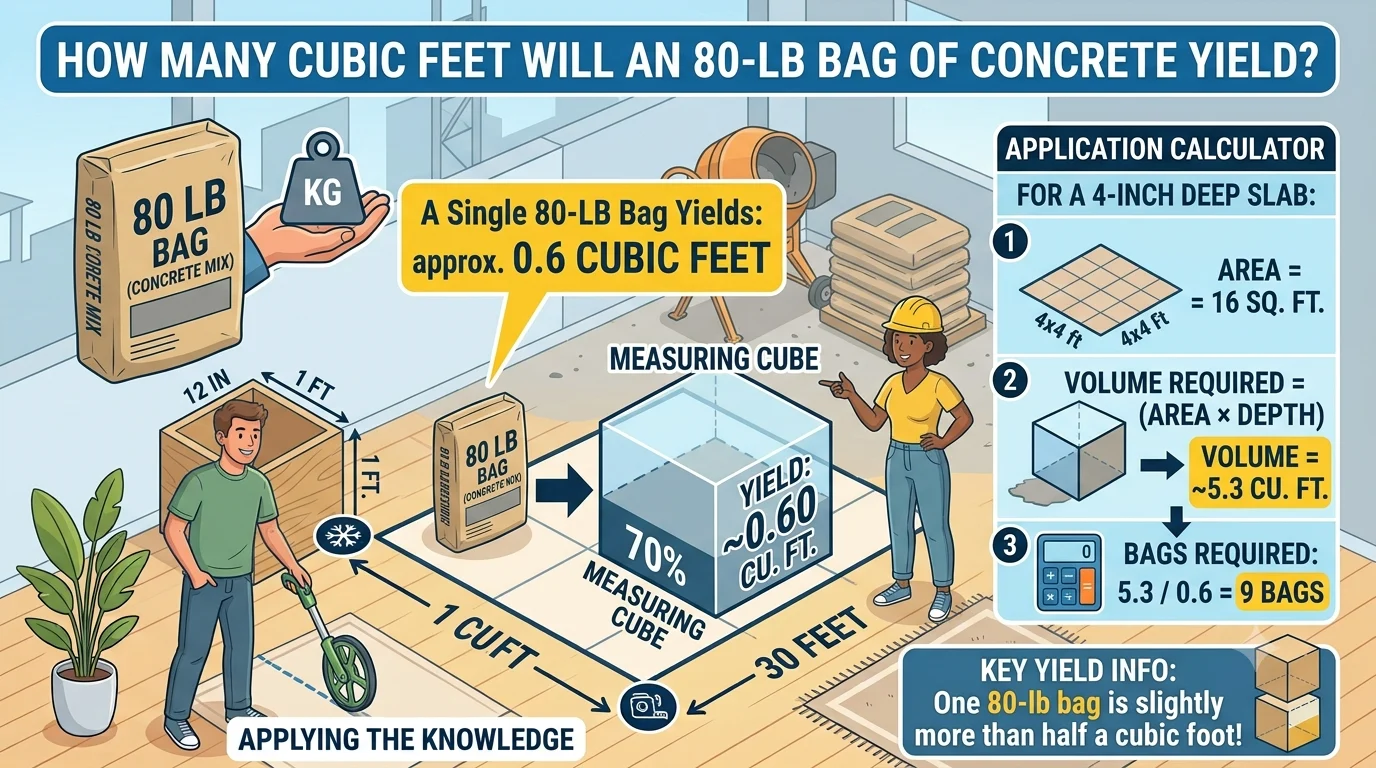
When planning a concrete project, one of the most important questions to answer is how many cubic feet will an 80 lb bag of concrete make? Knowing the concrete yield helps homeowners, DIY builders, and contractors estimate how many bags they need before starting a project.
An 80 lb bag of concrete mix typically produces around 0.60 cubic feet of concrete after adding water and mixing properly. The exact amount may vary slightly depending on the brand, water ratio, mixing method, and how the concrete is placed.
Whether you are building a patio, sidewalk, fence post, slab, step, or small foundation, understanding concrete coverage can save time, money, and effort. Instead of buying too much or running out during a project, you can calculate the required number of bags with a simple formula.
Understanding Concrete Bag Yield
Concrete yield refers to the amount of finished concrete created after a dry concrete mix is combined with water.
An 80 lb bag of concrete usually contains a mixture of:
- Portland cement
- Sand
- Gravel or crushed stone
- Other additives
The weight of the bag does not represent the final volume of concrete. An 80 lb bag does not create 80 pounds worth of space. Instead, the dry ingredients combine with water to create a specific volume measured in cubic feet.
Concrete volume is usually measured in:
- Cubic feet for small projects
- Cubic yards for large construction jobs
Knowing the yield of your concrete bags allows you to convert your project measurements into the correct number of bags needed.
How Many Cubic Feet Will an 80 lb Bag of Concrete Make?
The standard yield of an 80 lb bag of concrete is approximately 0.60 cubic feet.
This means:
- 1 bag of 80 lb concrete = about 0.60 cubic feet
- 5 bags = about 3 cubic feet
- 10 bags = about 6 cubic feet
- 20 bags = about 12 cubic feet
The actual yield can vary slightly depending on the manufacturer’s formula and mixing instructions, so always check the bag label for the most accurate information.
80 lb Concrete Bag Yield Chart
| Number of 80 lb Bags | Concrete Volume |
|---|---|
| 1 bag | 0.60 cubic feet |
| 5 bags | 3 cubic feet |
| 10 bags | 6 cubic feet |
| 15 bags | 9 cubic feet |
| 20 bags | 12 cubic feet |
| 30 bags | 18 cubic feet |
| 45 bags | 27 cubic feet (1 cubic yard) |
This chart helps estimate how much concrete you need for common projects.
How to Calculate How Many 80 lb Concrete Bags You Need
Calculating the number of concrete bags required is simple when you know your project dimensions.
Use this formula:
Length × Width × Depth = Total Cubic Feet
Then divide:
Total Cubic Feet ÷ 0.60 = Number of 80 lb Concrete Bags
Step 1: Measure Your Project
Measure:
- Length
- Width
- Thickness or depth
Make sure all measurements are converted into feet.
For example, if your concrete slab is 4 inches thick:
4 ÷ 12 = 0.33 feet
Step 2: Find the Total Volume
Example:
A concrete walkway is:
- 20 feet long
- 3 feet wide
- 4 inches thick
Convert thickness:
4 inches = 0.33 feet
Calculate volume:
20 × 3 × 0.33 = 19.8 cubic feet
Step 3: Divide by Concrete Yield
Since one 80 lb bag creates about 0.60 cubic feet:
19.8 ÷ 0.60 = 33 bags
You would need approximately 33 bags of 80 lb concrete for this walkway.
Adding a few extra bags is recommended because of waste, uneven surfaces, and small calculation errors.
Real-World Examples of 80 lb Concrete Bag Calculations
Example 1: Concrete Patio
Suppose you are creating a patio that measures:
- 10 feet long
- 12 feet wide
- 4 inches thick
Convert thickness:
4 inches ÷ 12 = 0.33 feet
Calculate volume:
10 × 12 × 0.33 = 39.6 cubic feet
Calculate bags:
39.6 ÷ 0.60 = 66 bags
You would need about 66 bags of 80 lb concrete mix.
Example 2: Fence Post Installation
Fence posts usually require less concrete than slabs.
If one post hole requires approximately 0.5 cubic feet:
0.5 ÷ 0.60 = 0.83 bags
One 80 lb bag may be enough for one standard fence post, depending on the hole size and depth.
Example 3: Small Concrete Repair
For a repair area:
- Length: 5 feet
- Width: 4 feet
- Depth: 3 inches
Convert depth:
3 ÷ 12 = 0.25 feet
Calculate volume:
5 × 4 × 0.25 = 5 cubic feet
Calculate bags:
5 ÷ 0.60 = 8.3
You would need approximately 9 bags of 80 lb concrete.
How Many 80 lb Bags Make One Cubic Yard of Concrete?
Large construction projects usually measure concrete in cubic yards.
One cubic yard equals:
27 cubic feet
Since one 80 lb bag produces approximately:
0.60 cubic feet
The calculation is:
27 ÷ 0.60 = 45 bags
Therefore, you need approximately 45 bags of 80 lb concrete to make one cubic yard.
For large projects like driveways, foundations, or large slabs, ready-mix concrete delivery is often more practical than mixing dozens of bags manually.
80 lb Bag of Concrete Compared With Other Bag Sizes
Concrete is available in different bag weights. The larger the bag, the more concrete it usually produces.
| Bag Size | Approximate Yield |
|---|---|
| 40 lb bag | 0.30 cubic feet |
| 50 lb bag | 0.375 cubic feet |
| 60 lb bag | 0.45 cubic feet |
| 80 lb bag | 0.60 cubic feet |
| 90 lb bag | 0.67 cubic feet |
An 80 lb bag is popular because it provides good coverage while still being manageable for many DIY projects.
Factors That Affect Concrete Coverage
Although an 80 lb bag usually makes about 0.60 cubic feet, several factors can affect the final amount.
Concrete Mix Brand
Different manufacturers may use slightly different formulas. Some mixes may have a higher or lower yield.
Always check the product label for exact coverage information.
Amount of Water Used
Adding too much water can change the concrete consistency and reduce strength.
Too little water can make mixing difficult and prevent proper hydration.
Follow the recommended water amount on the bag.
Mixing Quality
Poor mixing can create uneven concrete with dry areas. Proper mixing ensures all ingredients combine evenly.
Project Surface Conditions
Uneven ground, slopes, or rough surfaces can require additional concrete.
Material Waste
Some concrete is usually lost during:
- Mixing
- Pouring
- Spreading
- Cleanup
Many professionals recommend purchasing 5% to 10% extra concrete.
Common Mistakes When Estimating Concrete
Forgetting Concrete Thickness
A common mistake is calculating only length and width.
Concrete requires three measurements:
- Length
- Width
- Depth
Without thickness, your calculation will be incorrect.
Confusing Square Feet With Cubic Feet
Square feet measure surface area, while cubic feet measure volume.
A concrete slab requires cubic feet because it has depth.
Buying the Exact Number of Bags
Exact calculations do not account for waste or uneven areas.
Buying extra bags prevents delays.
Ignoring Concrete Settling
Fresh concrete may settle slightly after placement, affecting the final volume.
Expert Tips for Accurate Concrete Estimates
Follow these tips to avoid mistakes:
- Measure your project carefully before buying materials.
- Convert inches into feet before calculating.
- Use a concrete calculator for complex shapes.
- Add extra bags for unexpected needs.
- Keep unused concrete bags dry.
- Follow manufacturer mixing instructions.
- Consider ready-mix delivery for large projects.
Accurate planning ensures your project has enough concrete without unnecessary waste.
Frequently Asked Questions
How many cubic feet will an 80 lb bag of concrete make?
An 80 lb bag of concrete makes approximately 0.60 cubic feet of finished concrete after mixing.
How many 80 lb bags of concrete do I need for one cubic yard?
Since one cubic yard equals 27 cubic feet and one bag produces about 0.60 cubic feet, you need approximately 45 bags of 80 lb concrete.
How much area can an 80 lb bag of concrete cover?
Coverage depends on thickness. For example, one bag producing 0.60 cubic feet covers about 7.2 square feet at 1 inch thick.
Can one 80 lb bag of concrete fill a fence post hole?
Yes, in many cases one bag can fill a standard fence post hole, but larger holes may require more concrete.
Should I buy extra bags of concrete?
Yes. Buying 5% to 10% extra is recommended to cover waste, uneven surfaces, and small measurement errors.
Conclusion
Knowing how many cubic feet will an 80 lb bag of concrete make is essential for planning any concrete project. On average, one 80 lb bag produces about 0.60 cubic feet of concrete when mixed correctly.
To estimate your project needs, measure the length, width, and depth, calculate the total cubic feet, and divide by 0.60. This method helps you determine how many concrete bags are required for patios, slabs, sidewalks, posts, and repairs.
Accurate measurements, proper mixing, and purchasing a small amount of extra material will help ensure your concrete project is completed successfully.