
When planning a garage, designing a parking lot, or organizing storage space, one common question is: how many square feet does a car take up?
The answer depends on the vehicle’s length and width. Most passenger cars occupy between 60 and 100 square feet, while larger SUVs, trucks, and vans can require well over 100 square feet.
Knowing a vehicle’s footprint helps you determine parking requirements, garage dimensions, driveway capacity, and storage needs. In this guide, you’ll learn how to calculate car square footage, compare vehicle sizes, and understand how much space different types of cars actually need.
Understanding a Car’s Footprint
A car’s footprint refers to the amount of ground space it covers when parked.
To calculate square footage, multiply the vehicle’s:
Length × Width = Square Feet
For example:
- Length: 15 feet
- Width: 6 feet
Calculation:
15 × 6 = 90 square feet
This means the vehicle physically occupies approximately 90 square feet of surface area.
However, the actual parking space required is usually larger because drivers need room to open doors, walk around the vehicle, and maneuver safely.
How Many Square Feet Does a Car Take Up on Average?
The average passenger car measures:
- Length: 14–16 feet
- Width: 5.5–6.5 feet
Using average dimensions:
| Vehicle Size | Length | Width | Square Feet |
|---|---|---|---|
| Small Car | 13 ft | 5.5 ft | 71.5 sq ft |
| Average Sedan | 15 ft | 6 ft | 90 sq ft |
| Large Sedan | 17 ft | 6 ft | 102 sq ft |
For most drivers, the answer to how many square feet does a car take up is approximately 80–100 square feet.
This represents the vehicle’s physical footprint, not the total parking area needed.
Square Footage by Vehicle Type
Different vehicle categories vary significantly in size.
Compact Cars
Compact cars are among the smallest passenger vehicles.
Typical dimensions:
- Length: 12–14 feet
- Width: 5–6 feet
Square footage:
| Measurement | Value |
|---|---|
| 12 × 5 ft | 60 sq ft |
| 13 × 5.5 ft | 71.5 sq ft |
| 14 × 6 ft | 84 sq ft |
Average compact car footprint:
60–85 square feet
Sedans
Sedans are the most common passenger vehicles.
Typical dimensions:
- Length: 14–16 feet
- Width: 5.5–6.5 feet
Square footage:
80–100 square feet
Many family cars fall into this range.
SUVs
SUVs require noticeably more space.
Typical dimensions:
- Length: 16–18 feet
- Width: 6–7 feet
Square footage:
| SUV Size | Approximate Area |
|---|---|
| Small SUV | 96 sq ft |
| Mid-Size SUV | 108 sq ft |
| Full-Size SUV | 126 sq ft |
Average SUV footprint:
100–130 square feet
Pickup Trucks
Pickup trucks are generally longer than standard cars.
Typical dimensions:
- Length: 18–22 feet
- Width: 6–7 feet
Square footage:
110–150 square feet
Large crew-cab trucks may exceed 150 square feet.
Vans
Passenger and cargo vans require substantial parking space.
Typical dimensions:
- Length: 18–20 feet
- Width: 6.5–7 feet
Square footage:
117–140 square feet
Commercial vans may require even more room.
Car Size Comparison Table
The table below shows typical vehicle footprints.
| Vehicle Type | Average Length | Average Width | Approximate Square Feet |
|---|---|---|---|
| Compact Car | 13 ft | 5.5 ft | 72 sq ft |
| Sedan | 15 ft | 6 ft | 90 sq ft |
| Crossover SUV | 16 ft | 6.5 ft | 104 sq ft |
| Full SUV | 18 ft | 7 ft | 126 sq ft |
| Pickup Truck | 20 ft | 6.5 ft | 130 sq ft |
| Van | 19 ft | 7 ft | 133 sq ft |
This comparison highlights how dramatically space requirements increase with larger vehicles.
How to Calculate the Square Footage of Any Car
If you know your vehicle’s dimensions, calculating square footage is simple.
Step-by-Step Formula
Use the formula:
Square Feet = Length × Width
Measurements should be in feet.
Example 1
Vehicle dimensions:
- Length: 15 feet
- Width: 6 feet
Calculation:
15 × 6 = 90 square feet
Example 2
Vehicle dimensions:
- Length: 18 feet
- Width: 6.5 feet
Calculation:
18 × 6.5 = 117 square feet
Example 3
Vehicle dimensions:
- Length: 22 feet
- Width: 7 feet
Calculation:
22 × 7 = 154 square feet
This method provides a reliable estimate of the vehicle’s footprint.
Parking Space vs. Car Footprint
Many people confuse a vehicle’s footprint with the parking space it requires.
They are not the same.
A sedan may occupy only 90 square feet, but a parking space is much larger.
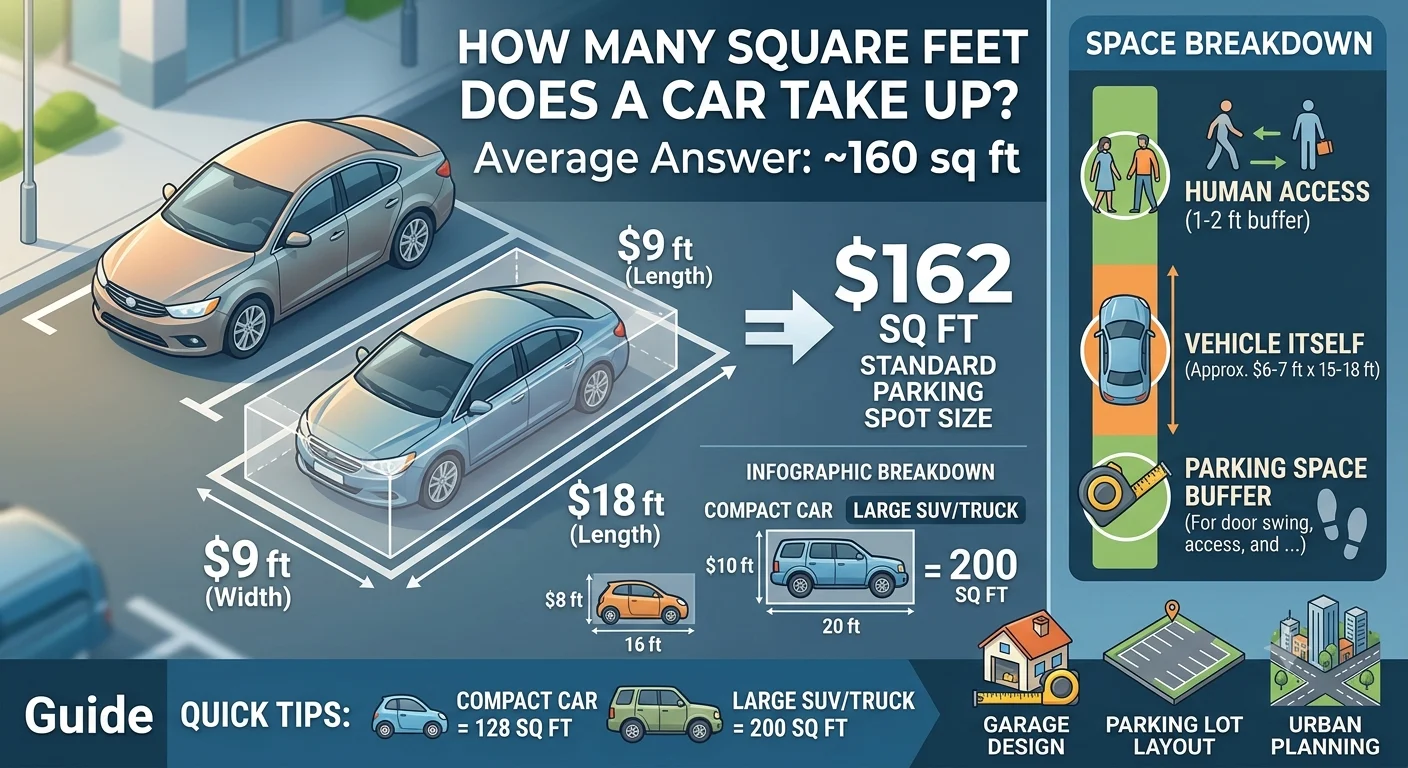
Standard Parking Space Dimensions
Most parking spaces measure:
- Width: 8.5–9 feet
- Length: 18 feet
Calculation:
18 × 9 = 162 square feet
Therefore, a standard parking space typically provides around:
150–170 square feet
This extra area allows:
- Door opening clearance
- Walking space
- Vehicle maneuvering
- Safer parking
Garage Space Requirements
When building or buying a garage, consider more than the vehicle’s footprint.
You need clearance around the car.
One-Car Garage
Common dimensions:
| Garage Size | Square Feet |
|---|---|
| 12 × 20 ft | 240 sq ft |
| 14 × 22 ft | 308 sq ft |
Even though a sedan may occupy only 90 square feet, the garage should provide enough room for storage and movement.
Two-Car Garage
Typical dimensions:
| Garage Size | Square Feet |
|---|---|
| 20 × 20 ft | 400 sq ft |
| 22 × 22 ft | 484 sq ft |
| 24 × 24 ft | 576 sq ft |
These dimensions accommodate two vehicles comfortably.
Extra Clearance Recommendations
Experts often recommend:
- 2–3 feet on each side
- 2–4 feet at the front
- 2–4 feet at the rear
This improves accessibility and safety.
Practical Uses for Knowing a Car’s Square Footage
Understanding vehicle square footage has many real-world applications.
Garage Planning
Determine whether your garage can fit:
- One vehicle
- Two vehicles
- Storage shelves
- Workbenches
Parking Lot Design
Property managers use vehicle footprints to estimate:
- Parking capacity
- Traffic flow
- Layout efficiency
Driveway Sizing
Homeowners can calculate whether a driveway can hold:
- Multiple vehicles
- RVs
- Trucks
Storage Facilities
Vehicle storage businesses rely on square footage calculations to maximize available space.
Real Estate Planning
Builders use vehicle dimensions when designing homes and commercial properties.
Common Mistakes When Estimating Car Space
Many people underestimate how much room vehicles require.
Ignoring Mirrors
Side mirrors increase a vehicle’s effective width.
Forgetting Door Clearance
Doors need extra space to open comfortably.
Using Manufacturer Dimensions Only
Published dimensions often exclude operational space.
Not Accounting for Walking Areas
People need room to enter, exit, and move around vehicles.
Overlooking Future Vehicle Upgrades
A larger future vehicle may not fit in a tightly planned space.
Expert Tips for Accurate Vehicle Space Planning
To avoid costly mistakes, follow these recommendations.
Measure Your Actual Vehicle
Manufacturer specifications can vary.
Use a tape measure for accuracy.
Add Safety Margins
Include at least:
- 2 feet per side
- 3 feet front and rear
Plan for Storage
If you store tools, bicycles, or equipment, increase the required area.
Consider Vehicle Growth
Families often move from sedans to SUVs.
Designing for future needs can save money.
Use Parking Standards
Follow local building and parking regulations whenever possible.
Frequently Asked Questions
How many square feet does an average car take up?
Most average sedans occupy approximately 80–100 square feet.
How much space does a parking spot require?
A standard parking space typically requires 150–170 square feet.
How many square feet does an SUV take up?
Most SUVs occupy between 100 and 130 square feet depending on size.
Is a car’s footprint the same as parking space requirements?
No. Parking spaces are larger because they include clearance for access and maneuvering.
How do I calculate my car’s square footage?
Multiply the vehicle’s length by its width, using measurements in feet.
Conclusion
If you’ve been wondering how many square feet does a car take up, the answer depends on the vehicle type and dimensions. Most passenger cars occupy between 60 and 100 square feet, while larger SUVs, trucks, and vans can require 100 to 150 square feet or more.
For practical planning, remember that the vehicle footprint is only part of the equation. Parking spaces, garages, and storage areas need additional clearance for safety and convenience. By understanding vehicle square footage and applying simple length-by-width calculations, you can accurately estimate the space needed for any car, whether you’re planning a garage, designing a parking area, or organizing storage.