

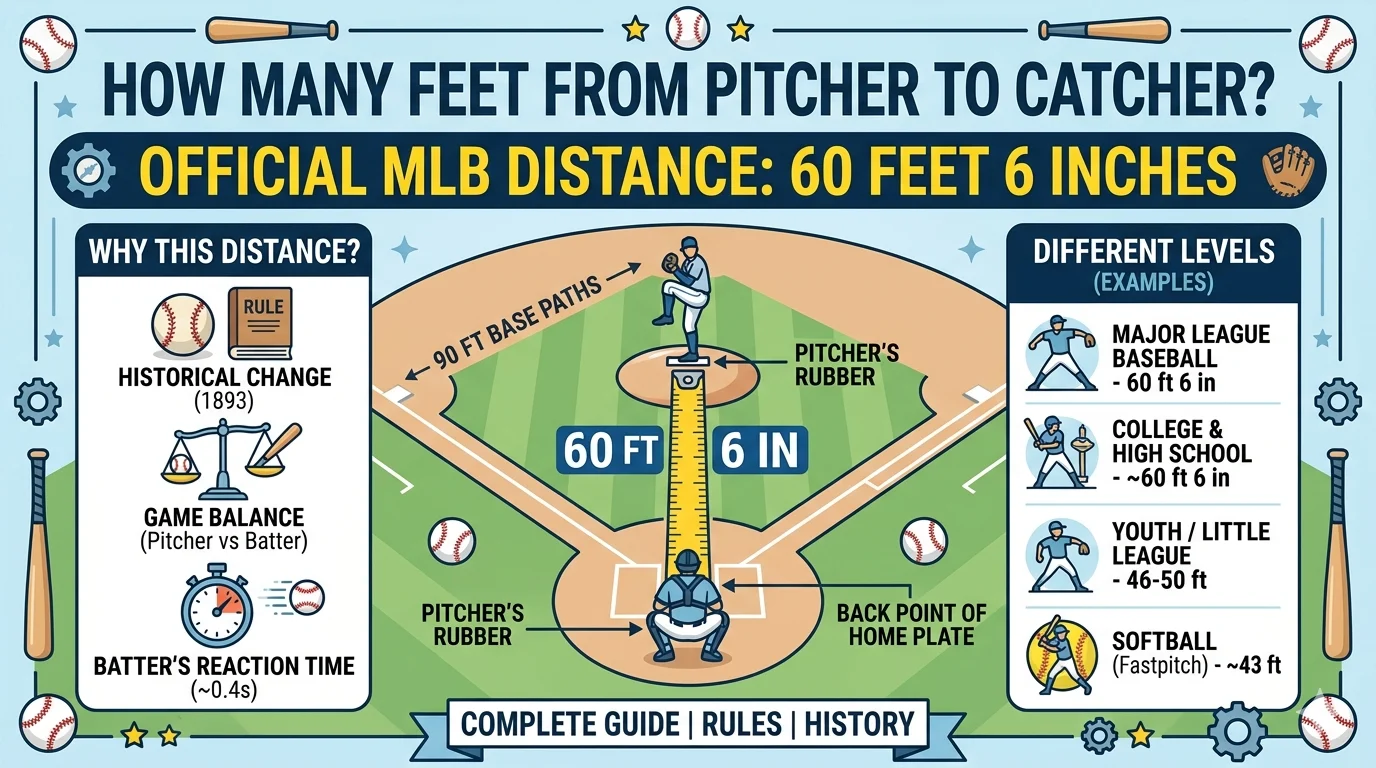
If you are asking how many feet from pitcher to catcher, the official answer in professional baseball is 60 feet 6 inches. This is one of the most important fixed measurements in the game and directly affects pitching speed, batting reaction time, and overall gameplay balance.
This distance is not just a random number. It is carefully designed and officially regulated in baseball rules, especially in Major League Baseball (MLB). Understanding it helps you better understand how baseball works at every level.
What is the distance from pitcher to catcher in baseball?
Technically, baseball does not measure the distance directly to the catcher. Instead, it is measured from the pitcher’s mound to home plate.
The catcher stands behind home plate, so the commonly asked question “how many feet from pitcher to catcher” actually refers to this official measurement.
Official MLB distance
- 60 feet 6 inches (18.44 meters)
This is measured from the pitching rubber on the mound to the back point of home plate.
How many feet from pitcher to catcher in MLB and other levels?
Different levels of baseball use different pitching distances depending on age and skill level.
MLB and professional baseball
- Standard distance: 60 feet 6 inches
College and high school baseball
- College (NCAA): 60 feet 6 inches
- High school: around 60 feet
Little League and youth baseball
- Ages 9–10: 46 feet
- Ages 11–12: 50–60 feet
- Teen divisions: 60 feet 6 inches
Softball comparison
- Fastpitch softball: around 43 feet
So the answer to how many feet from pitcher to catcher depends on the level of play.
Why is the pitching distance 60 feet 6 inches?
The unusual number has a historical background.
Early baseball
In the early days of baseball, pitchers stood much closer to batters. This made pitching extremely dominant.
Rule change in 1893
To balance the game, Major League Baseball increased the distance to:
- 60 feet 6 inches
Reason behind the change
The goal was to:
- Give batters more reaction time
- Reduce pitcher dominance
- Improve fairness in the game
This single rule change significantly shaped modern baseball.
How the pitcher-to-catcher distance affects the game
The distance plays a huge role in how baseball is played.
1. Reaction time
At professional pitching speeds (90–100 mph), batters only have:
- About 0.35 to 0.4 seconds to react
2. Pitch speed perception
Even small changes in distance would:
- Make pitches feel faster or slower
- Completely change batting difficulty
3. Game balance
- Shorter distance = advantage for pitchers
- Longer distance = advantage for batters
That is why 60 feet 6 inches is considered the perfect balance.
Pitcher’s mound and baseball field setup
To understand the distance properly, you also need to know field structure.
Pitcher’s mound
- Slightly raised (about 10 inches high in MLB)
- Contains the pitching rubber used for measurement
Home plate
- A fixed 17-inch plate
- The target for all pitches
Baseball diamond layout
- Pitcher to home plate: 60 feet 6 inches
- Base paths: 90 feet
- Outfield distances vary by stadium
Common misunderstandings
“Is the distance to the catcher?”
No. The catcher is not part of the measurement. The correct reference point is home plate.
“Why does it look shorter on TV?”
Camera angles compress depth, making the field look smaller than it really is.
“Is the distance the same in all baseball leagues?”
No. Youth and amateur leagues use shorter distances for safety and development.
Comparison of pitching distances
| Level | Distance |
|---|---|
| MLB | 60 ft 6 in |
| College | 60 ft 6 in |
| High School | ~60 ft |
| Little League (11–12) | 50–60 ft |
| Youth Baseball | 46–50 ft |
| Softball | ~43 ft |
How far is 60 feet 6 inches in real life?
To imagine the distance:
- Slightly longer than a bowling lane
- About the length of a school bus
- Around 18.44 meters
- Half a basketball court
This helps visualize how many feet from pitcher to catcher in a real-world sense.
Why this distance matters so much
This measurement is critical because it:
- Controls game difficulty
- Balances offense and defense
- Impacts pitch speed perception
- Defines modern baseball structure
Even a few feet difference would completely change the sport.
FAQs
1. How many feet from pitcher to catcher in MLB?
It is 60 feet 6 inches, measured from the pitcher’s mound to home plate.
2. Why is it not a round number?
It became 60 feet 6 inches after a historical rule change in 1893 to balance pitching and hitting.
3. Is the catcher included in the measurement?
No, only the distance to home plate is measured.
4. Do kids play at the same distance?
No, youth leagues use shorter distances like 46–50 feet.
5. Has the distance always been the same?
No, it was shorter in early baseball history before the rule change.
Conclusion
The answer to how many feet from pitcher to catcher is 60 feet 6 inches in professional baseball. This standard distance from the pitcher’s mound to home plate is one of the most important rules in the sport.
It ensures fairness between pitcher and batter, shapes game strategy, and defines the rhythm of baseball at every level.