

Choosing the right heater size is one of the most important steps when heating a home, garage, office, or workshop. If the heater is too small, the room stays cold. If it is too large, you may waste energy and money.
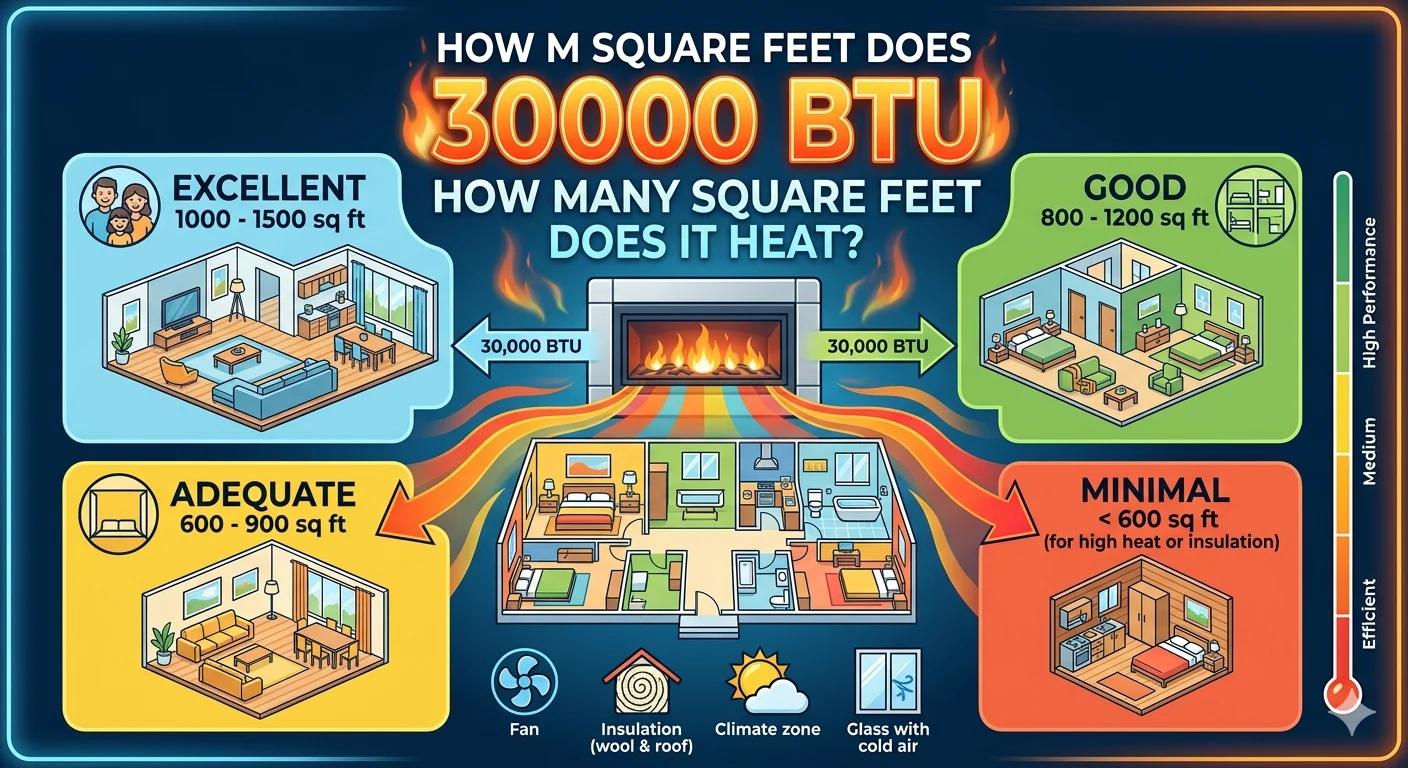
So, how many square feet does 30000 BTU heat?
In general, a 30,000 BTU heater can heat around 1,000 to 1,250 square feet in a moderately insulated space. However, the exact coverage depends on several factors, including insulation quality, ceiling height, climate, and the type of heating system.
This guide explains everything you need to know about 30,000 BTU heating capacity, including charts, examples, sizing tips, and common mistakes to avoid.
What Does BTU Mean?
BTU stands for British Thermal Unit. It measures the amount of heat needed to raise the temperature of one pound of water by one degree Fahrenheit.
In simple terms, BTUs tell you how much heating power a heater or HVAC system produces.
The higher the BTU rating:
- The larger the area it can heat
- The faster it can warm a room
- The more energy it may consume
For heating systems, BTU ratings help homeowners choose the correct heater size for a specific room or building.
How Many Square Feet Does 30000 BTU Heat?
A 30,000 BTU heater typically heats:
| Insulation & Climate | Estimated Coverage |
|---|---|
| Warm climate, excellent insulation | 1,250–1,400 sq ft |
| Moderate climate, average insulation | 1,000–1,250 sq ft |
| Cold climate, poor insulation | 700–1,000 sq ft |
These estimates assume:
- Standard 8-foot ceilings
- Typical residential insulation
- Average window and door efficiency
If your space has high ceilings, many windows, or poor insulation, the actual heating area may be smaller.
Understanding the Basic BTU Formula
Many HVAC professionals use a simple rule:
For example:
- Mild climates may need around 20 BTUs per square foot
- Colder climates may require 30 BTUs or more per square foot
Using this formula:
- 30,000 ÷ 20 = 1,500 sq ft maximum estimate
- 30,000 ÷ 30 = 1,000 sq ft safer cold-weather estimate
That is why most experts recommend a practical range of 1,000 to 1,250 square feet for a 30,000 BTU heater.
30000 BTU Heating Coverage Chart
Here is a quick reference chart for heating coverage.
| BTU Rating | Approximate Coverage |
|---|---|
| 10,000 BTU | 300–450 sq ft |
| 15,000 BTU | 500–700 sq ft |
| 20,000 BTU | 700–1,000 sq ft |
| 30,000 BTU | 1,000–1,250 sq ft |
| 40,000 BTU | 1,300–1,700 sq ft |
| 60,000 BTU | 2,000–2,500 sq ft |
This chart is based on average insulation and moderate climates.
Factors That Affect Heating Capacity
Even though 30,000 BTUs sounds straightforward, many real-world factors affect performance.
Insulation Quality
Good insulation keeps warm air inside your home. Poor insulation allows heat to escape quickly.
A well-insulated home may allow a 30,000 BTU heater to cover over 1,200 square feet, while an older drafty house may struggle to heat 800 square feet.
Signs of poor insulation include:
- Drafts near windows
- Cold walls
- Uneven room temperatures
- High energy bills
Ceiling Height
Most BTU estimates assume 8-foot ceilings.
If your ceilings are taller:
- More air volume must be heated
- Heating efficiency decreases
- You may need additional BTUs
For example:
- A room with 12-foot ceilings may require 20–30% more heating power.
Climate Zone
Your geographic location matters a lot.
Warm Climates
In southern regions with mild winters, 30,000 BTUs may heat up to 1,400 square feet.
Moderate Climates
In average winter conditions, expect around 1,000–1,250 square feet.
Cold Climates
In northern areas with freezing winters, coverage may drop below 1,000 square feet.
Windows and Doors
Large windows and exterior doors increase heat loss.
Spaces with:
- Sliding glass doors
- Old single-pane windows
- Frequent door opening
may require a larger heater.
Sun Exposure
Rooms with strong sunlight naturally stay warmer during the day. Shaded areas may require more heating power.
South-facing rooms often need less supplemental heating.
Types of 30000 BTU Heating Systems
Not all 30,000 BTU heaters work the same way.
Gas Heaters
Gas heaters are common in garages, workshops, and homes.
Benefits:
- Fast heating
- Lower operating cost
- Effective in cold weather
Drawbacks:
- Requires ventilation
- Professional installation may be needed
Electric Heaters
Electric heaters convert electricity into heat.
Benefits:
- Easy installation
- Cleaner operation
- No fuel storage
Drawbacks:
- Higher electricity costs
- Less efficient for large spaces
Mini Split Systems
A 30,000 BTU mini split can efficiently heat and cool large rooms or small homes.
Benefits:
- Energy efficient
- Quiet operation
- Heating and cooling in one unit
Drawbacks:
- Higher upfront cost
- Requires professional installation
Furnaces
Central furnaces distribute heat through ducts.
Benefits:
- Whole-home heating
- Consistent temperatures
- Good for large homes
Drawbacks:
- Duct maintenance required
- Installation can be expensive
Is a 30000 BTU Heater Enough for Your Space?
Let’s look at common real-world examples.
Small Homes
A well-insulated 1,100-square-foot home can often be heated effectively with 30,000 BTUs.
However, older homes may require more capacity.
Garages
Garages usually have poor insulation.
A 30,000 BTU heater may heat:
- A 2-car garage comfortably
- A medium workshop
- A detached garage with insulation
Uninsulated garages may still feel cold in severe winters.
Basements
Basements are naturally cooler because they are below ground level.
A 30,000 BTU heater usually performs well in:
- Finished basements
- Entertainment rooms
- Home gyms
Open Floor Plans
Open layouts need more heating power because warm air spreads across larger spaces.
In open-concept homes, a 30,000 BTU heater may only effectively heat around 900–1,100 square feet.
Common BTU Sizing Mistakes
Many homeowners choose the wrong heater size.
Oversizing the Heater
A heater that is too large may:
- Turn on and off too frequently
- Waste energy
- Create uneven temperatures
- Increase utility bills
Undersizing the Heater
A heater that is too small:
- Runs constantly
- Struggles to maintain warmth
- Wears out faster
- Leaves cold spots
Ignoring Insulation
People often calculate square footage but forget insulation quality.
Two homes with the same size can require completely different BTU levels.
Tips to Improve Heating Efficiency
Even the best heater performs poorly if the home loses heat.
Seal Air Leaks
Use weather stripping and caulk around:
- Windows
- Doors
- Baseboards
This can significantly reduce heat loss.
Upgrade Insulation
Adding attic or wall insulation improves heating performance and lowers energy bills.
Use Ceiling Fans
Ceiling fans help push warm air downward during winter.
Set fans to rotate clockwise at low speed.
Maintain Your Heating System
Regular maintenance improves efficiency.
Important tasks include:
- Replacing filters
- Cleaning vents
- Inspecting burners
- Checking thermostat settings
30000 BTU vs Other Heater Sizes
Here is a comparison of common heater capacities.
| Heater Size | Best For |
|---|---|
| 10,000 BTU | Small bedrooms |
| 20,000 BTU | Apartments or medium rooms |
| 30,000 BTU | Small homes and garages |
| 40,000 BTU | Larger homes |
| 60,000 BTU | Whole-house heating |
A 30,000 BTU heater offers a good balance between efficiency and coverage for medium-sized spaces.
Expert Tips Before Buying a 30000 BTU Heater
Before purchasing, consider these expert recommendations:
- Measure your actual square footage carefully
- Check insulation levels
- Consider local winter temperatures
- Think about ceiling height
- Factor in window size and airflow
- Choose Energy Star-certified equipment when possible
If you are unsure, an HVAC professional can perform a heat load calculation for the most accurate sizing.
Frequently Asked Questions
Can a 30000 BTU heater heat a whole house?
Yes, a 30,000 BTU heater can heat a small well-insulated home, usually around 1,000–1,250 square feet.
Is 30000 BTU enough for a garage?
In many cases, yes. A 30,000 BTU heater works well for most 2-car garages, especially if insulated.
How many BTUs do I need for 1,500 square feet?
Most 1,500-square-foot homes need around 30,000–45,000 BTUs depending on climate and insulation.
Does insulation really make a big difference?
Absolutely. Good insulation can reduce heating requirements significantly and improve comfort.
Can a 30000 BTU mini split cool a home too?
Yes. Most 30,000 BTU mini split systems provide both heating and cooling for medium-sized spaces.
Conclusion
So, how many square feet does 30000 BTU heat?
In most situations, a 30,000 BTU heater can heat approximately 1,000 to 1,250 square feet comfortably. However, insulation quality, climate, ceiling height, and room layout all affect real-world performance.
For well-insulated homes in mild climates, coverage may reach 1,400 square feet. In colder regions or poorly insulated spaces, the effective heating area may drop closer to 700–1,000 square feet.
Choosing the right heater size helps improve comfort, reduce energy costs, and extend the life of your heating system. Before buying, always consider your room conditions and local climate to get the best results.