
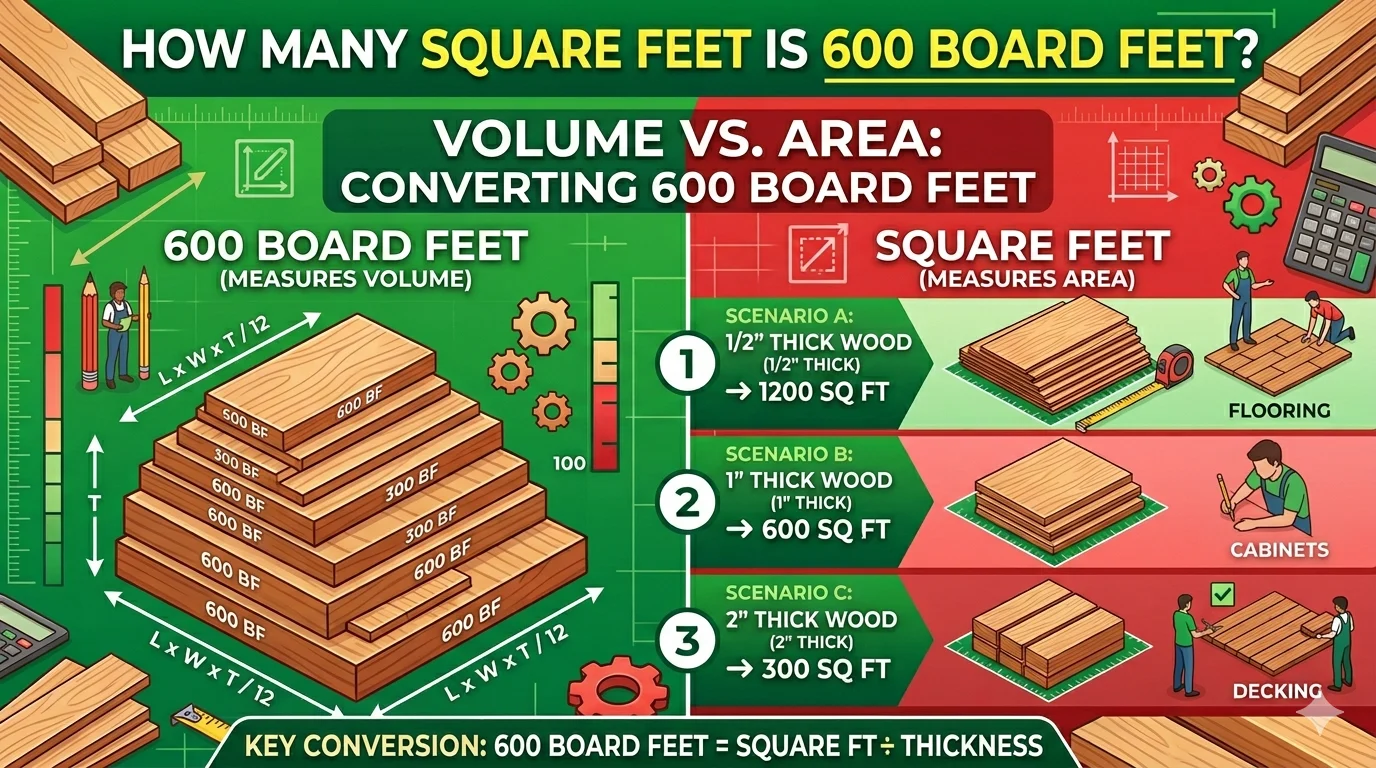
If you have ever purchased lumber for a woodworking or construction project, you may have wondered, “how many square feet is 600 board feet?” The answer depends on one important factor: the thickness of the wood.
Board feet and square feet are both measurement units used in construction and woodworking, but they measure different things. A board foot measures volume, while a square foot measures area. Because of this, you cannot directly convert board feet into square feet without knowing the thickness of the lumber.
In simple terms:
- 600 board feet equals 600 square feet when the wood is 1 inch thick.
- If the wood is thicker, the square footage becomes smaller.
- If the wood is thinner, the square footage becomes larger.
This guide explains everything you need to know about converting 600 board feet into square feet. You will also learn formulas, examples, charts, and expert tips to make lumber calculations easier.
Understanding the Difference Between Board Feet and Square Feet
Before converting measurements, it helps to understand what each unit means.
What Is a Board Foot?
A board foot is a unit of lumber volume commonly used in the United States and Canada.
One board foot equals:
- 1 foot long
- 1 foot wide
- 1 inch thick
The standard formula is:
Lumberyards use board feet to price hardwood and rough lumber.
What Is a Square Foot?
A square foot measures surface area.
One square foot equals:
- 12 inches by 12 inches
Square feet are commonly used for:
- Flooring
- Roofing
- Drywall
- Decking
- Wall coverage
Unlike board feet, square feet do not include thickness.
How Many Square Feet Is 600 Board Feet?
The answer depends entirely on lumber thickness.
The formula for converting board feet to square feet is:
However, because 1 board foot already assumes a thickness of 1 inch, the conversion becomes simpler.
The Basic Formula
For lumber that is exactly 1 inch thick:
So, 600 board feet covers 600 square feet at a 1-inch thickness.
Why Thickness Matters
If the wood is thicker than 1 inch, the same volume covers less area.
Here are some common examples:
| Lumber Thickness | Square Feet From 600 Board Feet |
|---|---|
| 1 inch | 600 sq ft |
| 2 inches | 300 sq ft |
| 3 inches | 200 sq ft |
| 4 inches | 150 sq ft |
| 1/2 inch | 1,200 sq ft |
As you can see, thicker wood reduces coverage area.
Board Feet to Square Feet Conversion Chart
This chart helps you quickly estimate coverage for 600 board feet.
| Thickness | Coverage Area |
|---|---|
| 1/4 inch | 2,400 sq ft |
| 1/2 inch | 1,200 sq ft |
| 3/4 inch | 800 sq ft |
| 1 inch | 600 sq ft |
| 1.5 inches | 400 sq ft |
| 2 inches | 300 sq ft |
| 2.5 inches | 240 sq ft |
| 3 inches | 200 sq ft |
| 4 inches | 150 sq ft |
This table is useful for flooring installers, cabinet makers, and contractors.
Examples of 600 Board Feet in Real Projects
Understanding real-world applications makes the conversion easier.
Flooring Projects
Suppose you are installing hardwood flooring with boards that are 3/4 inch thick.
Calculation:
So, 600 board feet of 3/4-inch hardwood flooring covers about 800 square feet.
That could cover:
- A large living room
- Multiple bedrooms
- A small apartment
Deck Building
Deck boards are often 2 inches thick.
Calculation:
This means 600 board feet covers roughly 300 square feet of decking.
That is enough for:
- A medium backyard deck
- A patio sitting area
- Outdoor stairs and railing materials
Furniture Making
Furniture builders often buy hardwood in board feet.
If using 1-inch walnut or oak boards:
- 600 board feet provides 600 square feet of material.
This amount could build:
- Dining tables
- Cabinets
- Bookshelves
- Bed frames
Wall Paneling
Thin wall paneling may be only 1/2 inch thick.
Calculation:
That covers a surprisingly large wall area.
Step-by-Step Guide to Convert Board Feet to Square Feet
Here is a simple process anyone can follow.
Step 1: Determine the Thickness
Measure the lumber thickness in inches.
Examples:
- 1 inch
- 3/4 inch
- 2 inches
Step 2: Use the Formula
Apply this formula:
Step 3: Calculate the Result
Example with 600 board feet at 2 inches thick:
Final answer:
- 300 square feet
Step 4: Add Extra Material
Professionals usually add:
- 5–10% extra for waste
- 10–15% for complex cuts
This prevents material shortages during installation.
Common Lumber Thickness and Coverage
Different types of lumber have different standard thicknesses.
| Lumber Type | Common Thickness |
|---|---|
| Hardwood flooring | 3/4 inch |
| Plywood | 1/2 inch to 3/4 inch |
| Deck boards | 2 inches |
| Framing lumber | 1.5 inches actual |
| Wall paneling | 1/4 inch to 1/2 inch |
| Cabinet wood | 3/4 inch |
Knowing standard sizes helps estimate square footage more accurately.
Common Mistakes When Calculating Board Feet
Many people make simple conversion errors.
Ignoring Thickness
This is the biggest mistake.
Board feet always include thickness, while square feet do not.
Using Nominal Instead of Actual Thickness
Lumber labels can be misleading.
For example:
- A “2×4” is actually 1.5 inches thick and 3.5 inches wide.
Always use actual dimensions for accurate calculations.
Forgetting Waste
Projects almost always require extra wood because of:
- Cutting mistakes
- Defects
- Pattern matching
- Damaged boards
Mixing Units
Always keep measurements consistent:
- Inches for thickness
- Feet for area
Board Feet vs Square Feet Comparison Table
| Feature | Board Feet | Square Feet |
|---|---|---|
| Measures | Volume | Area |
| Includes Thickness | Yes | No |
| Common Use | Lumber sales | Flooring and coverage |
| Formula Needed | Yes | Simple area math |
| Used By | Lumberyards | Contractors and homeowners |
This comparison helps beginners understand why conversions can be confusing.
When Should You Use Board Feet Instead of Square Feet?
Use board feet when buying:
- Hardwood lumber
- Rough-cut wood
- Specialty wood
- Thick timber
Use square feet when calculating:
- Floor coverage
- Roofing
- Wall paneling
- Deck surface area
In many projects, you may need both measurements.
For example:
- Lumberyard sells wood in board feet.
- Contractor estimates installation area in square feet.
Expert Tips for Lumber Estimation
Professionals use several strategies to improve accuracy.
Buy Slightly More Than Needed
Extra lumber prevents delays.
A good rule:
- Add 10% extra material.
Check Moisture Content
Wet wood may shrink after installation.
Dry lumber is more stable.
Use Lumber Calculators
Online calculators reduce math mistakes.
They are especially helpful for large projects.
Understand Actual Dimensions
Always confirm:
- Actual thickness
- Actual width
- Actual length
This improves accuracy dramatically.
Plan for Cuts
Complex designs create more waste.
Diagonal flooring patterns may require additional boards.
FAQs
How many square feet does 600 board feet cover?
It depends on thickness. At 1 inch thick, 600 board feet equals 600 square feet.
What is the formula to convert board feet to square feet?
Use this formula:
Square Feet = Board Feet ÷ Thickness in inches
How many square feet is 600 board feet at 2 inches thick?
600 board feet at 2 inches thick equals 300 square feet.
Why are board feet different from square feet?
Board feet measure volume, while square feet measure surface area.
Is board foot measurement used for plywood?
Usually no. Plywood is commonly sold by sheet size and square footage instead of board feet.
Conclusion
Understanding how many square feet is 600 board feet becomes much easier once you know the role thickness plays in the calculation.
Here is the quick answer:
- 600 board feet equals 600 square feet at 1-inch thickness.
- Thicker wood covers less area.
- Thinner wood covers more area.
Whether you are planning a flooring installation, deck build, woodworking project, or lumber purchase, knowing how to convert board feet to square feet helps you estimate materials accurately and avoid costly mistakes.
Always remember to:
- Measure actual thickness
- Add extra material for waste
- Use the proper conversion formula
- Double-check lumber dimensions before buying
With the right calculations, you can confidently plan your next construction or woodworking project while staying within budget and avoiding material shortages.