
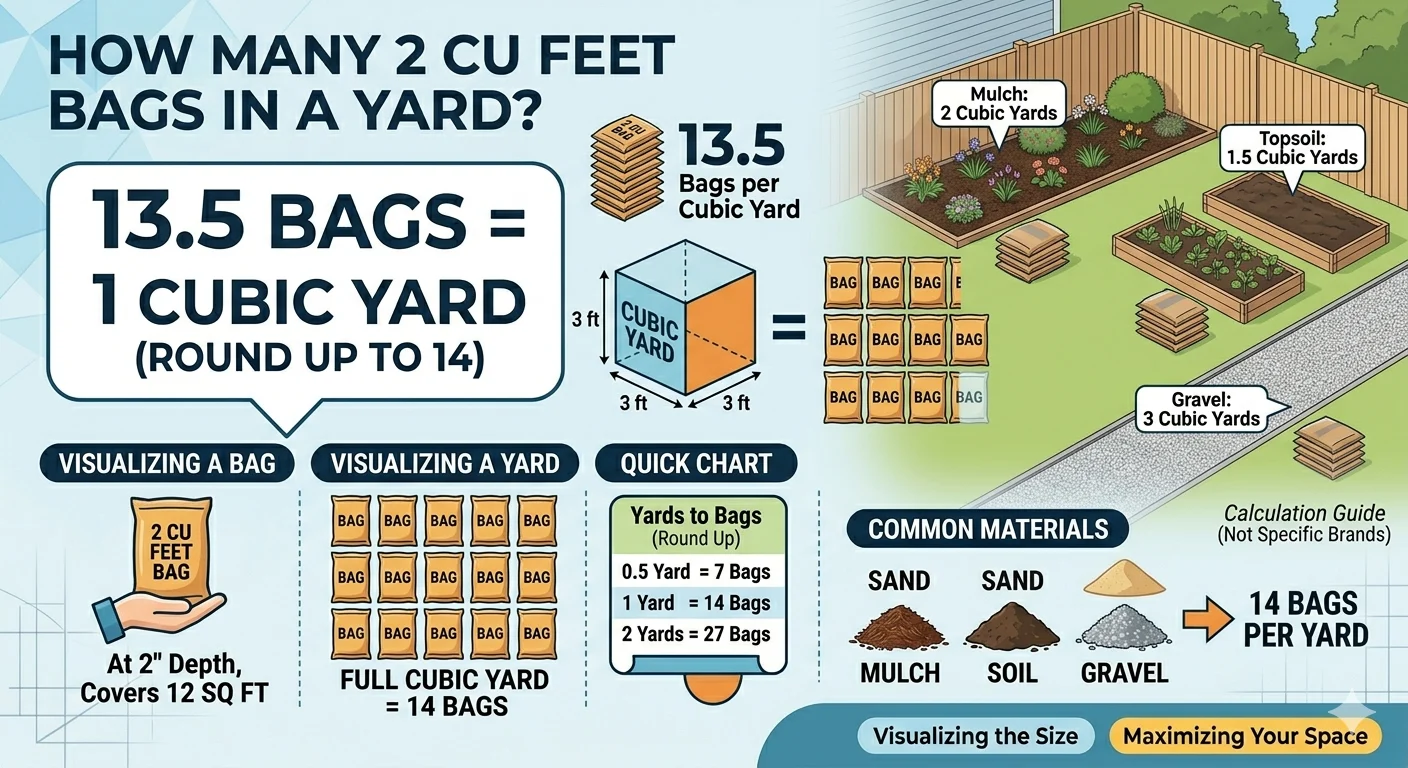
If you are planning a landscaping, gardening, or construction project, you may wonder: how many 2 cu feet bags in a yard?
This is one of the most common questions people ask when buying mulch, soil, gravel, sand, or other materials. Knowing the correct conversion helps you avoid overspending or running short during your project.
The quick answer is simple:
Since each bag contains 2 cubic feet:
So, you need approximately 13.5 bags of 2 cubic feet material to equal 1 cubic yard.
Most people round up and buy 14 bags to ensure full coverage.
This guide explains everything in simple terms, including formulas, charts, examples, and expert tips.
Understanding Cubic Feet and Cubic Yards
Before calculating how many 2 cu feet bags in a yard, it helps to understand these measurements.
What Is a Cubic Foot?
A cubic foot is a unit of volume. It measures the amount of space inside a cube that is:
- 1 foot long
- 1 foot wide
- 1 foot high
It is commonly used for:
- Soil
- Mulch
- Gravel
- Sand
- Compost
What Is a Cubic Yard?
A cubic yard is much larger. It represents a cube that measures:
- 3 feet long
- 3 feet wide
- 3 feet high
Because:
One cubic yard equals 27 cubic feet.
Relationship Between Cubic Feet and Cubic Yards
Here is the basic conversion:
| Measurement | Equivalent |
|---|---|
| 1 cubic yard | 27 cubic feet |
| 1 bag | 2 cubic feet |
| Bags needed per yard | 13.5 bags |
This conversion works for nearly all landscaping materials.
How Many 2 Cu Feet Bags in a Yard?
The standard calculation is very easy.
Simple Formula
Use this formula:
The result is:
- 13.5 bags
Since you cannot usually buy half a bag, most people purchase:
- 14 bags
Exact Answer Explained
A cubic yard contains 27 cubic feet. Each bag contains 2 cubic feet.
So:
- 13 bags = 26 cubic feet
- 14 bags = 28 cubic feet
Buying 14 bags gives slight extra coverage, which is useful because materials settle over time.
Quick Conversion Table
| Cubic Yards | 2 Cu Ft Bags Needed |
|---|---|
| 0.5 yard | 7 bags |
| 1 yard | 14 bags |
| 1.5 yards | 21 bags |
| 2 yards | 27 bags |
| 3 yards | 41 bags |
| 4 yards | 54 bags |
Always round up for safety.
Bag Conversion Chart
Here is a more detailed chart for quick reference.
1 Cubic Yard Conversion
| Bag Size | Bags Per Yard |
|---|---|
| 1 cu ft | 27 bags |
| 1.5 cu ft | 18 bags |
| 2 cu ft | 13.5 bags |
| 3 cu ft | 9 bags |
Half Yard Conversion
| Yard Amount | 2 Cu Ft Bags |
|---|---|
| 0.25 yard | 4 bags |
| 0.5 yard | 7 bags |
| 0.75 yard | 11 bags |
Multiple Yard Conversion
| Cubic Yards | Approximate Bags |
|---|---|
| 5 yards | 68 bags |
| 6 yards | 81 bags |
| 10 yards | 135 bags |
For larger projects, buying bulk material is usually cheaper.
Common Materials and Bag Estimates
Different materials use the same volume conversion, even though their weight differs.
Mulch
Mulch is one of the most common materials sold in 2 cubic feet bags.
For 1 cubic yard of mulch:
- You need about 14 bags
Mulch is commonly used for:
- Flower beds
- Weed control
- Moisture retention
Topsoil
Topsoil bags are often labeled in cubic feet.
For 1 cubic yard of topsoil:
- Buy 14 bags of 2 cu ft topsoil
Topsoil is ideal for:
- Lawn repair
- Raised beds
- Garden leveling
Gravel
Gravel also follows the same volume formula.
However, gravel is heavy. Large projects may require delivery instead of bagged materials.
Sand
Sand bags vary in moisture content. Wet sand becomes heavier and may compact more.
Still, the standard conversion remains:
- 13.5 bags per cubic yard
Concrete Mix
Concrete calculations are slightly different because water and mixing affect final volume.
Always check manufacturer instructions for concrete bag yields.
Why Bag Counts Sometimes Vary
Even though the formula is simple, actual coverage may differ slightly.
Material Compression
Some materials settle during transport or after spreading.
Examples include:
- Mulch
- Compost
- Soil
Compressed materials may cover slightly less area.
Moisture Content
Wet materials become denser and heavier.
This especially affects:
- Sand
- Soil
- Mulch
Manufacturer Differences
Not all bags contain the exact same usable volume.
Some brands may loosely pack material while others compress it tightly.
Always check the label carefully.
Step-by-Step Calculation Method
You can calculate any project yourself using a simple process.
Formula Example
Suppose you need 3 cubic yards of mulch.
Use the formula:
You need:
- About 41 bags
Real Project Example
Imagine a flower bed measuring:
- 18 feet long
- 10 feet wide
- 3 inches deep
First convert depth into feet:
Now calculate total cubic feet:
Now divide by bag size:
You should buy:
- 23 bags
This method works for nearly every landscaping project.
Bulk Material vs Bagged Material
Many people wonder whether they should buy bags or bulk delivery.
Cost Comparison
| Material Type | Average Cost |
|---|---|
| Bagged material | Higher per cubic yard |
| Bulk material | Lower per cubic yard |
Bulk delivery is usually more affordable for large jobs.
Convenience Comparison
Bagged materials offer:
- Easy transport
- Cleaner storage
- Better for small jobs
Bulk materials offer:
- Lower cost
- Faster installation
- Better for large landscapes
Best Choice for Small Projects
Bagged material works best for:
- Small gardens
- Raised beds
- DIY repairs
- Minor landscaping projects
Bulk delivery works better for:
- Large lawns
- Major landscaping
- Construction projects
Common Mistakes to Avoid
Many DIY homeowners make avoidable errors.
Mixing Weight and Volume
A common mistake is confusing pounds with cubic feet.
Remember:
- Cubic feet measure volume
- Pounds measure weight
Two materials may weigh differently while having the same volume.
Ignoring Material Settling
Mulch and soil often settle after spreading.
Buying a little extra prevents thin coverage.
Buying Too Little Material
Running out during a project wastes time and money.
Experts recommend adding:
- 5% to 10% extra material
Expert Tips Before Buying
Add Extra Material
Always round up instead of down.
For example:
- Buy 14 bags instead of 13.5
Measure Carefully
Measure:
- Length
- Width
- Depth
Even small measurement errors affect total volume.
Use Online Calculators
Many home improvement stores provide free calculators for:
- Soil
- Gravel
- Mulch
- Sand
These tools simplify planning.
FAQs
How many 2 cu feet bags are in 1 yard?
There are approximately 13.5 bags of 2 cubic feet in 1 cubic yard. Most people round up to 14 bags.
How many cubic feet are in a cubic yard?
One cubic yard equals 27 cubic feet.
Is it cheaper to buy bulk instead of bags?
Yes. Bulk material is usually cheaper for large landscaping projects.
How much area does a 2 cu ft bag cover?
Coverage depends on depth. At 2 inches deep, a 2 cu ft bag covers roughly 12 square feet.
Should I buy extra material?
Yes. Buying 5%–10% extra helps account for settling, waste, and uneven spreading.
Conclusion
Understanding how many 2 cu feet bags in a yard is important for landscaping, gardening, and construction projects. Since one cubic yard equals 27 cubic feet, you need approximately 13.5 bags of 2 cubic feet material per yard. In most situations, buying 14 bags is the safest option.
Whether you are spreading mulch, adding soil, filling raised beds, or installing gravel, knowing this simple conversion saves time, money, and frustration. By measuring carefully, using the correct formulas, and purchasing slightly extra material, you can complete your project smoothly and avoid unnecessary trips to the store.